
Rethinking Business Strategy? Link with a University for New Ideas, Knowledge & Resources.

The resources, experts and ideas within a university campus are a rich source of diversity that can complement a business’s internal capabilities.
In the wake of the COVID-19 pandemic, businesses everywhere are rethinking purpose and strategy. Amidst the turmoil and uncertainty, at least one thing is clear: building a sustainable and impactful organisation in this radically changed environment requires more new knowledge and less reference to past ways.
As we shift from response to recovery — from reactive to proactive — there’s an opportunity for leaders to create new links with innovative universities for knowledge and resource exchange.
A positive downstream effect of increasing the quality and quantity links between individual businesses and universities is the strengthening of the business-university nexus; a core element of local, national and global innovation systems.
To facilitate the first stages of establishing links with universities, I’m presenting here practical ways to initiate personal connections and some of the potential benefits that can spring from business-university links.
Businesses can benefit from links to universities.
The benefits which can emanate are rooted in the differences that exist between a business and a university. The resources, experts and ideas within a university campus are a rich source of diversity that can complement a business’s internal capabilities. In general terms, by linking with a university a business and its decision-makers can:
- Gain new knowledge
- Access different modes of thinking
- Expand the expert network
- Access new resources e.g. equipment, methods
- Make progress towards R&D goals
- Add to the talent pipeline
- Make progress towards social responsibility goals
These are all critical factors for building a sustainable and impactful organisation. Yet, business-university links haven’t been utilised to the fullest extent. There have been more pressing issues requiring attention or the return on investment hasn’t been attractive. Now, however, the need for new knowledge and resources is greater and the experience of moving fast and differently during the pandemic has emboldened leaders and liberated businesses “to experiment with radical new ideas”.
Universities can benefit too.
Universities produce ideas, technologies and people vital to societal advancement, wellbeing, resilience and preparedness. The COVID-19 pandemic is providing almost daily examples of the intrinsic value of university research and experts, from modelling to treatment and vaccine development, to response and recovery strategies. When universities are connected to businesses (and other organisations) the ideas and technologies can be translated and maximum value realised. So too can graduates more easily transition into employment and reach their full potential when universities have purposeful connections with business.
Business-university links are also critical channels for the transfer of knowledge from businesses to universities. This feedback allows universities to hone strategies and make progress towards missions. Vice-chancellors, professors, researchers, managers and students alike need input from diverse sources in order to be cognizant of current and future challenges and opportunities.
Building links with universities is a personal and creative exercise.
Each business-university link is unique and the possibilities many and varied. Research collaborations are perhaps the best-known type of partnership. However, it’s important to establish other types of links too because the missions of both sectors span beyond R&D and lack of research isn’t always the factor that most limits business innovation. Within universities, for example, the research mission often has equal emphasis as the educational mission. There’s increasing weight being placed on graduate employability and progress towards the SDGs too.
With regard to scale, it’s worth noting that the success of a business-university link isn’t determined by size. Grassroots one-to-one engagements between a handful of people can be just as productive as multi-million-dollar institution-level agreements. It’s also easier to build up sustainable links from the micro to the macro level, this allows due attention to developing and nurturing human-scale interactions. Similarly, age isn’t a decisive factor for success. A link with a ‘young’ university can have just as much impact as one with a university steeped in hundreds of years of history.
Rather, the two key factors important for establishing a successful link are, 1) using a customised approach and 2) creating personal connections.
A customised approach.
To create a link with the greatest chance of success, the specific needs of your business and of the university must be taken into account along with the unique circumstances of this new world. It’s a process of exploration, conversation and commitment. Take reference from existing models and practices and then design a bespoke fit-for-purpose collaboration.
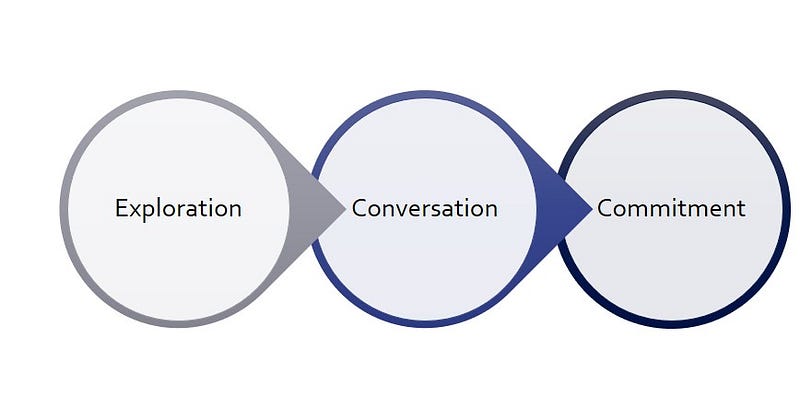
Exploration. Take some time to reflect on and understand your own business’s situation by answering questions such as:
What specific objectives and tangible outcomes do you wish to achieve by linking with a university?
What particular expertise or resources are you seeking?
Are you seeking a transactional or transformational engagement?
What time commitment and depth of engagement are manageable on your side?
What can you offer? e.g. expertise, time, money, space, equipment, proprietary information (databases, methods, materials).
In addition to business needs, one may wish to connect with a university for entirely personal reasons, for example, to share life experience with students or donate money to a university program. Placing priority on personal versus business needs will influence the type of engagement, therefore it’s advisable to determine this priority at an early stage.
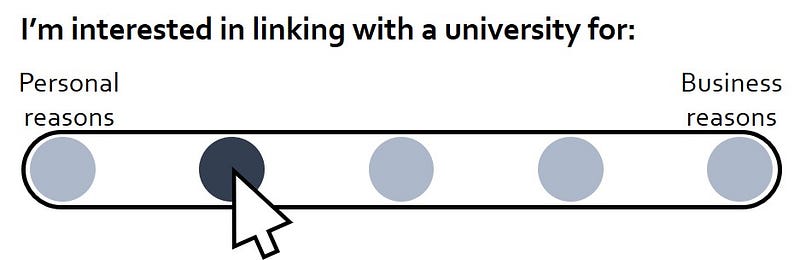
Conversation. Just as you take time to define your own goals and resources, it’s equally important to become familiar with the university environment. To optimise the ‘fit’ and mutual benefits, learn about what’s needed in a university, by whom, where, when, how and why. In a previous article, I shared ideas about how to proactively learn about universities and their people, resources and capabilities. As conversations with professors, staff and students progress hopefully some common and/or complementary goals will organically arise and you can begin sketching out possible ways to reach the goals. The unique combinations of knowledge, skills and resources at the table may even generate new project ideas. If not, revisit your goals and resource offerings in light of information gained from conversations with university personnel and prepare for another round of discussions.
Commitment. Business — university links are the result of human interactions, so after brainstorming about all the exciting possibilities, it’s time to set out who specifically does what. In the next section I outline examples of roles which someone from the business sector could take up in order to create a link with a university.
A personal connection.
In the figure below are examples of roles a business representative can have for the purpose of creating a link with a university. (There are details about each role below the figure.)
The roles are placed across the page on a sliding scale indicating whether they satisfy personal or business needs, or both. An executive who attends university webinars and networking events for personal learning will bring some of that new knowledge into the business, hence the business can gain too.
The placement on the horizontal scale also correlates with the amount of company resources needed. For example, an executive making a personal donation to a university program will require less (or zero) company resources compared to if the business sponsors a university event.
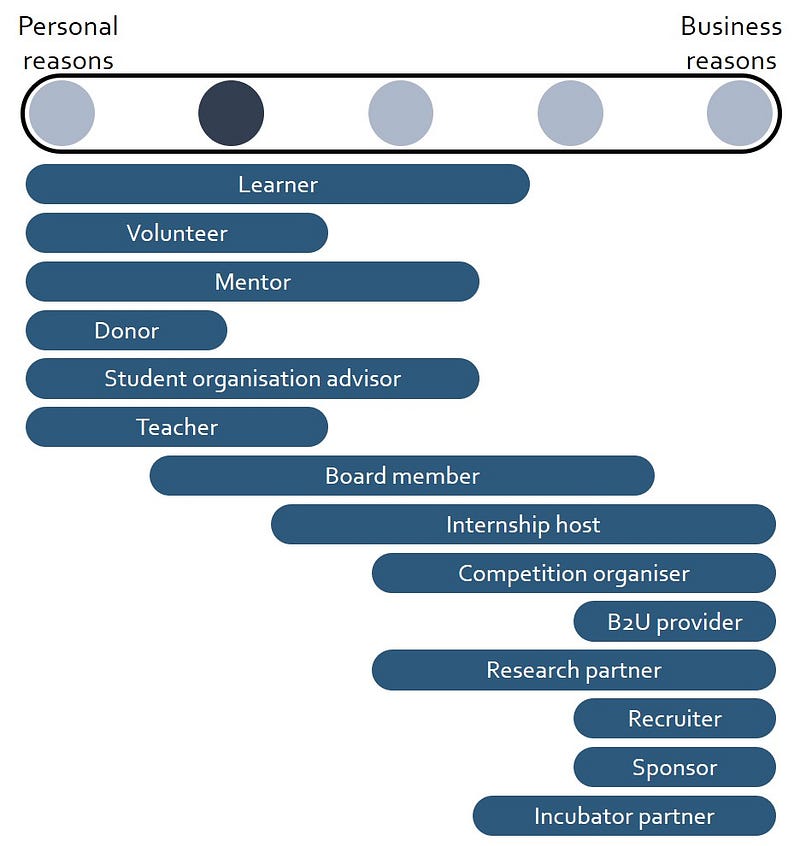
Learner. Acquire knowledge and inspiration as an active participant in university activities. New knowledge can stimulate thinking about new and existing projects and challenges.
Volunteer. Offer your time and knowledge in support of activities organised by the university. Contact the alumni association of your alma mater or get in touch with the specific department at the local university which suits your interests.
Mentor. Most universities run mentor programs which enable professionals to share their experiences with and support student mentees. Mentorship is also a key service provided in incubators for student entrepreneurs, hence there is a demand for mentors interested in supporting start-up founders.
Donor. Make a financial contribution to a university to support an existing program, or tailor your gift in discussion with the staff. For example, you may wish to create an award for student academic performance or as recognition for student service to the community.
Student organisation advisor. Organisations managed by and for students typically have advisory committees which include external members. The number of groups active in a university can run into the hundreds, so there is a good chance of finding one which can benefit from your knowledge and skills.
Teacher. Guest lecturer, casual and adjunct teaching positions allow working professionals to share their expertise with undergraduate and graduate students.
Board member. University research institutes and programs usually have both a governance and an advisory board comprising internal and external members. Join a board to contribute to research directions and share expertise in strategic planning and operations. (Also consider joining boards of independent research institutes and foundations which conduct and/or fund research and scholarships.) University departments that offer undergraduate and graduate programs often appoint external members to boards to support their educational mission. Such boards and committees typically review curricula, work placement programs, and/or graduate employment matters.
Internship host. Provide an experiential learning opportunity for students by being an internship host organisation. Many undergraduate and graduate programs offer their students the chance to immerse in the working environment via accredited placements (e.g. internships, work placements, research projects). Create internship places and consider personally supervising a student for their off-campus experience.
Competition organiser. Initiate a competition for students and/or researchers such as a hack-a-thon or business case competition. It’s an opportunity to support internal R&D and spot emerging talent. Or offer your services as a competition judge.
B2U provider. Business-to-university, or B2U, providers typically deliver products and services for campus management and administrative support (e.g. products such as software and hardware, and services such as the management of housing, health, recreation, retail facilities). Consultancy services are frequently sought by university executive teams during strategic planning exercises. B2U opportunities are of a transactional nature.
Research partner. Establish a joint R&D partnership to collaborate on mutually beneficial research projects. University research can be translated from the lab to market, business ideas can receive technical expertise, or together develop completely new projects.
Recruiter. Join the university’s employer network as part of your company’s recruitment strategy and participate in career-based activities for students. Or facilitate the inclusion of technical experts and critical thinkers in your expert network.
Sponsor. Be a sponsor of activities that are organised by university departments or student groups by making financial or in-kind contributions. This could form part of your business’s marketing campaign, outreach activities or social responsibility strategy.
Incubator partner. Incubators and start-up hubs are becoming a routine feature of university campuses. In fact, every Australian university has at least one incubator. Becoming an incubator partner increases connections with university-based entrepreneurs, innovative ideas and access to resources.
Throughout this article I have presented examples of links, roles and benefits which are common in mid-2020. As universities, businesses and individuals continue to rethink purpose and strategy there will be new opportunities created so this information should be used as inspiration rather than the rule.
If we have learnt anything in 2020, it’s that anything is possible.
Business — university links must be fit for purpose, specific and defined. The people who create the connections must be open-minded, flexible and creative.
For independent advice and support for your specific circumstances, please contact me for a private discussion.
Kristen Sadler, PhD is an independent advisor, speaker and author. She uses futures thinking and strategic foresight to explore possible, probable and preferable futures and how to take action today to shape tomorrow.