
Retail Therapy in Japan: Going Crazy with ¥100
Japan’s Dollar Shops are a Guilt-Free Shopper’s Paradise
I have been a minimalist-wannabe for over a decade. Every time I moved apartments, I decluttered and threw away so much stuff. Nowadays, my attempt has finally been working out. I don’t buy things that I don’t want to leave behind to my family. I’ve been successful with clothes and shoes so far, although I had a thing for beautifully-shaped heels.
Books are the only exception because I simply cannot live without them. And even with books, I purchase Kindle and Audible books when I can to save space.
When people say retail therapy is real, I’ve been on the skeptical side. It sounds irrational because shopping hasn’t solved anything for me. It’s just one of those things that gives you an adrenaline kick, but the excitement only lasts for a few minutes. Leaving a shop with bags in hand used to be fun, but years of decluttering have killed the fun.
However, a recent stop at a store called Daiso reintroduced me to shopping for fun. If you have lived in Japan, you may recall the vivid pink shop signs that dot everywhere. Although I don’t shop a lot, going through the shelves provides me with something better than retail therapy. It’s entertaining, refreshing, and guilt-free because it’s a $1 products shop.
Dedication to ¥100
Daiso was founded in 1977 and since has grown to around 3,300 shops in Japan. I once caught a documentary that featured the company and the employees.
In the program, a buyer of Daiso was looking for a new slipper supplier. At a conference room sitting with a potential supplier, a woman from the procurement division said that the company should keep surprising their customers by providing high-quality products. She carefully examined the prototype slippers. Cutting them in the middle, she let the supplier see the cross-section. “It’s too thin, and the internal sheets aren’t flattened enough, are they?”
My mouth dropped. Daiso is the last customer I would work for if I were a slipper manufacturer, I thought as I sat rivetted to the screen.
Daiso tells seasons in Japan
After seeing the documentary, I grew a little weird trust as a customer for Daiso. If the employees are such strict quality seekers, their finished products must be good enough to pay 100 yen. But most of the time, that price is too low when thinking about all the associated costs.
Since the nearest Daiso is within walking distance of my house, I often stop by the store to see what is new on the shelves. To my surprise, seasonal products are rotated with a Swiss-like accuracy to the time of year. For instance, just after Halloween, the shop was full of Christmas mood with glittery baubles and gift wrapping materials.
Then, on December 26th, employees were pulling out all the traditional Japanese ornaments of the New Years holiday. Now, it’s time to get ready for Valentine’s Day on January 2nd! The store is now filled with the sweet chocolate smell and baking tools to encourage people to make confectionery for their loved ones.
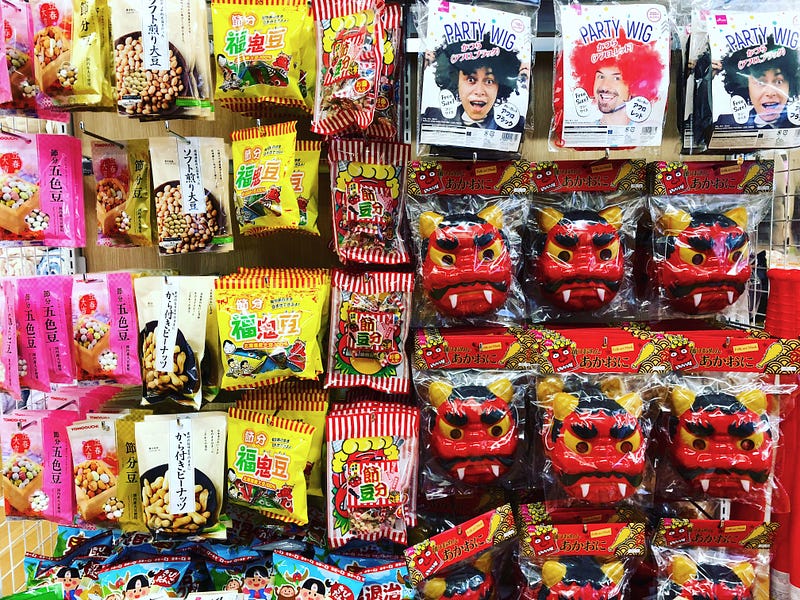
Along with them, there are also Setsubun products on the next shelf. On February 3rd, we throw dried soybeans to Oni, a monster representing bad luck. Don’t worry. You can get Oni masks there. Now I’m touched by their passion for offering us everything we need to live in this fairly Westernized Asian country.
For me, Daiso is like a public cultural clock to tell me what I should do next. When I had to pack snacks for my daughter’s friends, I ran there to get some cute plastic bags. For my girl’s birthday, I bought a giant gold mylar balloon which was shaped as a four.
Although Amazon enables us to buy almost anything online, it still lacks some excitement to encounter unpredictable surprises. Next time you visit Japan, don’t miss visiting the 100 yen shops that are everywhere. You can enjoy shopping as much as you want with the minimum amount of guilt because everything you’ll buy costs only 100 yen, thanks to Japanese peoples’ insane dedication to their employers and customers.
Follow me for more stories about parenting, education, and cross-cultural topics. You can also subscribe with the referral link that supports me directly.


