
Resting The Mind (aka Meditation) — Integral To Active Spiritual Growth
Meditation, the art of getting to know who you truly are, is the keystone to Spiritual Growth.
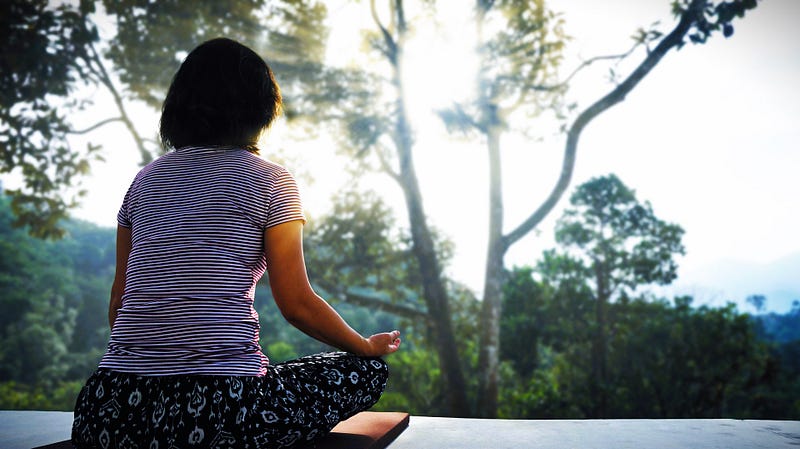
This post continues the thoughts of Now, What is this NOW Thing? Here we will take a little closer look at meditation. The intent is to
- Introduce some of the wonders of meditation
- Take a look at various practices
- Provide tips and encouragement for those starting meditation and those who struggle to meditate
We start with understanding what meditation is.
Humans have an incredible capacity to think continuously about all sorts of things. Every one of us has started doing something, got distracted, and forgot what we were doing. Like the time you came into a room and forgot what you went into there for.
Our minds are constantly at work. We think about projects, chores, and our list of things that need to be done today.
We think about work- not only what has to be done but all the office drama that goes with it. Advancement, lack of advancement, co-workers, mistakes, could — of, should -of, would of. We think about all sorts of stuff — Constantly.
On top of that, we are our own time machine. We go back in time at the slightest trigger. We go forward to the next thing — always the next thing.
Meditation is the breaking or at least pausing of the parade of thoughts.
Why do we meditate
We are tired of the merry-go-round, and we want to learn and experience something new.
“I meditate so that my mind cannot complicate my life” — Sri Chinmoy
We want to get to know our thoughts. What do I believe? What do I feel?
“Quiet the mind, and the soul will speak.” — Ma Jaya Sati Bhagavati
“The quieter you become, the more you are able to hear” — Rumi
“The more regularly and the more deeply you meditate, the sooner you will find yourself acting always from a center of inner peace.” — J. Donald Walters
That inner peace is the real you. It is there, it may be buried at the moment, but it is there.
We do so with the realization that life is lived now — this moment — not in the past, not on tomorrow’s to-do list, but here now.
“Encounter each moment with freshness, its rich potential is held in awareness. We look deeply into it and let it go into the next moment.” — Jon Kabat-Zinn
“Meditation is allowing what is” — Victor Davich.
“Your goal is not to battle with the mind, but to witness the mind.”– Swami Muktananda.
So meditation is a welcomed quieting of the mind.
What can you expect from meditation?
In the beginning, meditation is like any other new behavior — a bit awkward and full of questions. Am I doing this right? Where do my hands go? What am I supposed to do when my mind wanders? How long do I have to do it?
In time and with practice, those questions go away.
I have had both tremendously insightful meditations and I have had my share of duds. That is Ok. It is unrealistic to assume that each session would be outstanding. If they were all outstanding, outstanding would be the norm, and there would be no outstanding.
Meditation and emotional and physical well-being
Meditation has caught the attention of medical researchers. A study from the Mayo Clinic lists the following as benefits of meditation.
When you meditate, you may clear away the information overload that builds up every day and contributes to your stress.
The emotional and physical benefits of meditation can include:
- Gaining a new perspective on stressful situations
- Building skills to manage your stress
- Increasing self-awareness
- Focusing on the present
- Reducing negative emotions
- Increasing imagination and creativity
- Increasing patience and tolerance
- Lowering resting heart rate
- Lowering resting blood pressure
- Improving sleep quality
From a non-medical perspective:
There is an increase in awareness.
You begin to realize that life is more than we were taught. Life is filled with mystery, wonder, awe, and joy — ours for the taking. All we have to do is slow down and look.
We learn we are much more than our bodies.
Awareness … can help us to perceive even in the midst of this fragmentation, our fundamental nature is already integrated and whole. — Jon Kabat-Zinn
Meditation is watching thought itself… thought patterns are often so strong in us which are narrow, inaccurate, self-involved, and habitual to the point of imprisoning, and are also just plain wrong. — Jon Kabat-Zinn
The awareness fosters a quiet sense of solidity.
As you become aware of who you truly are, you find the resilience to being swayed by the opinion of others. You know you. Others do not. They know only their thoughts about you.
Awareness fosters compassion
Realizing who you are, opens up empathy and compassion. As your mind opens up to new experiences, you begin to see more — feel more. And, you begin to relate differently to the world around you.
You see joy, and you see people struggling.
You feel, and the increased feelings enrich you like nothing else.
With awareness comes gratitude.
As you begin to see and feel the majesty that is you, you cannot help but feel grateful for this moment, this life.
You are learning who you are!
You are beginning to see your world differently — finding joy in the small things of everyday life.
You are learning that these sources of joy are abundant.
And, you are grateful!
“You have a treasure within you that is infinitely greater than anything the world can offer” — Eckhart Tolle.
Why do some feel it is so hard to meditate?
Some feel meditation is woo-woo and not part of the “Real World.”
This cultural argument is based on a narrow view of the “Real World.” Proponents argue that the real world is made of men and women working — for what they need and want. There is no place and no time for “woo- woo.”
No time for navel-gazing.
This argument reminds me of bricklayers who built a building day in and day out, never stopping to see the magnificent structure they created. Yes, work has to be done! And one can choose to work with his head down or his head up.
There is great joy in seeing the world as more than one unattractive task after another. It is a matter of perspective — head down vs. head up.
Some believe that meditation is trying to escape what is happening in the world.
There is no doubt that some use meditation to escape; by focusing on something other than their pain, one can find respite.
And, there is no doubt that some use meditation to engage fully with life at the moment. For them, there is no intention of running from anything. Every thought and every feeling is treated as part of what is happening now and honored.
“The goal of meditation is not to get rid of thoughts or emotions. The goal is to become more aware of your thoughts and emotions and learn how to move through them without getting stuck.” — Dr. P Goldin.
“Meditation is not evasion; it is a serene encounter with reality” — Thich Nhat Hanh.
“Meditation is to be aware of what is going on — in our bodies, in our feelings, in our mind, and in the world. Every day 9000 children die of hunger. The superpowers have more than enough nuclear warheads to destroy our planet many times. Yet the sunrise is beautiful, and the rose that bloomed this morning was a miracle.” — Thich Nhat Hanh
Some have tried meditation and found it “not for them.”
Maybe the block is in technique.
Maybe the sitting position is uncomfortable. Perhaps sitting is the only method of meditation that they are aware of.
While many people around the world are firm believers that all true meditation is of the sitting variety, others do not think so. For them, meditation can take on many forms.
Back to the Mayo Clinic Piece for their take on recognized forms of meditation:
- Guided meditation. Sometimes called guided imagery or visualization, with this method of meditation, you form mental images of places or situations you find relaxing. You try to use as many senses as possible, such as smells, sights, sounds, and textures. You may be led through this process by a guide or teacher.
- Mantra meditation. In this type of meditation, you silently repeat a calming word, thought, or phrase to prevent distracting thoughts.
- Mindfulness meditation. This type of meditation is based on being mindful or having an increased awareness and acceptance of living in the present moment. In mindfulness meditation, you broaden your conscious awareness. You focus on what you experience during meditation, such as the flow of your breath. You can observe your thoughts and emotions. But let them pass without judgment.
- Qi gong. This practice generally combines meditation, relaxation, physical movement, and breathing exercises to restore and maintain balance. Qi gong (CHEE-gung) is part of traditional Chinese medicine.
- Tai chi. This is a form of gentle Chinese martial arts training. In tai chi (TIE-CHEE), you perform a self-paced series of postures or movements in a slow, graceful manner while practicing deep breathing.
- Transcendental meditation. Transcendental meditation is a simple, natural technique. In this form of meditation, you silently repeat a personally assigned mantra, such as a word, sound or phrase, in a specific way. This form of meditation may allow your body to settle into a state of profound rest and relaxation and your mind to achieve a state of inner peace, without needing to use concentration or effort.
- Yoga. You perform a series of postures and controlled breathing exercises to promote a more flexible body and a calm mind. As you move through poses that require balance and concentration, you’re encouraged to focus less on your busy day and more on the moment.
Some may have taken meditation training and do not want to take the time to perform all the steps necessary to meditate “properly.”
To these, I offer the opportunity to look at what relaxes them. What do they do to get away from it all and clear their mind?
Playing music, cooking, walking, lying still, physical exertion, in the gym or the field, etc., are all ways to meditate.
Zen Masters would advise when you are cooking — cook and don’t wobble between cooking and thinking. Life is what is happening at the moment. Live it!
Slow down and open your mind.
“The best meditation is effortless. The best meditation is a gentle awareness” — Maxime Lagacé.
Meditation may “not be for them” because the mind is constantly moving, and trying to stop it, is frustrating and does not feel real.
Yes, the mind wanders — for all of us. And the wandering is addressed (as you guessed it) in different ways.
Some practitioners call it the “monkey mind.” To tame the “monkey mind,” they advocate giving the mind tasks to keep it busy. These may range from counting breaths to repeating mantras, intoning sounds, and repeating guru’s names.
Some do not give the “Monkey mind” space. Instead, these practitioners rely on focus.
“Don’t hate the arising of thoughts or stop the thoughts that do arise. Simply realize that our original mind, right from the start, is beyond thought, so that no matter what, you never get involved with thoughts. Illuminate the original mind, and no other understanding is necessary.”– Zen Master Bankei Yotaku.
“The mind can go in a thousand directions, but on this beautiful path, I walk in peace. With each step, the wind blows. With each step, a flower blooms.” — Thich Nhat Hanh
Sometimes the teachers advocate just letting the thoughts arise, whatever they are, and letting them come and go.
“In meditation, we look mindfully at the river of (thoughts and) feelings. We contemplate their arising, their remaining, and their disappearance. This (thought), this feeling is in me, it will stay for a while, and then it will disappear because it is impermanent”. — Thich Nhat Hanh
“Notice any labels. Let go of the labels. Just feel who you are- feeling — cultivating — moment-to-moment awareness. Riding the wave of ‘up and down’ ‘good and bad, ‘weak and strong until you see they are inadequate to fully describe your experience. Trust in your deepest strength to be present, to be wakeful.” — Jon Kabat-Zinn
Having a wandering mind is part of being human. Learning to live and work with it can be challenging for sure. Yet many have found a way to overcome the wandering. They are not all gifted sages. They are people like the rest of us who have a genuine desire to grow spiritually.
If you desire to be more to live fuller, you can!
We have covered a lot of ground.
Starting with framing meditation as resting of the mind, we moved to what you can expect from meditation.
The Mayo Clinic provided a medical perspective on meditation’s emotional and physical benefits.
Non-medical benefits focus on what happens when we become aware. Increased compassion, increased gratitude, and increased joy were all mentioned.
Next, we turned our attention to why some people might not meditate.
We looked at the WooWoo factor, the perceived negative notion of escaping, disenchantment with technique, and inability or unwillingness to battle the wandering mind inherent in each of us.
Hopefully, you came away with increased curiosity about how meditation might impact your life — what wonders are in store for you. There is little doubt that meditation over time will change you. You deserve to know who you really are!
You can do this.
“I have lived with several Zen masters — all of them cats.” — Eckhart Tolle
Resources
Eckhart Tolle: The Power of Now
Jon Kabat-Zinn: Wherever You Go There You Are
Pema Chodron: When Things Fall Apart
Thich Nhat Hanh: Your True Home


