
Responding to a Hot Take: Autism, Neurodiversity & Capitalism
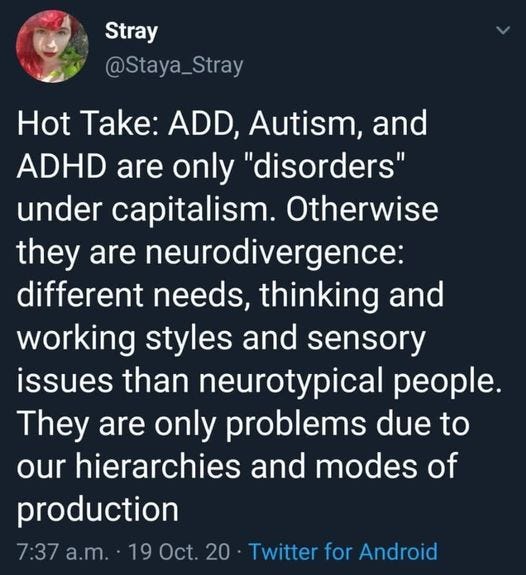
In response to what Stray said on Twitter back in October 2020 (see above), it’s worth noting that a ‘syndrome’ similar to autism was described by Grunya Sukhareva, a child psychiatrist working in the Soviet Union in the 1920s.
Stray argues that capitalism leads us to see autism and ADHD as ‘disorders’; but I’d suggest that equally, in the Soviet Union under Stalin, ‘hierarchies and modes of production’ had a hand in autism (or something like it) being framed as a disorder.
I agree with Slavoj Žižek (2006, p. 109) when he says, ‘Stalinist “totalitarianism” was the capitalist logic of self-fulfilling productivity liberated from its capitalist form, which is why it failed: Stalinism was the symptom of capitalism.’ In other words, there could have been no Stalinism without capitalism, or what Žižek refers to as a ‘capitalist logic’ of production. The syndrome described by Sukhareva came to light in a capitalist world, where the capitalist genie was already out of the bottle.
Autistic individuals and their symptoms may well have been pathologised in societies that predate the capitalist era; it’s just that autism wasn’t a diagnostic category back then, and any kind of retrospective diagnosis or tracing of autism in historical personages is a highly speculative exercise.
As an autistic person myself, I’ve occasionally been privy to conversations where someone has argued that in Indigenous or pre-industrial communities, autistic people or other individuals considered ‘neurodivergent’ would be given a role, perhaps as a shaman, a healer, a tracker, a soothsayer, etc. Though perhaps in some cases such individuals would be ostracised, or would choose to live apart from their community?
Regardless, discussions of ‘historical cases’ of autism tend to be problematic. Who’s to say that there was anyone alive in, say, ancient Egypt or medieval Europe who, if they were alive today, would meet the DSM criteria for an autism diagnosis? Even if we take the view that autism is primarily a genetic condition, how can we be sure whether environmental factors in historical societies could have promoted genetic expression that would have given rise to autism? I’m no geneticist, but to me this seems a dubious realm of conjecture.
I understand that some autistic people (as well as some non-autistic people) don’t consider autism a disability. Nevertheless, I think the social model of disability can be useful for highlighting how autism is pathologised, broadly speaking, due to the way that societies are structured, in so far as they’re generally not set up with autistic people in mind. Autistic people may come up against systemic barriers, stigma, and a lack of appropriate accommodations, for instance.
I agree with Stray that compared to most of their peers, autistic people, as well as people with ADHD, may have ‘different needs, thinking and working styles and sensory issues’. Stray characterises autism and ADHD as forms of ‘neurodivergence’.
However, if someone is ‘neurodivergent’, the question remains: divergent from who or what exactly? There may be statistical norms regarding the size, structure and functioning of human brains, but I’d argue that ‘neurodivergence’ is more about normativity than these statistical norms. I’m suspicious of the term ‘neurotypical’, in the same way that I don’t see ‘normal’ as a helpful category for understanding differences between humans, their mental life, and the ways in which they experience and act in the world.
Rather than ‘neurodiversity’, I prefer Bonnie Evans’ term ‘psydiversity’. As Evans puts it:
If we are to genuinely acknowledge the value of all human life, we must first see the human mind in all its fluidity and complexity as our mediating instrument, rather than a detached, ahistorical object that neuroscience allows us to stand outside of.
As far as I know, though, Evans doesn’t use the term ‘psydivergent’; in other words, in theorising psydiversity, she doesn’t emphasise deviation from any kind of norm. I agree with her that diversity exists and that we should acknowledge it and celebrate it.
On the other hand, creating a divide between ‘neurotypical’ and ‘neurodivergent’ people produces another case of ‘us and them’. I know some people will say they find ‘neurodivergent’ and ‘neurotypical’ helpful categories, and it’s not that I’ve never used them myself, but I’ve come to the point that I no longer see them as helpful most of the time.
For all that, I still applaud the neurodiversity movement, championed by the likes of Judy Singer and Steve Silberman, for the significant gains it has made for autistic people, as well as people with ADHD, dyslexia, dyspraxia, and many other conditions. According to Evans, one of the central achievements of the neurodiversity movement is that it ‘allowed for a new form of identity that was psychologically distinct, but didn’t see its members as lacking in some way.’
As a psychoanalysis nerd, I find this ‘lack of lack’ potentially problematic. According to the strand of psychoanalysis that I’m most drawn to, everyone lacks. Which, to be clear, is not to say, for example, that autism should be seen in terms of deficiency, or that autistic people should pathologise their autism. But rather that autistic people are beings who lack at a constitutive level— as are all other human beings.
In her book The Call of Character and elsewhere, the late Mari Ruti argued that all humans face ‘existential’ lack, which is not to be confused with what could be called ‘circumstantial’ lack — examples of which would be poverty, abuse, neglect, racial or gender-based discrimination, or various other forms of disadvantage.
The social model of disability focuses on circumstantial lack, leading us to the conclusion that, for example, when an autistic person’s differences are seen or experienced as deficiencies, this is due to social structures or biases that also preclude equitable outcomes for autistic people.
However, when it comes to autism or other conditions, we sometimes see things going to the other extreme, where supposed deficits or pathologies are turned on their heads and proclaimed as ‘super powers’ and so on. While possibly well-intentioned, such discourse can be patronising and othering, because although it might put a positive spin on individuals’ exceptional abilities, it also tends to rely on stereotypes and highlight ‘abnormality’.
Psychoanalysis, at least in its Freudian and Lacanian iterations, also baulks at the notion of normality. The French psychoanalyst Jacques Lacan argued that ‘we’re all mad’, whether we be neurotic, psychotic, perverse, autistic, or something else. We are all singular, and must be understood on a one-by-one, case-by-case basis. The psychoanalytic theorist Leon Brenner has even said, somewhat flippantly (and I hope this isn’t taken the wrong way) that from a Lacanian point of view, we all have our own kind of ‘developmental disorder’. In a way I take Brenner to mean that each of us develops a uniquely imperfect way of responding to existential lack, of coming to terms with limits and desires, as well as negotiating our way through our immersion in language and culture.
And in case you were wondering, no, I don’t think that ‘existential lack’ is particular to capitalist societies either. However, I’d argue that when it comes to the ways in which existential lack is usually theorised or understood, there is a focus on the individual. Whereas more communal societies, and some Indigenous communities, would probably be more likely to share in their existential lack, as well as their material lack. In other words, the way that ‘existential lack’ is sometimes characterised may be at least somewhat culturally specific.
I’d like to think that if psydiversity were mobilised as a movement, it would make room for some of these insights/offerings from psychoanalysis. However, I accept that for many individuals or communities, psychoanalysis may be a hard sell, whether as a form of treatment or as a way of understanding human subjectivity and society more broadly. But I plan to make a case for psychoanalysis, or at least to ask what it can offer the autistic community in 2023. In fact, that’s the article I’m planning to write next.
References Evans, Bonnie (2021), ‘After neurodiversity’, Aeon, https://aeon.co/essays/neurodiversity-is-not-enough-we-should-embrace-psydiversity.
Harris, John (2023), ‘The mother of neurodiversity: how Judy Singer changed the world’, The Guardian, https://www.theguardian.com/world/2023/jul/05/the-mother-of-neurodiversity-how-judy-singer-changed-the-world.
Lacan, Jacques (2013), ‘There Are Four Discourses’, Culture/Clinic, no. 1, p. 3.
Ruti, Mari (2013), The Call of Character: Living a Life Worth Living, Columbia University Press.
Silberman, Steve (2015), NeuroTribes: The Legacy of Autism and the Future of Neurodiversity, New York, Penguin.
Žižek, Slavoj (2006), ‘Objet a in Social Links’, in Clemens and Grigg (eds.) Jacques Lacan and the Other Side of Psychoanalysis: Reflections on Seminar XVII, Durham and London, Duke University Press.