
Research Shows Fast Poops Are Better
And yes, it may be linked to your gut microbiome. Could you change it with effort?

Table of Contents
· Who wins in an intestinal race, when it comes to getting nutrients? · Speed and nutrient absorption are both linked to the dominating bacterial group · What should we take away from this? ∘ Limitations ∘ Actions we can take · In summary: certain microbiomes lead to fast transit times and lots of absorbed calories
When we eat food, we usually aren’t thinking about what’s going to happen to it after we swallow. We’re mainly focused on the taste, texture, and enjoyment.
But when it comes to our survival and health, taste plays a very small part in the role of food. From a biology perspective, we care about how much energy we can absorb from the food, as well as whether we can get the adequate levels of various nutrients (vitamins, minerals) that we need.
Unfortunately, we can’t just hold onto the food we eat until we’ve extracted everything. The food that we eat flows through our digestive system at a fairly steady rate; it’s like a conveyor belt, and we need to pull everything we want off the belt before it deposits the remaining stuff into the (toilet) bin.
But not all people have food move through them at the same rate (which is called intestinal transit time). For some people, food that they eat ends up coming out the other end much faster than for others.
And new research shows some surprising observations about how intestinal transit time impacts our health — and what may be playing a role in determining the transit time.
Who wins in an intestinal race, when it comes to getting nutrients?
Before we get into what researchers found, let’s run a quick common sense check. Let’s imagine two individuals:
- Usain wolfs down his food, and it speeds quickly through his body! Food that he eats takes an average of around 10–20 hours to pass through his digestive system.
- Donatello prefers to take his time, and his body takes its time passing food through his system as well. Food that he eats takes an average of 50–70 hours to travel through his digestive system.
Usain and Donatello both eat a pretty similar diet, and neither of them takes any supplements that could impact their intestinal transit time (no Metamucil or fiber supplements, no laxatives).
Which one will get more energy from the food he eats? Usain or Donatello?
Most of us would probably guess that Donatello would get more energy. The food spends longer in his intestine, which means there’s more time for it to be broken down and absorbed. His conveyor belt is running more slowly than Usain’s.
But new research from scientists at Wageningen University and Research and the University of Copenhagen in the Netherlands suggests that the opposite is true: people absorb more energy from food when it travels faster through their digestive system.
How can this be? Why would we get more energy out of food when it spends less time inside us?
The answer may depend on the diverse collection of trillions of bacteria living in our gut — which we refer to, collectively, as our gut microbiome.
Here’s what the researchers found.
Speed and nutrient absorption are both linked to the dominating bacterial group
Each of us harbors trillions of bacteria living in an uneasy, ever-jostling sort of loose harmony inside our small and large intestines. There are many different species of bacteria, often around 1,000 different species, and each person has a unique mix. Your blend of bacteria is different from mine, and it’s almost like a fingerprint (just smellier).
But while each person has a unique microbiome when we look at exact species, we can sort people into general groupings based on the overall dominant species that’s in their gut. The term for this sorting is enterotyping, where individuals are classified into different enterotypes.
(It’s kind of like being sorted into your House in Harry Potter; someone may be clever (Ravenclaw) and a bit scheming (Slytherin), but if they’re predominantly brave and determined, they’re classified as, overall, a Gryffindor.)
When the researchers looked at the enterotypes of the individuals in their study, they found three different groupings:
- B-type: a microbiome dominated by the genus Bacteroides
- P-type: a microbiome dominated by the genus Prevotella
- R-type: a microbiome dominated by the family Ruminococcaceae
These groupings seemed to be the biggest factor correlated with intestinal transit time and with levels of energy absorption.
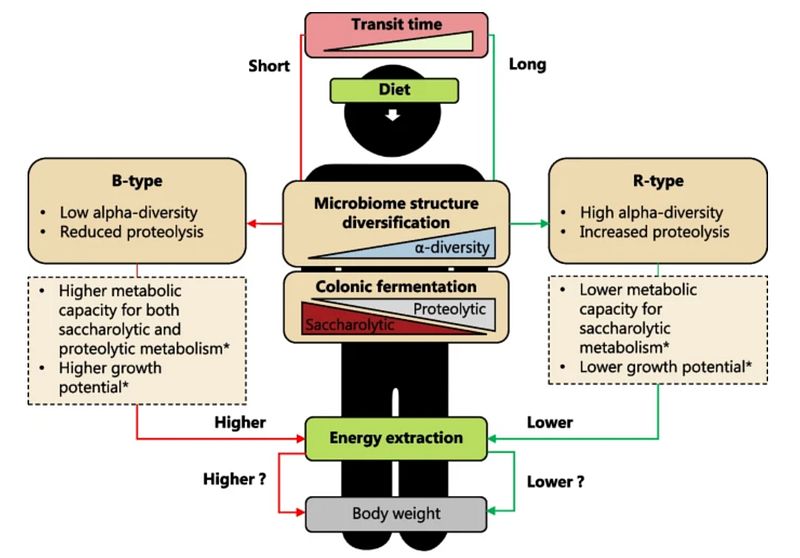
Specifically, individuals with the B-type enterotype had the fastest transit time, the greatest amount of energy absorption, and a higher average body weight.
On the other hand, individuals with the R-type enterotype had the slowest transit time, the least amount of energy absorption, a lower average body weight.
Individuals with the P-type enterotype fell somewhere in the middle.
Here’s a decent figure from the paper, summarizing their findings:
What should we take away from this?
This study is interesting, but we should note its limitations and drawbacks before we decide to alter our life strategy, trying to get the right enterotype for success and health.
Limitations
First, this study was only looking at about 85 participants. These participants varied in both gender, age, health conditions, and overall diet; the researchers asked participants to record what and how much they ate, but they weren’t in a controlled laboratory environment getting identical rations.
The researchers also didn’t monitor physical activity; sometimes, physical activity can “get things flowing” in the digestive system.
The experiment also only ran for one week; it’s quite possible that transit time may shift on a longer time-scale, such as seasonally.
Finally, this study openly acknowledges that it only shows correlation, and not causation. I’ve written plenty about the tendency for us to latch onto correlation and try to read too much into it, such as looking at studies that show that overweight people are less likely to die.
Are the bacteria altering the flow of food through our system, and controlling how much energy we absorb from it? Or do we pick up the bacteria that suit our body’s chosen flow speed?
We don’t know.
Actions we can take
Overall, there’s not a ton that we can do as individuals, based on these findings. Enterotypes have been shown to be fairly stable over time, so we can’t switch our diet for just a few days and expect our microbiome to also undergo widespread changes.
Enterotypes will, however, change over time if there is a sustained modification of diet. They’ve remained stable for up to 6 weeks of a changed diet, so we’re talking months to years of a different diet in order to significantly sway our enterotype.
There’s some limited evidence that our enterotype tends to swing towards different directions based on the food we eat. Bacteroides favor protein and animal fat, Prevotella prefer carboydrates and simple sugars, while Ruminococcaceae may prefer fermentable high-fiber diets.
Even months after switching a diet, evidence also shows that enterotypes revert if we revert our diet. Thus, it’s going to be hard to separate out the effects; are you losing weight because your diet has switched you towards the Ruminococcaceae enterotype, or because that dietary change consisted of cutting out unhealthy, high-fat foods?
In the end, likely the best actions we can take are to control the variables that we can (our diet), and feel a bit more confident in our dietary choices, knowing that we’re both impacting ourselves and our microbiome composition.
In summary: certain microbiomes lead to fast transit times and lots of absorbed calories
We’d expect that, the longer food spends in our digestive tract, the more of it we’ll absorb. But new research suggests that this may not be the case; our absorption rates may be based more on the composition of our gut microbiome.
Different dominant species in our microbiome seem to have differing effects on how many calories we take in from the food we eat — and also on how long food takes to travel through our system.
It’s hard to change our microbiome makeup; it takes more than a quick “crash diet” for a few days. But changing our dietary intake, long-term, may impact our microbiome as well as our own waistline — and that microbiome may, in turn, provide more benefits for us.
One last note: while there are plenty of sequencing options to examine your gut microbiome makeup, it seems like a super-rough method might simply be to eat a big meal and then see how long it takes to pass through your system!
Grab a big plate of food, maybe with a unique food dye or coloring in it! And who says that microbiome experiments aren’t fun?
Enjoyed the story? Consider sharing it on Twitter — you can tag me @swestreich with your thoughts.
Not yet a paid Medium member? Consider joining: you can read unlimited articles, and you can earn money if you try publishing your own articles. Use my referral link and you support my writing, at no additional cost to you:


