
Rescuing myself from the rubble.
On transition as archeology, a dysphoria of diaspora, and telling a less normative gender story.
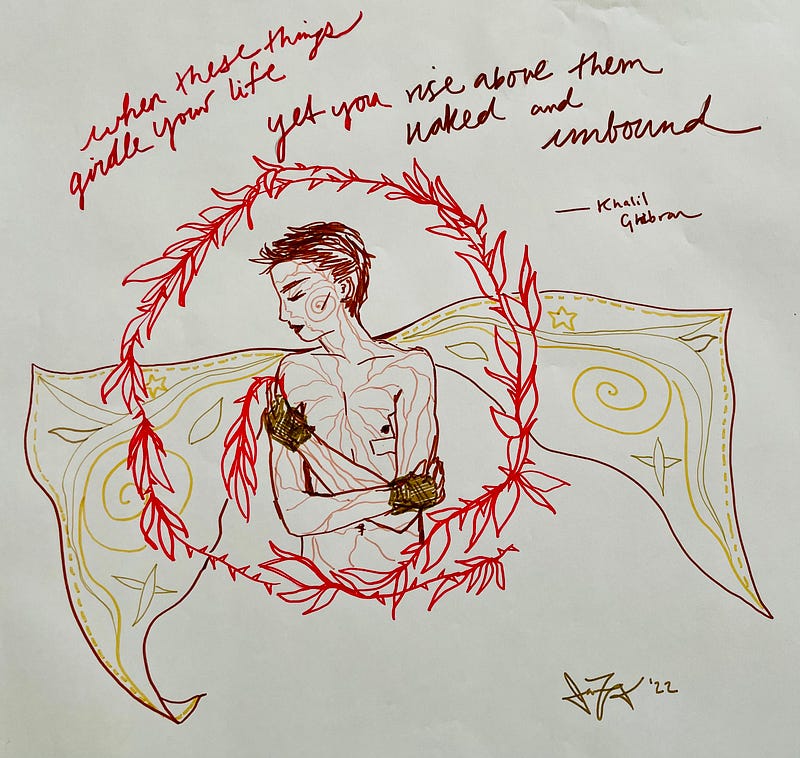
When you are so close, yet so far, from your own skin, what do you do?
When your identity is split by forces far greater than yourself, when even the words you’ve known vanish and are replaced with unintelligible garbles, when the confident shining self cultivated in your earliest years becomes invisible and harassed, when community care is replaced by chaos and derison, what is there to do?
What can you choose, but to steer with all your might away from any lingering tender knowings that may anchor you, in the face of needing to survive?
There is a reason my gender story starts with immigration and cultural assimilation. I was aware of the dysphoria of diaspora long before I could unpack deeper layers of wrongness, before I could even begin to re-locate my sense of my own body.
When you are, at the age of five, pushed into florescent rooms of unfamiliar behavior, pressured to start regurgitating syllables you’ve never heard before. When the bean sprouts your mom packs the night before lies cold and congealed in its tupperware, and you learn disgust from their faces, so you leave your body so as not to deal with it all coming back up your throat. When you flit between different elementary schools for years like a constantly reassimilating ghost so that the pressure, the peer disgust, never go away, no matter how much you perfect your speaking, how much you try to fit in… nothing inside you becomes that important anymore.
Outside intel becomes far more valuable. That’s how you survive. You sharpen what’s inside you into tools to meet whatever comes. Anything that doesn’t assist in that process is discarded.
We frequently hear trans people talk about living with a persistent state of wrongness, of knowing something was amiss from a young age. There’s also the oft-pushed narrative, heavily influenced by cis writers and the medical establishment, of knowing that one was “born in the wrong body”.
When I first came out to myself, my gender like a silver star suddenly glinting in the mud, I waded through so much imposter syndrome because of these dominant narratives. I couldn’t understand how I had not realized that my gender was wrong earlier in my life, how I could have been so dense or oblivious.
But I’ve come to realize that for me, this wrongness pervaded everything I knew growing up. Layers upon layers of incongruities between what I knew and what I felt, what I thought and what I presented.
For many years, gender identity ranked low on the hierarchy of what I had capacity to process. Thoughts of gender blended seamlessly into the wealth of presentation I perfected in order to be accepted.
I fought so hard to be seen as real by others, that it didn’t occur to me I needed to be real to myself.
For decades, the transition goal of having one’s insides match one’s outsides was nowhere within reach for me, stuck under so many layers of trauma and social pressure.
I can almost understand why some unhappy people spout transphobia, from this place of self-repression. If one feels unable to inhabit one’s own truth for whatever reason, it must be irksome, downright painful, to see trans people refusing to settle for wearing a miserable mask their whole lives. People who dare to be themselves out loud, despite so much opposition.
It took me a decade of actively unwinding the false stories from my bones, shedding the layers of fog that had hid my realities, before I could envision transition.
I often say that I spent my 20’s doing inner work while others spent that energy on their careers or social lives. A decade of trauma healing, of restoring my nervous system, of managing physical and neurological pain, of bringing the levels of inflammation, cortisol, and generally living in a state of emergency down, one agonizingly slow step at a time.
During the healing years, the dark years, the lost years, I lived an isolated existence with my partner and their family in Seattle. 3/4th of our household was debilitatingly sick, and we had very little community around us. My partner was my crisis partner, supporting me through a constant storm of neurological pain and trauma reactions. No one should have to live the way we did.
The things I found my way to that helped me — Organic Intelligence, the right herbs, energy healing systems, Workaholics Anonymous — were by trial and error. A slow, dark, groping process. I didn’t have any idea of what I was even fighting against or healing from, most of the time.
With few helpful professionals to assist my process, I myself came to know intimately my C-PTSD, my chronically flaring illnesses, my neurodivergence.
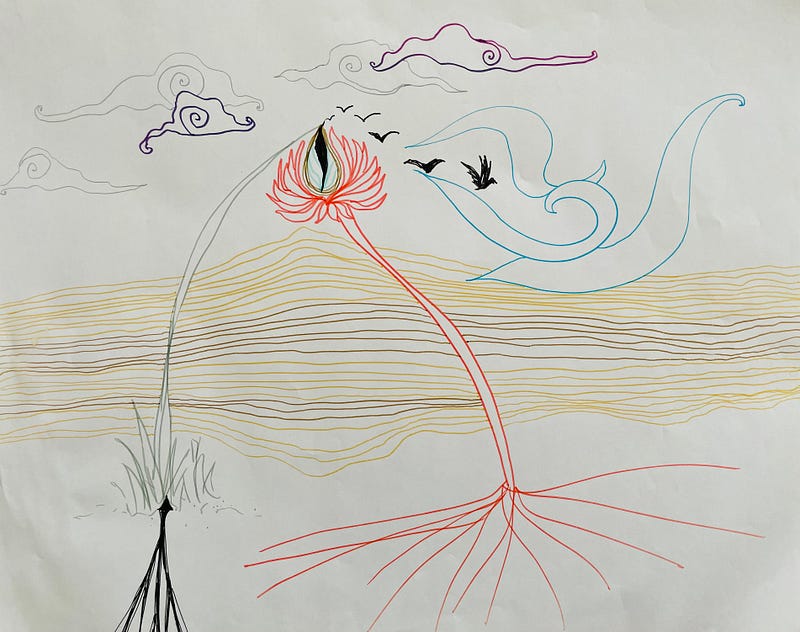
In this archeological dig for self, even as I uncovered more and more of my chronic conditions, my body’s needs for emotional regulation, my assimilation into whiteness, it was like there was still something missing. Something just out of reach. Something still hiding and stirring unease through my murky depths.
Uncovering a lifelong compulsiveness around work and the recovery community hastened the digging, until finally the tip of my proverbial shovel hit something hard and unmoving last fall.
At first, I didn’t even realize I had struck something so enormously central, a core clue to the bedrock of my unexcavated being.
It was an experience of gender euphoria that first caught my attention, when I dressed in “drag” for Halloween, and had what could be called an in-body experience. The costume felt more like me than normal me. I had never known that my body could feel so good, so like my own, until I painted my face, slicked my hair back, and wore a suit.
What did it mean? Though I had tentatively been exploring the concept that I might not be cisgendered for a couple years at that point, I had still been identifying as “femme”. Somehow, I had not thought to inquire into masculinity, and now it here it was, staring with pleasure back at me in the mirror.
Serendipitously, the San Diego Asian Film Festival took place the following week, and a dear friend had gotten me a pass to see any film I liked. I wound up at a screening of As We Like It, a Taiwanese film that spun a queer Shakespearian tale, casting all AFAB actors in the roles. I was not prepared for the wealth of representation exploding onto the screen.
I had never before seen faces that looked like mine inhabiting an entire spectrum of gender presentation. Though the actors themselves may not have identified this way, transmasculine configurations dazzled my eyes. I found myself snapping countless furtive photos from my seat, trying to capture the outfit aesthetics that my body was urgently clamoring for.
Apropos, on screen, the main actor mused: “If I change into a boy, will anyone love me?”
I drove home flushed with possibilities, not knowing where they would lead me, but only knowing that there grew within me a feeling of brightness, of hope, of finally fitting into the kind of story I had longed my whole life to embody.
These experiences of euphoria became the initial critical elements of a much deeper exploration. They began to thaw the long freeze of my disconnection from selfhood.
A few weeks later, I read this article about symptoms of depersonalization and derealization as undiagnosed dysphoria. I began to recognize a lifetime of living not in the wrong body, but of barely living in a body at all.
It was as if all of the coagulated experiences of my life started to swim into focus. The constant feelings of being unreal, of standing outside of myself, of trying to get inside of my own experience somehow like fumbling at a lockbox.
When I was in high school, I remember wishing I had a video camera trained on me at all times so I could better evaluate how I should act and look. At the time, I thought everyone felt this way. I didn’t realize how alien I had become to myself.
Rather than try to describe exactly how depersonalization felt for me, I’ll share a poem I found in my journal, written almost a year before I realized I was trans:
come into your calling
calling to the thousand beasts of
your blood, the air
what timeline is my healing
on? where will I find the
reins of my wholeness?
I gather my courage for another
day of walking in the unknown,
my skin splitting to reveal an
unknown self. This body holds
many secrets. The first December
of my thirties is upon me
like a long cloak that conceals
my feet, drags over the ground
following and obscuring my path, both.
trust. that elusive bat
winging like a shadow overhead
asking me to believe, echolocating
my despair, solid on some
dimension that I struggle to
reach. Reaching isn’t the
point, trusting is. And I begin
again these tender labors.
In retrospect, it’s probably so obvious that this is a poem about being trans. But for me, it was just another day battling my way through the impenetrable fog that was my life for so long.
Amid the grief, I send gratitude to the not-me’s that helped keep the true me alive. The tender labors of excavation that began in my early twenties, that got me rescued from the rubble. I give thanks for this body, bruised and shaky underneath the layers of struggle and survival stratagems, but still solid and strong, for making it through and fiercely seeking a belonging that I didn’t know was possible.
Here I am.
Author’s note:
I wanted to tell my story because it’s a different kind of gender story. One that isn’t white, ablebodied, or neurotypical. I think trans folks who have lived at many intersections of marginalization — before and after transition — don’t share our stories as often or as loudly. Nor are our voices represented in mainstream perceptions of what it means to be trans, what transition looks like, or how gender dysphoria/euphoria are defined. Given all that, I hope my writing down my experience is helpful to someone struggling to recognize themself.
Here’s to Trans Day of Visibility 2022; may all trans people be free to experience their own truths out loud.


