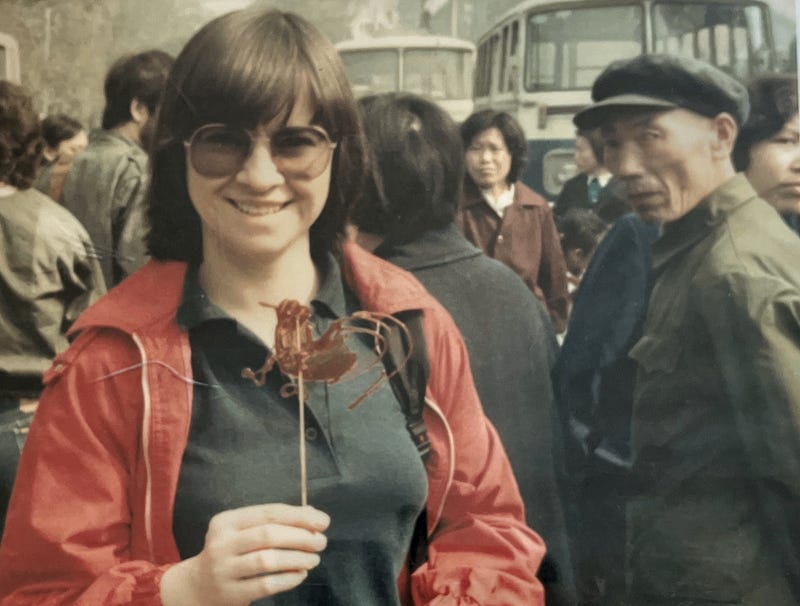
Rescued in the People’s Republic of China
“You mean ‘Red’ China?”, Uncle Eddie asked with concern.
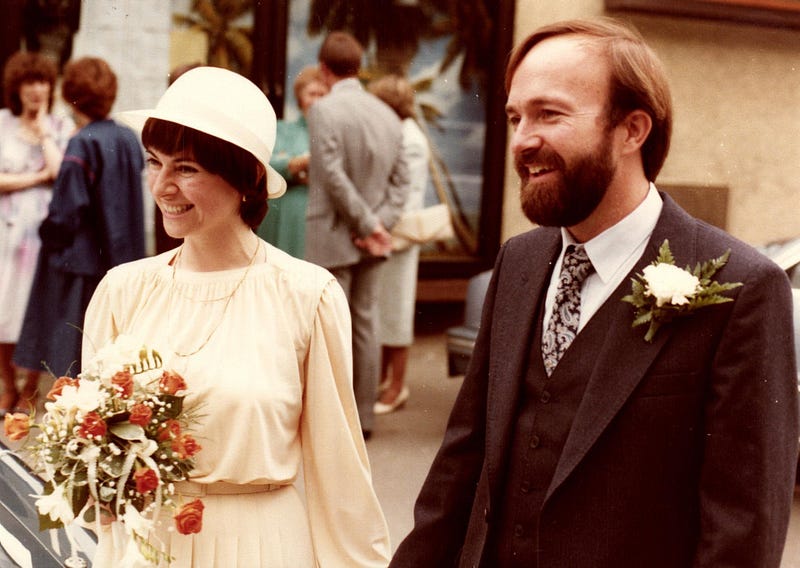
It was 1983. As far as I knew, Uncle Eddie may have fought the “Red” Chinese in Korea just 30 years ago. It was my first meeting with him that summer afternoon in Massachusetts. We were telling the gathering about our new jobs in China.
He was concerned for the safety of his niece, and my new bride, Linda. In my mind, always writing the script of my life, I said to myself “Is this foreshadowing?”
Linda and I were married a few weeks earlier in West Germany, surrounded by our friends from the Frankfurt International School.
That summer, we were on our way to the new International School of Beijing. It was the first English-speaking international school in the People’s Republic of China since the communist revolution in 1949. John Ritter had been hired the year before to setup the school with the help of the spouses of diplomats, journalists, and bankers. We and a British couple would be the first professional teachers brought in to work at the school and to work in China.
But we had a number of hoops to pass through before we could get there.
We had to pass an intensive FBI background check. It was a very delicate time in the relations between the US and China and the FBI wanted to make sure John Ritter got it right. I guess they did not mind my subscriptions to Soviet Life when I was at the University studying Russian. We passed!
We had to become Official Members of the United States Department of State in order to work in China. That meant a couple of visits and interviews at the Office of Overseas Schools in Washington before we were cleared to get the maroon-colored US Official Passports. We could only use those passports going in and out of China.
We often ignored the rule about the use of the official passport. It meant we could pass through immigration lines in various countries and we did not have to pay airport taxes, a big deal in the 80s. One airport even gave us VIP treatment. I think I am still on the Office of Overseas Schools naughty list.
We also had to pack our bags very carefully. We were going to live for two years in a hotel room. We knew it would be hard, but we were newlyweds, so the hotel would be like an extended honeymoon, so we told ourselves.
That summer, after leaving our friends in West Germany, we had several post-wedding receptions in the US. Visiting and meeting friends, and extended family members including Uncle Eddie.
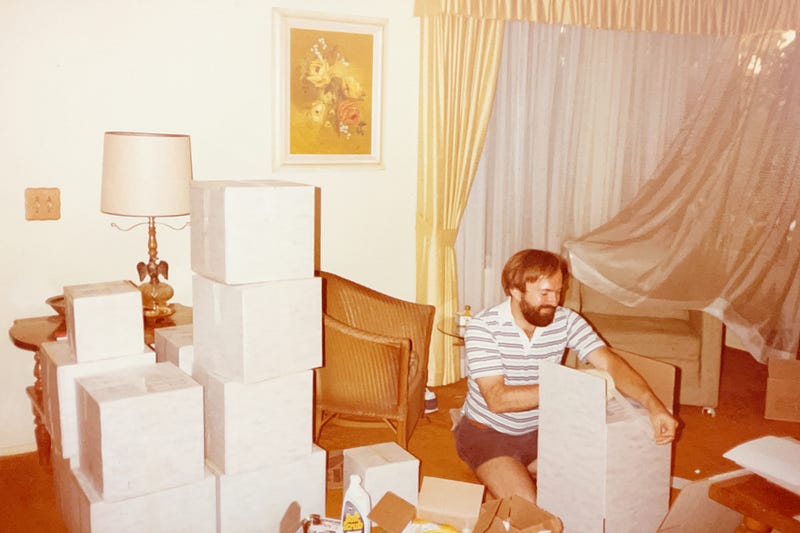
As newly minted official members of the US Embassy in Beijing, we had Fleet Post Office (FPO) privileges. All shipments from an address in the US went as domestic mail to a post office box in San Francisco. So we transformed my parents’ living room in California into a shipping center. Items that might have been in our luggage went as parcels to San Francisco. We took our 10-speed bikes as luggage.
The school had sent us tickets for our flight to Beijing. The flight was on Pan American Airways.
All flights between China and the US were canceled after the communist revolution in 1949. Full diplomatic relations did not resume until 1979 when the US Embassy opened in Beijing.
In 1980 Deng Xiaoping announced economic reforms and opened China to foreign, “Capitalist” investment.
The embassy expanded to include the staff that helps American businesses operate overseas. The staff brought their families. Those families needed teachers like Bill and Linda.
Among the first American companies to do business with China were Boeing and Pan American Airways. Together in 1981, they created a deal with China to open air routes with the US. There were four flights a week to and from China. China Airways would buy new Boeing aircraft to replace its aging Russian planes.
For Pan Am, it was a return to the China Clipper Service they created in the 1930s. Those flights had been a six-day journey from San Francisco to China with stops in Hawaii, Midway, Wake, Guam, and the Philippines.
There were few people on those flights in the 1930s and still few in 1983. It was difficult to get visas to enter China. Most adventure travelers at the time had to fly to Hong Kong and arrange a visa there. The State Department took care of our visas.
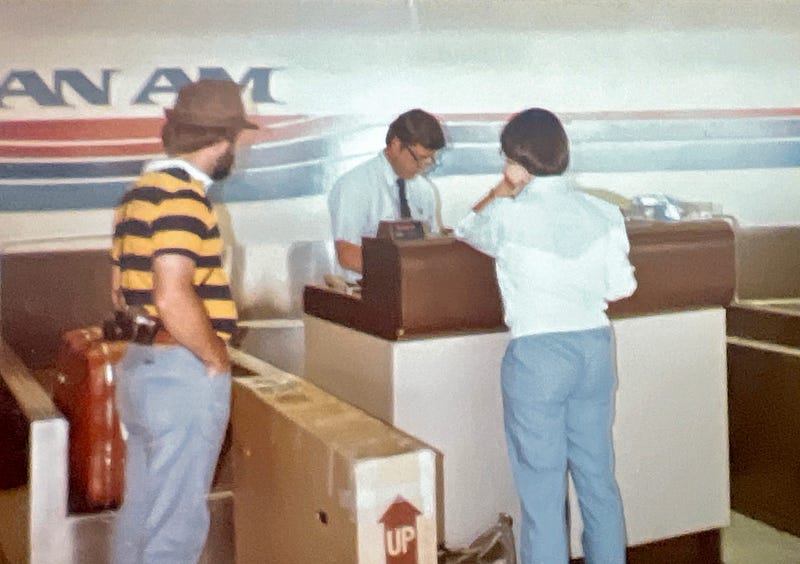
The final leg of the flight was from Tokyo to Beijing. The 747 was nearly empty. We had our choice of empty rows to sleep in.
The flight landed on time in Beijing at 9:30 pm.
In 1983 it was a small airport, similar to a regional airport in the States. The tired customs officials only gave us a cursory glance and stamped our Official Passports. Our bags and bikes were waiting for us outside customs.
But nobody was waiting for us! No one from the school or embassy was there. There were no rows of taxis waiting for passengers. No embassy cars. No buses.
We learned that night that the Pan Am flight was the last flight of the evening. At 10 pm the airport started to close.
The lights in the airport were being shut off as tired customs agents, baggage handlers and other staff headed home.
We were jet-lagged. Panic cooled our skin in the hot humid air. We were strangers in a strange and maybe hostile land without the ability to communicate.
We were gently pushed toward the exit by a pair of young men in green uniforms. They looked just like the people who held up Mao’s Little Red Book denouncing the West a decade earlier. But they smiled.
Near the exit door was a low booth that in any other airport in the world would be the information or help counter. It was empty. I peered over the edge. There was a dog-eared booklet with a single English word on the cover: “Embassies”. It was beside a phone.
I pantomimed making a call to the young guards showing us the exit. They shrugged, which I took as a yes. I found the number for the US Embassy and called. I got a Marine guard. I explained who we were. He knew who we were.
There had been a miscommunication with the school regarding our arrival day. The Marine said “Hold on, we’ll come get you. It will be about 50 minutes.”
The airport had completely shut down. We were on the curb near the entrance with our luggage and the two Chinese guards.
The two guards were interested in our bike boxes. They spoke loud and slowly to us in Chinese. At that time the words passed over us. They were two young kids curious about these two foreigners.
We on the other hand were two tired and hungry jet-lagged people who had no clue what was going to happen to us in the next two years. It was not an auspicious start.
The Marine arrived in a black van. On the way into town, I noticed van’s headlights were turned off. The Marine explained “It’s the law. You might blind the bicyclists on the road.”
The streetlights on the road were just close enough to illuminate the path. Under each one were knots of people sitting on benches and boxes in the summer heat.
We were starting our new adventure in this new land. We were curious and we were the curiosities.
We had only been in China a few hours and we had already been rescued by the US Marines. Who knew what adventures lay ahead as we peered through the darkness?
Other Stories of China from 1983–85