
Removing Traitors from the Names of American Military Bases
A move to correct the false narrative of the “lost cause”
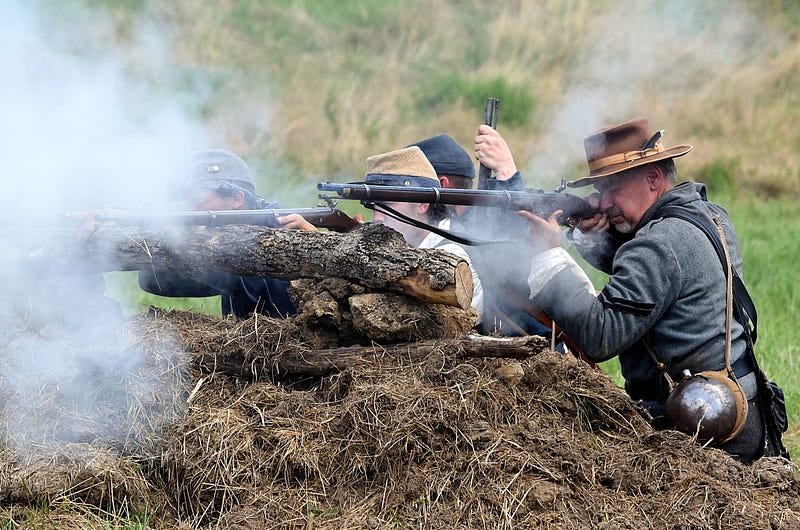
To remove some vestiges of American dishonor, a Congressional commission has announced new names for several military bases. The old names for these bases are a relic of the Jim Crow era. The government named the bases in the first half of the 20th century when the myth of the Lost Cause had been promoted by Southern racists for generations. Some names were losers more notable for their politics than their military skills. All the old names commemorated were traitors to the United States. Perhaps now we can bury that myth, as we correct the names it honored.
The damage done
The names to be dropped:
- General Robert E. Lee, Confederate States of America. Lee distinguished himself as an officer and as the Superintendent of the United States Military Academy at West Point. Despite the offer of a senior command in the Union Army, Lee took command of the Army of Northern Virginia. After the war, Lee became a symbol for the “Lost Cause” narrative. More recently, the removal of his statue served as a call to arms for the alt-right and white supremacists who rallied in Charlottesville in 2017.
- General Braxton Bragg (CSA). Considered one of the most incompetent generals of the Civil War. Most of the battles he engaged in resulted in defeat.
- Brigadier General Henry L. Benning (CSA). A vocal secessionist and defender of slavery. Benning was one of the last of Lee’s officers to report with his men to the surrender at Appomattox.
- Major General John Brown Gordon (CSA). Led his troops in a successful last charge by the Army of Northern Virginia before Lee’s surrender.
- Lieutenant General Ambrose P. Hill (CSA). Hill made his reputation as a subordinate of “Stonewall” Jackson. He was also a Corps commander at Gettysburg.
- General John Bell Hood (CSA). His aggressive leadership led to massive casualties among his men. Historian Bruce Caxton has described the decision to replace General Johnston with Hood as “the single largest mistake that either government made during the war.”
- Major General George Pickett (CSA). He is remembered for his role in Pickett’s Charge at Gettysburg. Pickett’s Charge led to a bloodbath that marked the highwater mark for the Confederate Army.
- General Leonidas Polk (CSA). Polk also served as a Bishop in the Protestant Episcopal Church of the Confederate States of America. Completely racist and incompetent. Polk clad his support for slavery in a veneer of Christianity. Historian Steven Woodworth has described his death by an artillery shell as “one of the worst shots fired for the Union cause during the entire course of the war.” Polk’s incompetence made him more valuable to the Union alive than dead.
- Brigadier General (unconfirmed) Edmund Winchester Rucker (CSA). Rucker worked his way from private to general commanding artillery and cavalry. Wounded and captured at the Battle of Nashville, he was returned in a prisoner exchange.
The myth of the Lost Cause
The Lost Cause myth was a psychological reaction to the total loss of the American Civil War. The Confederacy wasn’t just defeated. The South was “utterly destroyed”. Southern wealth dropped by over sixty percent. Around 300,000 Southerners died. As a former Confederate general who became a commander of the United Confederate Veterans observed,
If we cannot justify the South in the act of Secession, we will go down in History solely as a brave, impulsive but rash people who attempted in an illegal manner to overthrow the Union for our Country.
In other words, they would have to acknowledge the truth.
When faced with truths too ugly to accept, humans will go to any lengths to avoid them. (For a contemporary example, see a remaining Trump apologist clinging to the Great Lie.) Thus, the “Lost Cause” was born.
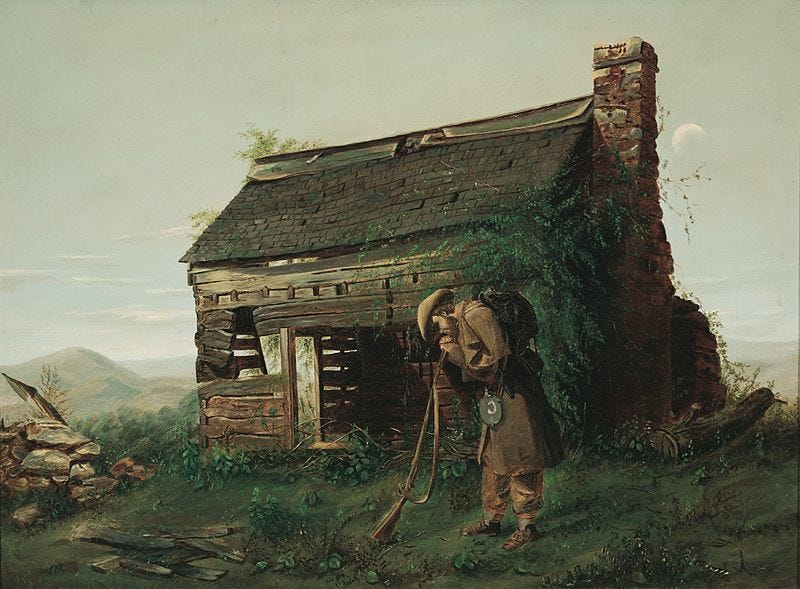

There were six main elements of the Lost Cause myth.
First, succession had little or nothing to do with slavery. It was a constitutional defense of state’s rights, crushed by the “War of Northern Aggression.” This is perhaps the easiest lie to disprove. The Declaration of Independence of the Confederate States of America affirmed it was the institution of slavery and opposition to the idea that black slaves should be considered “persons” that caused the war. General Benning was even more explicit about it.
What was the reason that induced Georgia to take the step of secession? This reason may be summed up in one single proposition. It was a conviction, a deep conviction on the part of Georgia, that a separation from the North was the only thing that could prevent the abolition of her slavery…. If things are allowed to go on as they are, it is certain that slavery is to be abolished. By the time the North shall have attained the power, the black race will be in a large majority, and then we will have black governors, black legislatures, black juries, black everything. Is it to be supposed that the white race will stand for that? …. We will be overpowered and our men will be compelled to wander like vagabonds all over the earth; and as for our women, the horrors of their state we cannot contemplate in imagination. That is the fate which abolition will bring upon the white race…. We will be completely exterminated, and the land will be left in the possession of the blacks, and then it will go back to a wilderness and become another Africa…. Suppose they elevated Charles Sumner to the presidency? Suppose they elevated Fred Douglass, your escaped slave, to the presidency? What would be your position in such an event? I say give me pestilence and famine sooner than that.
— Henry Lewis Benning, to the Virginia Convention (1861)
Second, slavery was a positive good. Since “the negro is not equal to the white man… slavery subordination to the superior race is his natural and normal condition.” The less time spent on that lie, the better.
Third, the Confederacy only lost because it was overwhelmed. The North’s advantages in men and resources exhausted the superior skill, morale, and moral position of the South. In 1869, Braxton Bragg, as well as former Generals Early and Fitzhugh Lee, created the Southern Historical Society and made the promotion of this Lost Cause narrative central to its mission.
Fourth, soldiers of the Confederacy were heroic, gallant, and even saintly. “Stonewall” Jackson, wounded by friendly fire, was a martyr. Southern women were idealized as well, and they played a large part in perpetuating the myth of the Lost Cause. They dedicated Confederate cemeteries and Memorial Days to Confederate soldiers. In 1900, they united into the Confederate Southern Memorial Association. This group collected relics of the Lost Cause. It promoted the myth through education and textbooks. It erected statues to Confederate martyrs across the country. While The Southern Poverty Law Center reports that 73 monuments were removed in 2021, approximately three thousand memorials or markers remain throughout the United States and its territories.
Fifth, General Lee, after his death in 1870, became the center of a “Cult of Lee.” The cult portrayed him as a second Washington and the ultimate Christian soldier who fought for Virginia and the Confederacy. Other ex-Confederates put Lee on a pedestal (figuratively and literally). His decisions were beyond criticism. James Longstreet, however, became a villain for his willingness to question Lee’s decisions. He was damned again for his choice to join the Republican Party. Longstreet even came to be blamed for Lee’s loss at Gettysburg.
It was the Lost Cause narrative that led to the naming of Army posts for Confederate traitors in the twentieth century: Fort Lee (1917), Fort Bragg (1918), Fort Benning (1909), Camp (now Fort) Gordon (1917), Fort A.P. Hill (1941), Fort Hood (1942), Fort Pickett (1942), Fort Polk (1941), and Fort Rucker (1942).
Many people, North and South, recognized this narrative as nonsense. Many were angered by its glorification of slavery and succession. Yet many Northerners came to tolerate the Lost Cause narrative to mend the wounds of the war. They hoped it might help the country move forward into the twentieth century. As we have seen, in its repetition by racists and the alt-right to this day, they were wrong. The myth of the Lost Cause is associated with much of the worst of what we still see today. Removing those names is a positive step. American military installations should honor heroes, not traitors.
Correcting the record
The new names, suggested by the Congressional commission:
- Fort Lee would be renamed Fort Gregg-Adams, in commemoration of Lt. General Arthur J. Gregg and Lt. Colonel Charity Adams. Adams commanded the first unit of African-American women to serve overseas, in 1944. She reached the highest rank then available to any woman. Gregg entered Officer Candidate School the same year President Truman ordered the desegregation of the military. He improved logistics around the world while promoting equality within the Army.
- Fort Bragg would become Fort Liberty.
- Fort Benning would become Fort Moore, for Lt. General Hal Moore and his wife, Julia. Both served military families and helped manage the transition to an all-volunteer Army.
- Fort Gordon would be renamed Fort Eisenhower, for the General of the Army who led Allied forces in Europe in World War II.
- Fort Hill would be renamed Fort Walker, for Dr. Mary Edwards Walker. Dr. Walker was a skilled surgeon who served as a civilian contractor in the Civil War. She won the Medal of Honor for her persistence, skill, and exceptional valor.
- Fort Hood would become Fort Cavazos, renamed for General Richard E. Cavazos. Cavazos led a unit of Puerto Rican soldiers in the Korean War with such bravery he won the Distinguished Service Cross. Yet another DSC came for his leadership in Vietnam. He also won two Legions of Merit, a Silver Star, five Bronze Stars, and a Purple Heart. In 1982 Cavazos became the first Hispanic-American promoted to four-star general.
- Fort Pickett would change to Fort Barfoot, named for Technical Sergeant Van T. Barfoot. Seargent Barfoot won the Medal of Honor for exceptional courage in World War II. He continued to serve in Korea and Vietnam. Eventually, he retired as a Colonel after thirty-four years in the Army and National Guard.
- Fort Polk would become Fort Johnson, in commemoration of Sergeant William Henry Johnson, who won his Medal of Honor in the Argonne Forest. At the time he was wearing a French uniform, having arrived ahead of the segregated American Army. Nicknamed the “Black Death” he was also the first American soldier to receive the French Croix de Guerre.
- Fort Rucker becomes Fort Novosel, named in honor of CW4 Michael J. Novosel, Sr. Novosel joined Army Aviation ten months before Pearl Harbor. He served in World War II and Korea. Later, he volunteered to return to active duty with a reduction in rank in Vietnam. There, he braved enemy fire as a helicopter pilot specializing in evacuating combat zone casualties, including his own son. Over one eighteen-hour mission, he extracted twenty-nine men who didn’t speak English, all while under direct fire as he hovered a few feet above the ground. The barrage inflicted severe damage to the helicopter and serious wounds to him. For these actions, Novosel won the Medal of Honor.
These people are exceptional alternatives for the traitors they replace. With the traitors removed, the United States can take another step towards relegating the evils of the past to where they belong: something to be ashamed of, not celebrated.
This is not the final step. Remaining to be corrected is a score of roads and facilities named for officers of the Confederacy. These include memorials to Confederate soldiers, as well as ships of the United States Navy whose names or crests refer to Confederate soldiers and sailors. But this step, to eliminate the most egregious of the insults to American honor, is a valuable move in the right direction.