
Remote Viewing Session Spotlight: mix lix
A door to perception and perception of a door — April 13, 2020
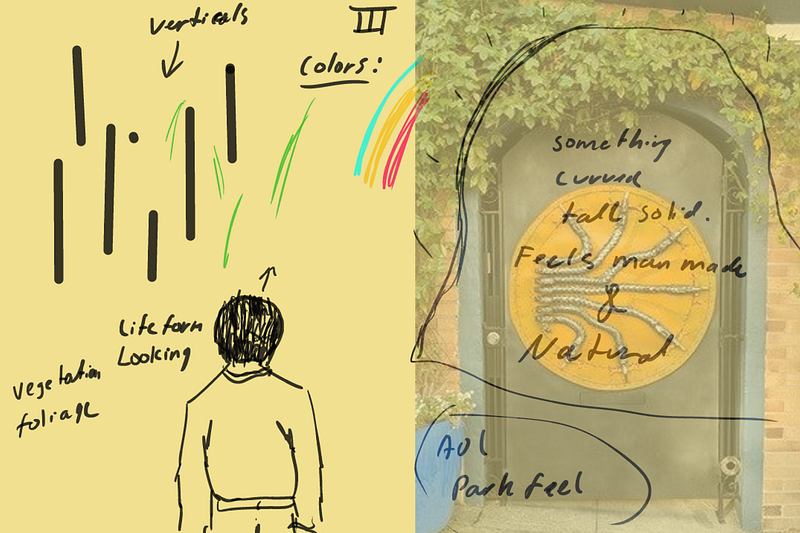
Recently, the r/remoteviewing/ community user known only as “mix lix” had asked me to select some targets for his remote viewing practice.
A prolific, enthusiastic and self-taught viewer, mix lix has been putting in the constant work to refine this natural human ability. Lately, he has been cultivating an ability to distinguish colors, practicing daily while blindfolded to detect papers of different hues.
Witnessing mix lix’s prior work has helped me over the personal hump of belief that humans can, indeed, by unknown means, perceive things distant in time and space. I think you'll also find it compelling.
Target set
On April 5, 2020, I found something interesting, wrote up a simple cue (a description of the information to be gathered), and saved it on my phone:
040–520
Chamber of Secrets Door
https://www.atlasobscura.com/places/entrance-to-the-chamber-of-secrets
See and describe the Chamber of Secrets Door and it’s function or purpose, San Francisco, CA
(Please click through and read the description and see the photograph there. Atlas Obscura is a wonderful website featuring user-submitted places of curiosity and beauty. I am not affiliated with them in any way.)
Unlike lucky you, mix lix did not have this information upfront. He would work fully “blind,” not knowing upfront whether to mentally seek information about a place, thing, event, or creature.
I provided him only the following pseudo-random objective identifier: 020–520. (For the unacquainted, a code like this serves as a mental focal point for a remote viewer to access a set objective or — in military parlance — target.)
On April 13, 2020, after a few unnecessary apologies for such a late response to what was a fully voluntary activity, mix lix turned in the following session work (pictured and transcribed, with minor edits and [comments] to aid comprehension). Mix lix used a semi-formal method of “controlled remote viewing” to capture his impressions.
Page 1 — Stage I
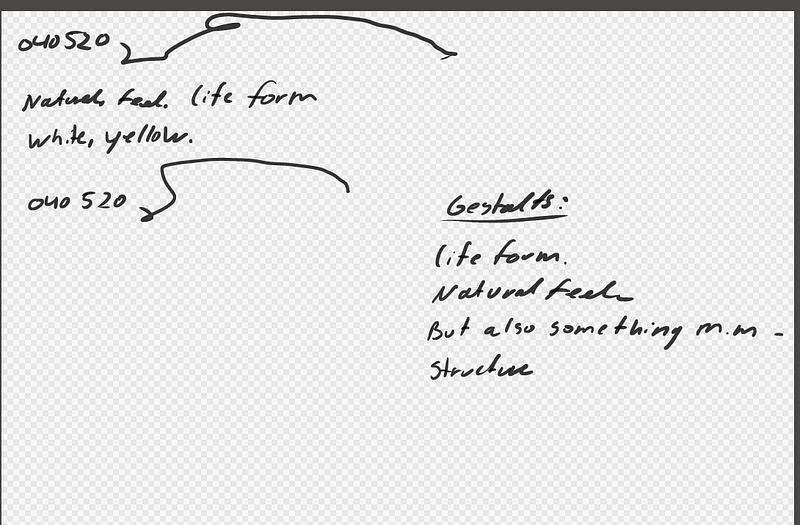
040520 — ideogram [This is an instinctive scribble that is performed with intent to receive a very basic initial impression of a target]
Natural feel. Life form [Initial data is often very general, consisting of the main “gestalts,” or the most succinct descriptions of what may be present. As work continues, the viewer’s impressions usually become more specific and involve the senses]
White, yellow. [Spontaneous impressions of color]
040520 — ideogram [Steps may be repeated either to clarify prior impressions or to garner impressions of finer detail]
Gestalts:
life form. Natural feel
But also something m.m [man-made] — structure
Page 2 — Stage II
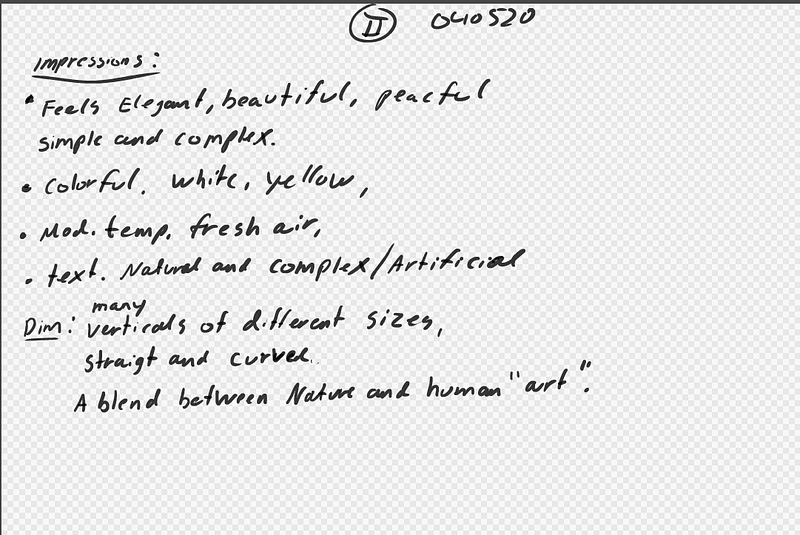
[Viewer is moving into more specific impressions, attempting to receive information that maps to all bodily senses, although not personally present at the target]
Impressions:
Feels Elegant, beautiful, peaceful simple and complex.
Colorful, white, yellow.
Moderate temperature, fresh air.
Texture, natural and complex/artificial
Dim[Dimensionals — low level impressions of shape and scale]: Many verticals of different sizes, straight and curved.
A blend between nature and human “art.” [At this point, the viewer has had an “aesthetic impression” of how the target has made him feel; he takes this more complex impression as a sign to transition to a more visual approach]
Page 3 — Stage III
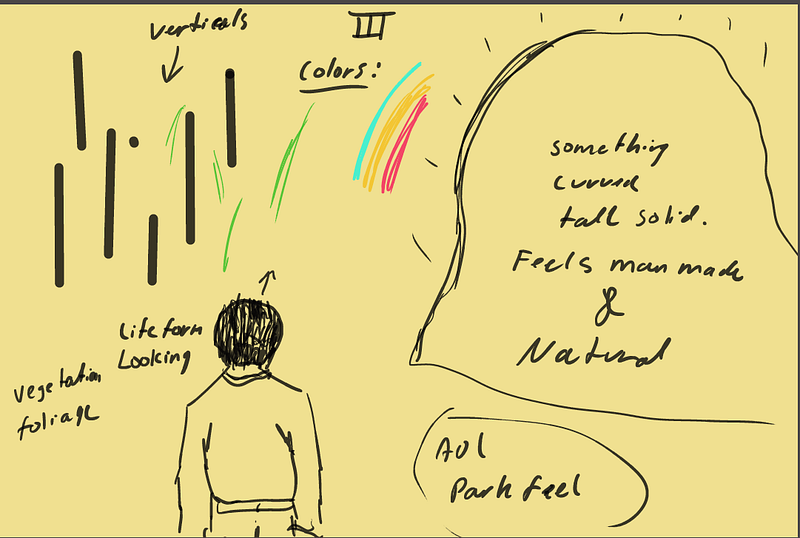
[Viewer is attempting to sketch impressions from the target]
Verticals [Left/top of page — Viewer perceives and sketches some vertical lines or textures in this relative area]
Colors: [Middle/top of page] — blue, yellow, red markings— [Viewer has impressions of these colors near this area, but is uncertain of how they map to physical features. The colors are perceived an abstract impression, but the viewer has a relative sense of location.]
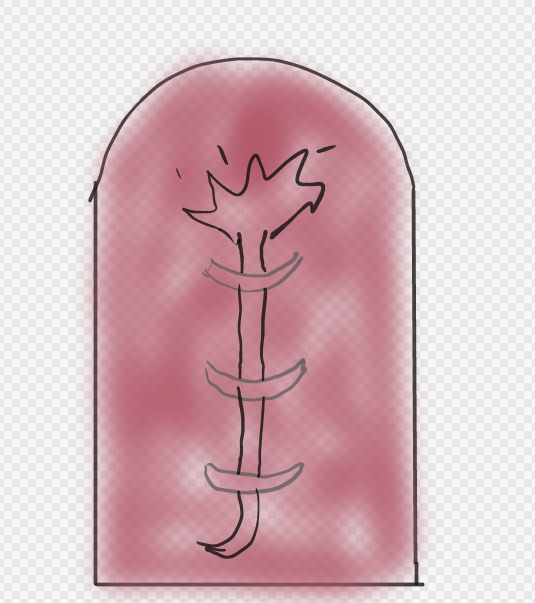
[Right of page — sketch with impression of depth, like etching in a flat surface or possibly extruded or standing. This is drawn with tall sides and an arching shape at the top. Inside are impressions:]
Something curved, tall, solid. Feels man-made and natural [has a combination of man-made and natural elements]
Vegetation, foliage [Left/bottom of page — accompanied by green marks interspersed between the sketched impressions of vertical lines]
Life form, looking [Middle/bottom of page — An apparent man-shape sketched with an arrow indicating perspective. Viewer does not want to falsely conclude that it is a human, so labels more generally.]
AOL: Park feel [Viewer recognizes an “analytic overlay” within his thought processes. The target reminds him of being at a park, but he does not want to falsely conclude that it is a park. He circles it and labels it to mentally set it aside, not wanting it to color or influence his next impressions.]
Page 4 — Stage IV
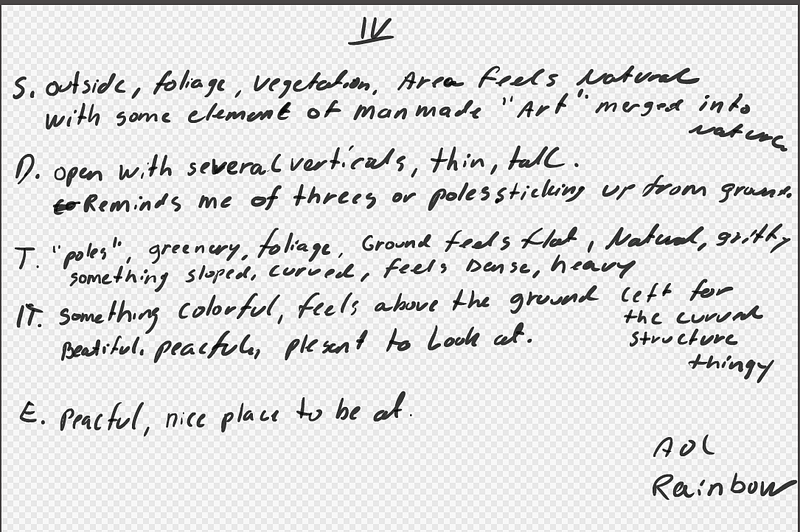
S[ensory]. Outside, foliage, vegetation. Area feels natural with some element of man-made “art” merged into nature. [This is a recap and elaboration of the page 2 — Stage II impressions]
D[imensionals]. Open with several verticals, thin, tall. Reminds me of [trees] or poles sticking up from ground. [Further impressions of shape and arrangement in space. These may have been perceived as piecemeal, and viewer is gaining a sense of how they relate to each other.]
T[angibles]. “Poles”, greenery, foliage. Ground feels flat, natural, gritty. Something sloped, curved, feels dense, heavy [These are things with physical presence that the viewer expects could be touched and felt, if present.]
I[n]T[angibles]. Something colorful, feels above the ground, beautiful, peaceful, pleasant to look at. [These are characteristics that cannot be touched.] Left for the curved structure thingy. [Viewer is again describing the location at which he has perceived colors, although they were not associated with specific physical features.]
E[motional impact]. Peaceful, nice place to be at. [How the target affects the mood and feelings of those present.]
AOL Rainbow [Viewer has the impression of a rainbow in his mind but doesn’t want to conclude that it is a rainbow. Something of the elements perceived — perhaps the shape or colors present — has recalled an image or
idea of a rainbow.]
Page 5: Summary
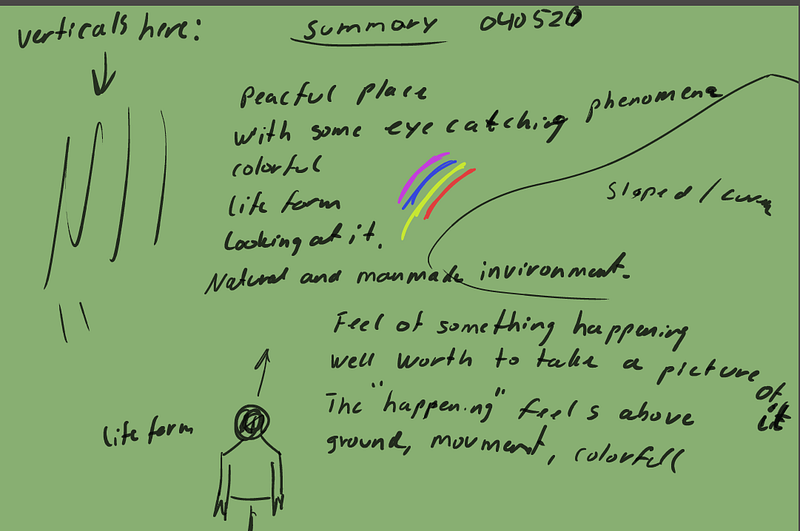
Verticals here [Left of page, sketch of several vertical lines]
Summary [Center of page, viewer is pulling together perceptions and feelings from prior pages]:
Peaceful place
With some eye catching phenomena
Colorful
Life form looking at it
Natural and man-made environment [Underneath, sketch of life form with arrow indicating its perspective]
Feel of something happening
Well worth to take a picture of it
The “happening” feels above ground, movement, colorful
Sloped / Curve [Right of page, sketch of curving line, markings of colors perceived]
Conclusion: On Target
The target was a fan-made reproduction of the “Chamber of Secrets Door” from the Harry Potter film series. Its creator had nothing more in mind than to create a pleasant, small diversion for people who might recognize it in passing. The door is on an actual private residence in San Francisco.
In selecting the target, I wondered, would mix lix correctly focus on the door and its purpose, or might he get caught up in unnecessary details, such as nearby traffic or the building’s interior?
By all indications, mix lix was on-target for a successful remote viewing session. There’s a colorful, curved, tall, solid, above-ground, man-made work of art. Prominent hues are red, blue and yellow. The temperate, park-like environment is accurate for San Francisco.
Mix lix recognized that there was vegetation nearby, which was sketched in green lines mixed among vertical textures. This is a clear match to the hanging vines on the building’s brickwork to the side of the door. The vertical lines are present in the seams between the brickwork, but also in black metal gratings that border the door on both sides.
Mix lix does, indeed, pick up on the correct focus for the target. It is “well worth to take a picture of it.” That must have been what the Atlas Obscura user was thinking when he or she, well, stopped to take a picture of it and decided to upload it to the website.
If mix lix is off-target at all, it is in his depiction of a specific life form seemingly stopping to peer at the artwork. It was not my intent for him to focus on the photographer if that who it is, but he has drawn and placed them in exactly the correct orientation to have taken the site’s photograph.
After-image
Mix lix and I were working from different time zones. He had submitted the session to me hours before I awoke and requested “feedback.” That is, he wanted to know what the target was. I responded with the cue that you read at the start of this article.
Hours later I heard back again. Mix lix had said that he’d gone for a nap after writing to me. While relaxing, he had tried to continue working on the target.
Of course, since I had given him the feedback, none of what he had done at this point would “count,” but he said he had not yet looked at the feedback. And I believe him.
So here’s a final bit, a punctuation mark — maybe a question mark or an exclamation point, depending on your mindset — and you can accept it into your personal consideration or not. For one, I believe mix lix, just as he has helped me to believe that remote viewing is a true phenomenon, a discipline that can be practiced and improved.

Be a writer for Remote Viewing Community Magazine.
Founding editor Katherine T. Hoppe.


