
Remembering my mentors (uniting a recent series of 4)
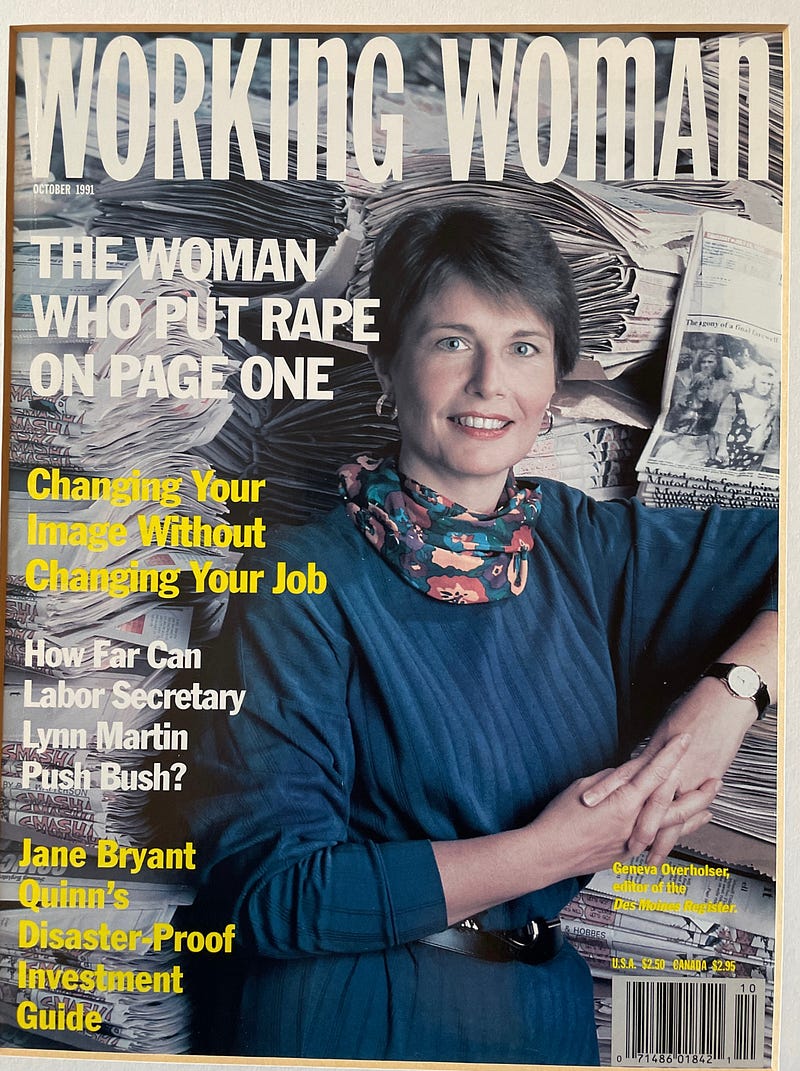
Last night, I began thinking about the remarkable number of men who gave me a leg up in my newspaper career.
Some of them probably didn’t even mean to. Take Ken Johnson, a college boyfriend, who had to listen to my senior-year muddle about what to do with my life. My family were all academics. Grad school seemed inevitable. Nothing drew me. One night, Ken had finally had it. “What would you really like to do?” he said. No one asked this of a young woman in 1970. I answered in an instant: “I’d like to be a newspaper reporter.”
Next came the fellow at the Boston Globe — a mid-level editor whose name I wish I could recall. It amazes me that he granted me a meeting at all. But it’s his response when I flourished my high-school newspapers that puts him on my list: “Listen here, girlie, you’d better go carry coffee to the editor of a New England weekly for a couple of years — or go to a damned fine journalism school.” “What are the damned fine journalism schools?” I asked. His patience hadn’t entirely run out: “Missouri, Northwestern and Columbia.” I went back to the dorm room and applied.
By June, I was riding the El from Evanston down to Chicago’s City Hall to report on Mayor Daley — the original Mayor Daley. I was reading “The Death and Life of Great American Cities” and dreaming of maybe, someday, getting a shot at government reporting. A couple of months in, Dick Schwarzlose, the professorial stand-in for gruff-but-tender-hearted city editor, growled this encouragement: “Overholser, if you can just lose those five-dollar Wellesley words, you’re going to be good at this.”
Fifty job-inquiry letters later, I had one offer — as “woman’s editor” at the Prescott (AZ) Daily Courier. On the very eve of graduation, I got a call from Bill Woestendiek, editor and publisher of the Colorado Springs SUN. This legendary, cat-of-nine-lives newspaperman was now editor and publisher of a feisty little paper battling the giant Gazette-Telegraph (so libertarian that it opposed even public schools).
My first day as a general-assignment reporter, I went to the police department to look over the crime reports. The cop on duty had never seen a woman reporter. He couldn’t show me the pink slips, he said, “because there’s rapes in there.” Back at the office, W. West McLean (the real gruff-but-tender-hearted city editor) was incredulous. “Sugar Babe,” he said, “you go right back to the copshop and read that guy the open-records law.” From G. A. to city hall to the state legislature, I learned a lot from West.
But Woestendiek was my first real mentor. He hired hungry young talent and demanded from each of us the fiery zeal that he poured into his own daily front-page column. He believed that we and our readers were partners in community building, there in the nation’s fastest-growing city. He told us that we were gonna be the best in the biz — indeed, that we were already well on our way. We would sit around over beers (or joints) in the evening, grousing about our paychecks (“does he think we can eat Pikes Peak?”). But most of us would say we spent some of our best years working for Woestendiek. And, when we left, his faith in journalism as public service was firmly imprinted.
A young woman who loves newspapering is likely to feel a terrible tension: Can you have this job and also have love? Maybe even a family? Back in the early Seventies, if you were 26, you thought you might lose your chance on the love front unless you jumped. My jump took me overseas for five years, so far and so long away from journalism that I thought I might never make it back.
Luckily, there’d be more mentors to come.
After my cub-reporting days in Colorado Springs, I spent five years overseas: two in Kinshasa, one traveling through Africa and Europe in a VW bus, two in Paris. There wouldn’t be as much mentoring during those years; there wouldn’t be nearly as much journalism.
I’d had visions of freelancing from Kinshasa. They vanished into the same thin air that sucked up phone calls, letters, telegrams or packages in Zaire in those days. I rarely knew if a story had reached its target. But one day, a piece on walking through Rwanda was returned. A short note was attached, from the New York Times travel desk: “Frankly, this is boring.” (I don’t know if I’d count this as mentoring, but I reread that yellowing copy recently, and they were right.)
I was hired as high-school librarian at the American School of Kinshasa, where my husband was teaching. I was grateful, but I longed to be back in the journalism world. Then, suddenly, the journalism world came to us. The Rumble in the Jungle brought not just Muhammad Ali and George Foreman, but George Plimpton and Hunter Thompson, John Vinocur and Horst Faas — and Norman Mailer. They all hung out at the Intercontinental bar. So did I. One evening, I asked Mailer to have a look at some pieces I’d written. The next evening, after much thumb-wrestling (and apparent disapproval that I was ignorant of his having stabbed his wife), Mailer delivered his verdict. “Your problem,” he said, “is that you’re too protean.” (He too was right.)
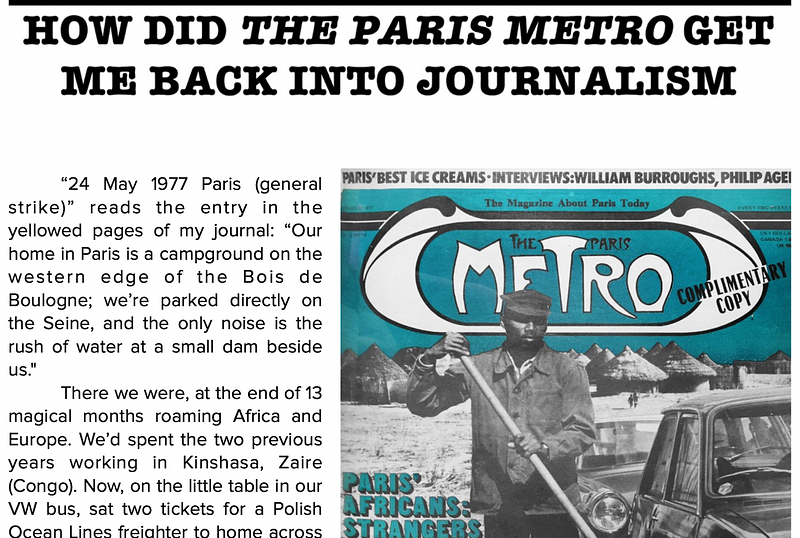
That’s about as much mentoring as I got in those days — until Paris, when we decided we’d stay there and start a family, as long as I could find an opportunity to work. I made the usual rounds, got the expected responses — “nothing right now.” Then one afternoon, at the Hotel des Postes, I heard a newsman phoning a story to the CBC in Toronto. He told me there was plenty of work in Paris. He said I should start by going to “The Paris Metro,” a lively alternative newspaper. I went, pitched a story idea to the wonderfully warm and welcoming co-editor Harry Stein, and set off reporting about Africans in Paris. The story made the cover. We stayed, I finally got that freelancing going. We had a baby. It was Paris.
It was wonderful.
Still. Five years is a long time to be away. We started applying for jobs back in the States. I would mention the years living and traveling in Africa. “Why did you leave a perfectly good newspaper job?” I’d include my clips from U.S. newspapers, the International Herald Tribune, my reporting on NPR with Susan Stamberg. “But you were freelancing.” (This reminds me: Susan belongs on my mentor list. When I called in my first report, on UNESCO’s proposal for a “new world information order,” I prepared a proper story. Of course. As soon as I began, she broke in: “Wait a minute. Are you reading this?” Well… uh… yes. “No, no, no,” she said. “Just pretend you’re calling a friend to tell them what happened.” If you lived in Paris in this era, you called a friend in the States only if somebody died. Still, it was exactly the right advice.)
Back on the job front, nothing was happening. A lot of it. But I landed a fellowship to spend a year in Congress — half on the House side, half on the Senate. Among the many fine staffers who mentored me there was Billy Shore, Gary Hart’s legislative director. Few of the fellows actually got to usher a bill through the process, but Shore made sure I did. It was a slight commemorative thing — but no less a delight to be part of the White House signing.
On the House side, I was in Elizabeth Holtzman’s office. She was brilliant — and seemingly determined never to be caught smiling. There appeared to be only two models for Congresswomen — hers and that of Pat Schroeder, who was given to giggling and complimenting colleagues on their ties. (That of course is far from all she did). It must have been awfully hard on them.
At the end of the fellowship I satisfied myself that I was well equipped for a variety of government reporting jobs. I’d done city hall, the statehouse, some reporting abroad and now a year in Congress. I applied widely, in Washington, in Denver, and elsewhere. “What were you doing on a fellowship?” said one editor.
I’d been seven years out of a newsroom. It’s a traditional business, newspapering. The patchwork of experiences I’d assembled impressed no one — with one exception: Gil Cranberg, the editor of the editorial page of The Des Moines Register. Ever since I’d pitched him a freelance piece from Paris (he didn’t buy it), he’d stayed in touch with me.
It was time to listen to Cranberg.
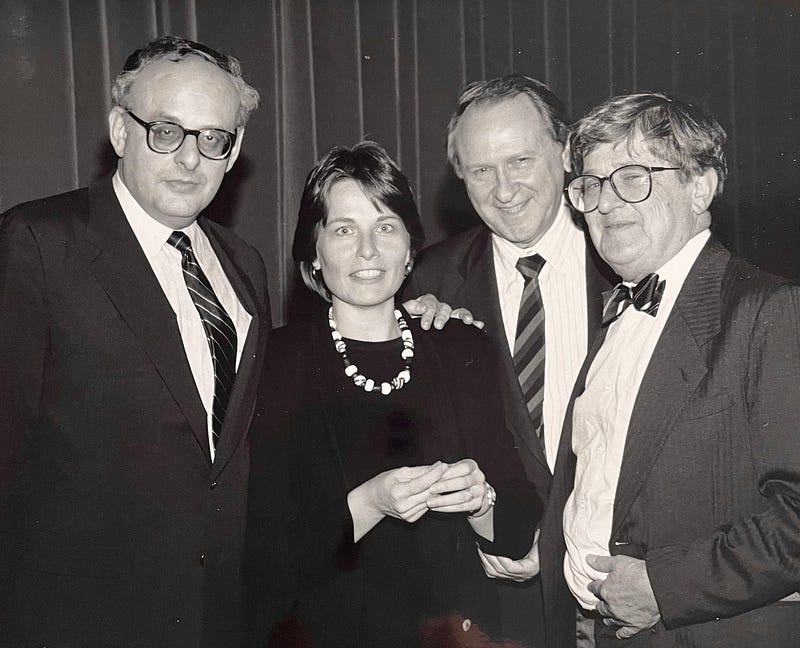
Paris to Washington to Des Moines: Not your standard route to success, yet surely the best move I ever made. But what led Gil Cranberg, editor of the editorial pages of The Des Moines Register, to open the door to the rest of my career?
Most of us are (lamentably) prone to hire people who remind us of ourselves. I hadn’t been having any luck with that. But maybe, with Gil, I did. He’d grown up in New York City, graduated from the Bronx High School of Science. He’d fought in the Pacific in World War II, he’d studied in Norway and in Hungary. Perhaps he saw in me a fellow outsider. Maybe he thought I might soar there, as he had, in his 33 defining years with the Des Moines Register and Tribune.
I was thrilled from day one. The Register was a newspaper that knew — even dared to love — the people it served. Landing on doorsteps daily in all 99 counties, the Register made a community out of a state. Bob Ray told me that he felt lucky, compared to his fellow governors, because he “knew what Iowans knew.”
But, if this sense of partnership reminded me of my Colorado Springs SUN days, this was a different ball game. The Register played in the big leagues — as in making Time’s list of America’s top ten newspapers. Or having won more Pulitzers for national reporting than any paper but The New York Times. The Cowles family invested in their newspaper. The people I came to know were among the most interesting — and surely among the most capable — I ever met. Practicing journalism in a state as bipartisan, as civically engaged, as Iowa was extraordinarily rewarding. (That this virtuous circle of good journalism and good citizenship was later broken is, I feel absolutely sure, a primary reason Iowa is a very different state today.)
Part of the explanation for the paper’s excellence was Cranberg, whose passion for justice and fairness knew no bounds (indeed, this is problematically accurate; he was also a leader in the local ACLU). The page he led had none of the pompous gravity common to editorials. His voice was clear and strong. His ideas of what was possible — what we should help Iowans believe was possible — seemed somehow both idealistic and, because he presented them so thoughtfully, achievable.
And then there was Michael Gartner, the Register’s editor. A quicker mind I’ve never known. Nor a more absolutist defender of the first amendment. Nor a more exacting guardian of the language. But there was also the twinkle in Gartner’s eye. The warm engagement that had him roaming the newsroom floor. And the dedication to nourishing talent that led some of us to discover, years later, that we’d each had this (did we think maybe singular?) experience: Gartner had taken us aside and told us, essentially, that we could do anything.
Nothing will get you dreaming like your editor telling you that you can do anything.
The next dream for our family was a Nieman fellowship. We had a new baby. A year at Harvard offered both incomparable cultural and intellectual riches — and the flexibility to spend more time with her. We expected to return to Des Moines, and to the Register, at the end of the fellowship. That was not to happen. The Cowles family sold the Register to Gannett during our Cambridge year. And I took a job at The New York Times.
I don’t know anyone who loved her first year at the Times. You might love that you are at the Times, but, in the moment, it’s a challenge. On the editorial board, I was one of the few women, one of the youngest members, the only mother of young children. Writing in the Times editorial voice was hard for me. And then this: I was from Iowa.
After a few months, the rhythm kicked in. Our family were loving New York. I thought I was at the Times for life. So many had helped in this transition. Les Gelb — whom I had met at an event in Des Moines before the Nieman and who (I’m pretty sure) was the reason Max Frankel hired me — continuously dropped by my office to buoy me with his wry smile. Jack Rosenthal, who succeeded Max as editorial page editor, stood with me in the toughest moments. I was writing about U.S.-Soviet relations (after devoting much of my Nieman year to the topic). One day I pulled from the wire a speech that Mikhail Gorbachev had given. It struck me as so extraordinary that I dared to present it at that morning’s editorial conference as a ground-breaking speech. I could virtually hear my colleagues’ (understandable) reaction: “She thinks you take a Soviet leader’s speeches seriously?”
Rosenthal later told an interviewer that “she probably understood before anybody here just how dramatic a difference Gorbachev was going to make.” He said it was in large part because of my “entreaties and urgings” that the Times was among the first papers to recognize that difference. I would never have made those entreaties unless I’d felt Jack’s steady (if puzzled) support.
Finally, there was the publisher. Punch Sulzberger was the quintessential gentleman. Here’s my favorite evidence: I was, from time to time, invited to one of the publisher’s luncheons. The guest might be a dignitary such as Soviet foreign minister, Eduard Schevardnadze, or one of our own correspondents, reporting in. I was typically the only woman. After lunch, a waiter would circle the table with an elegant humidor, opening its lid to everyone except me. A few lunches in, Punch seemed to notice this. “Please offer a cigar to Ms. Overholser,” he told the waiter.
I took it.
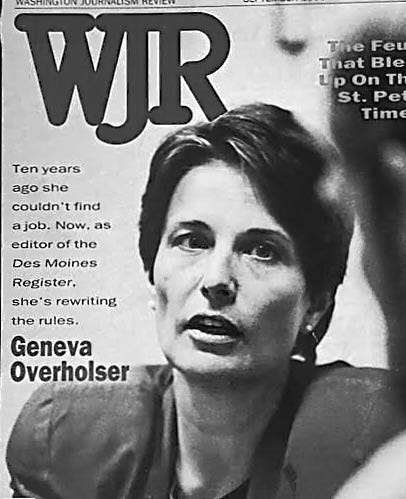
I remember staring out my window toward the Chrysler building, stunned. Charlie Edwards, the publisher of The Des Moines Register, was on the phone: Would I consider coming back to the Register — as editor? I couldn’t imagine leaving the Times. I couldn’t imagine uprooting my family. And I certainly couldn’t imagine becoming editor.
No, no, I told Charlie, no, thank you so much, what an opportunity, but no, I couldn’t possibly. He asked me to think about it, said he’d call me back. Unsettled, I called Howie Simons, the curator of the Nieman Foundation. Howie was like a rabbi to all of us Niemans. He was wise, funny, and deeply caring. Howie would affirm my decision, and I could put this behind me.
“Overholser,” said Howie, “if you have the opportunity to become editor of The Des Moines Register, and you turn it down, you’re not nearly as smart as I thought you were.”
Talk about mentors: Charlie gave me the opportunity of a lifetime. Howie knocked the sense into me to take it.
Not that all went smoothly. Charlie, scion of the Cowles family that had owned the Register, had (unusually enough) been named publisher by Gannett. And now Charlie was himself making an unusual choice. I had little management experience; my recent work had been on editorial pages rather than on the news side. My first charge, after telling Charlie yes, was to meet Brian Donnelly, head of Gannett’s metro papers, at their gleaming New York offices. Donnelly shook my hand, then said, “On paper, you’d never even have made the short list, but Charlie is a pretty good judge of horseflesh.”
The people whose opinions I was fretting about were back in Des Moines. What would all those veterans think of Charlie’s selecting a 40-year-old woman with an unconventional career? After Charlie’s announcement, I made the newsroom rounds — approaching with particular apprehension the sports desk, where reporters with names like Buck Turnbull awaited me. I sat down. Tom Witosky threw a baseball at me. “Keep it,” he said. “You’ve earned it.”
I had been worrying about the wrong things. What the staff had feared was Gannett’s forcing on Charlie someone who knew nothing of this state we loved or the newspaper we revered. But here I was, returning to the Register — and from The New York Times. Another thing I hadn’t known (a thing way too few women get to know) is how being given a title brings you so much more than the title. It aligns people’s hopes with yours. In a newsroom, at least, as long as you seem to be keeping the staff in mind, they’re rooting for you. They want you to lead. It was Buck, and others on the sports desk, who insisted on calling me “chief.” Please, I said, call me Geneva.
They called me chief.
Charlie’s leap-of-faith belief in me not only opened this door. He was as good as his word in supporting me and the newspaper through the next seven years. Even when I spoke out about profit pressures, to Gannett’s displeasure. Even when the newspaper’s coverage enraged advertisers — or, indeed, friends of his. Charlie hewed to the Cowles family publishing standards, enabling the Register to keep on doing fine work through those challenging years of change.
Another leader was in huge part responsible for that fine work. David Westphal, who became managing editor, was everything I wasn’t: An Iowa native (Iowans were still calling me “new to Iowa” when I’d been there 12 years). A veteran of positions throughout our newsroom and Washington bureau. He was a strong editor, a careful manager, and as good with numbers as I was not. Though he’d likely have become editor had I stuck with my original “no,” David was never anything but completely supportive. (Indeed, he was so entirely wonderful that I married him eight years later. But that’s another story.)
Given the prominence of the Register, and the paucity of women editors, opportunities for national service in journalism soon came my way. Too soon, I felt. When Burl Osborne asked me to chair the Freedom of Information Committee at the American Society of Newspaper Editors, I demurred. I hadn’t earned it yet, I said. Osborne scoffed: This is how it works. It happened exactly like this for me, and to everyone I know before me. Just take the job.
And so it did happen, with many a fine mentor/supporter extending a hand (or an opportunity) to me, from Gene Patterson to Gene Roberts, from Bill Kovach to Arthur Sulzberger, Jr., Tom Winship and many another. I came to understand that this was not only good for me and for the Register. It was good for journalism — and for the too many who’d been excluded from it. As Kovach told one reporter writing about my editorship, “We’re in a period where the whole concept of news is in the process of redefinition for a lot of reasons, not the least of which is that we’re moving into and through the system people who have not had access to the levers of journalistic power in the past, including women and minorities. They see the world differently, interpret the news in different ways.”
That I could bring to those levers of power Bill Woestendiek’s sense of partnership with community, Gil Cranberg’s zeal for equity and justice, Michael Gartner’s First Amendment passion and personal engagement, seasoned with my own years abroad and in Washington, my understanding of how it felt to be powerless, my personal experience as a mother and as a feminist — well, I could never have imagined this happening. The power to make change. To help others do their best work. To give different people a chance. To serve the public. To nourish democracy.
Maybe even the power to bring a little more light into other women’s lives. One reader from Cedar Rapids told me, “We’re all out here rooting for you. I think it’s the way men used to feel about Mickey Mantle.”
Later in my work life, I had at last the pleasure of women mentors. Katharine Graham (forget mentor, she was my hero) welcomed me to the Washington Post in a private lunch at which she told me how much she wished she could have bought the Register (me, too). Meg Greenfield, with whom I’d served on the Pulitzer Board, encouraged me to write a column after my Post ombudsman days, and she put it on her editorial page. The whip-smart Kathleen Hall Jamison, who gave me the opportunity to co-edit a book with her. More recently still, I ‘ve delighted in working with exceptional women leaders whose boards I’ve served on — Sarah Bartlett at CUNY Newmark and Elizabeth Christopherson at the Rita Allen Foundation stand out.
Finally, heading my women mentors’ list is my sister, Nannerl Overholser Keohane. Our mother died much too young. But with Nan out there ahead of me, how could I doubt that a preacher’s daughter with a strange name, educated in little southern public schools, might go places?