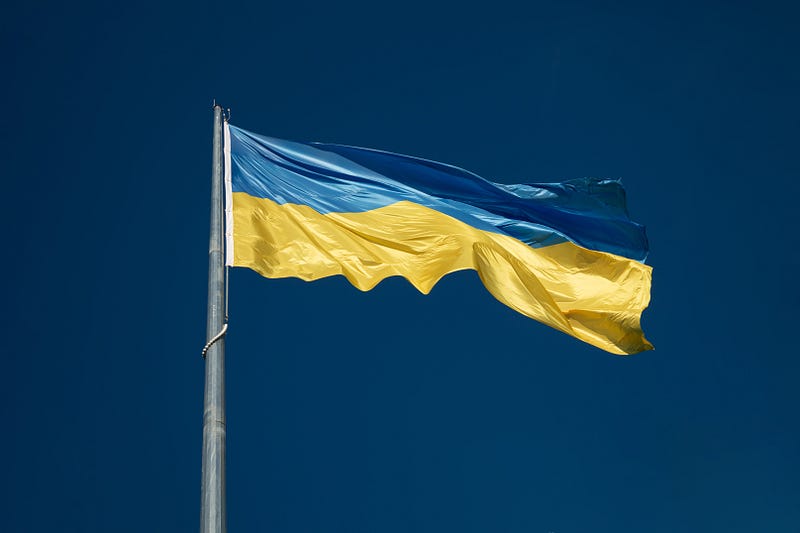
Remembering My Grandmother from Ukraine
Today we are all Ukrainians
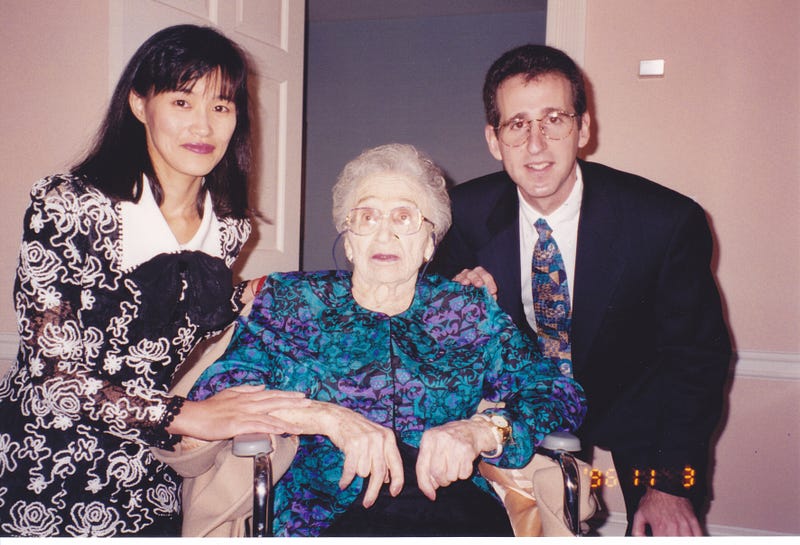
I wanted to title this article, “Remembering My Ukrainian Grandmother.” But that would have been whitewashing a complicated history.
My grandmother was born in Rozhyshche, in what is now western Ukraine. It’s a small town about 15 miles north of Lutsk and about 50 miles from the Polish border.
When she was born in 1907, she was in Russia. When she emigrated to the U.S. in 1921, the town was in Poland. Now it’s part of Ukraine.
As kids, when we asked her where she was from, she’d say Poland. Her US naturalization papers listed her nationality as Polish. But she wasn’t Polish. She wasn’t Ukrainian. She was Jewish.
Rozhyshche was a shtetl, a small town of Jews in the “Pale of Settlement”, the strip of land in the northern part of Eastern Europe where Jews were allowed to live.
The town was part of Poland from 1432 until it was annexed by the Russian Empire in 1795. The region was mostly ethnic Ukrainian, the remainder a mixture of Jews and Poles. The Russian government maintained an official policy of anti-Semitism and organized murderous programs against the Jews every few years.
During WWI, the town was taken over by Austria-Hungary, then retaken by Poland. When Hitler and Stalin split Poland between them, it became part of the Soviet Union.
Soviet troops arrived and massacred Poles, Ukrainians, and Jews. Then the Nazis arrived and killed all the remaining Jews, including all of my grandmother’s family.
My grandmother was 1 of 9 children. One sister moved to Palestine, one brother to Canada. She moved to America. Her other 6 brothers and sisters along with her parents were murdered by the Nazis simply because they were Jewish.
Sura Naczycz (Naiditch) arrived in New York on July 1, 1921 aboard the SS Polonia after departing from the port of Danzig (Gdansk) in Poland. She became Sarah Palter when she married Charles Palter from Odessa, now also in Ukraine, and Sarah Goldman when her husband died and she married the man I always knew as my grandfather.
She left her family behind and traveled to America with her younger cousin as a 14 year old. In those days before FaceTime, before even international telephone calls and air travel, it’s hard to fathom what she went through. She spoke no English and had no special skills. She moved to Boston with her cousin after knowing nothing but life in a poor, rural shtetle and later moved to Baltimore. On May 18, 1942, she became a U.S. citizen.
My life has been safe, peaceful, and prosperous because of the courage of a 14 year old to leave her life behind, and the greatness of the United States in accepting immigrants throughout history, even if reluctantly at times.
Today while pondering my grandmother and Ukraine and my own life, I walked with my wife through the Los Angeles Arboretum. Around me I heard so many different languages — Chinese, Korean, Japanese, Spanish, Farsi, Russian, Hindi, and Hebrew, plus others I couldn’t recognize.
There were probably more people speaking foreign languages than English. Yet, we were all Americans, enjoying the beautiful spring day together.
That brought me back to Putin and Russia and Ukraine. Like most countries, modern Ukraine is a complicated place, a mixture of ethnic Russian and Ukrainians, with a handful of other ethnicities, including Jews.
I’m sure Putin was thinking that if his Russian soldiers arrived, the ethnic Russians in the country would of course rise up to follow their brethren. And the ethnic Ukrainians would be glad to overthrow Volodymyr Zelenskyy, their Jewish president, and replace him with a Slavic cousin.
But it appears Putin miscalculated, assuming ethnicity and tribal affiliation would trump democracy and nationality. It’s the playbook the Russian State has pushed all over the world, including the U.S., to set countrymen at each other’s throats. Of course, it would work in next-door Ukraine, a former Soviet Republic with a centuries-long history of multi-ethnic strife. I am gratified it appears Putin was wrong.
Though I fear for the safety of everyone in Ukraine, I applaud the courage of the Ukrainian people of all ethnicities to come together and say, “We are all Ukrainians and we stand together.”
I never thought of myself as Ukrainian before, but today I say the same. Today I’m proud to call myself Ukrainian. Today we are all Ukrainians.