
Remember Mariupol
Like the Alamo, heroism has consequences that endure
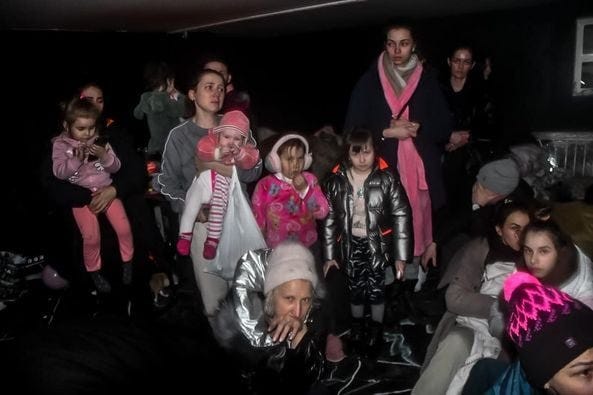
Russia has moved the focus of its attack from the north, a direct assault on the capital of Ukraine, to the east, an area known as Donbas — Ukraine’s old industrial heart, long the target of an eight-year war between Russian-backed separatists and the best-trained forces of the Ukrainian army. This has triggered a humanitarian crisis. It includes two large Russian-speaking areas in Luhansk and Donetsk, which run along the Sea of Azov from south of Mariupol all the way to the northern border with Russia. One thing that stands in Putin’s way of a declared victory on May 9th, Victory Day, when the Russian military marks the public celebration of the defeat of Nazi Germany in 1945, is the Ukrainian city of Mariupol.
Thus, the conquest of the port of Mariupol is a central task of the offensive in the east.
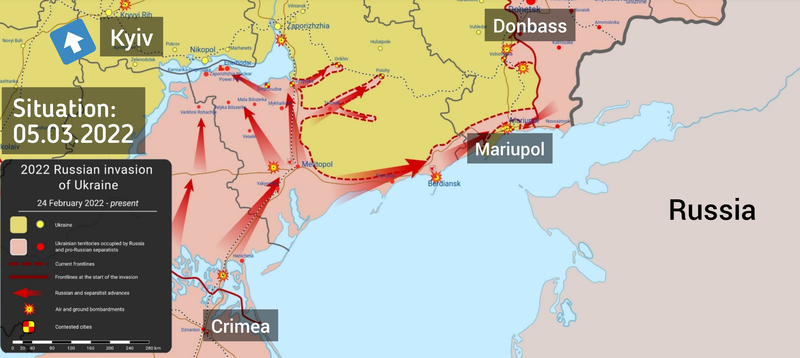
Mariupol is not the only strategic target. Slovyansk, a city of 125,000 people seized by Russian-backed forces in 2014 before being recaptured, is now held by Ukrainians. The Institute for the Study of War (ISW), based in the US, believes that so long as Ukraine holds on to Slovyansk and its strategic access to the railroads, Russia’s campaign to hold both Donetsk and Luhansk “will likely fail”. But Mariupol is a key seaport. It is critical both for logistics and for its symbolic value.
Symbolism and massacre
Americans (especially Texans) may recall the story of the Alamo. In itself, the mission was insignificant. But it was placed near the site of the surrender of Mexican General and President Santa Anna’s brother-in-law (at what is now the city of San Antonio), and Santa Anna had declared all the rebels to be pirates — meaning they were to be executed. The Texas garrison, in an “irregular fortification not worthy of the name,” had roughly 200 men to mount a defense. Santa Anna began with over 2000. The garrison fell, of course, but it bought precious time for the Texans to organize a government and raise an army. And the massacre of the defenders of the Alamo moved men to support both. The next month, the Battle of San Jacinto was over in eighteen minutes, with the Mexican army taken by surprise, overrun, and many of its troops slaughtered.
Like the Alamo, every soldier or weapon dedicated to the conquest and massacre of Ukrainian forces in Mariupol is a soldier or weapon not available for battle elsewhere. Every day Mariupol stands, the Ukrainian army can ready itself elsewhere.
The siege of Mariupol
Since February Mariupol has been under siege and severely damaged. In March it was declared a Hero City of Ukraine. On the 11th of April Ukrainian president Zelenskyy stated that the city had been “completely destroyed” and the Russians had “burned it to ashes”. On April 21st, Vladimir Putin claimed that Mariupol was under Russian control while admitting there were forces (and civilians) still holding out in Azovstal Iron and Steel plant.
This is Ukraine’s Alamo.
In a choreographed performance Russian Defense Minister Sergei Shoigu told Mr. Putin that the flattened city was now under Russian control. Of a seaside town of about half a million people, few buildings remain standing. Anyone who could flee has.
Ukraine’s Alamo
The zone of Ukrainian control has narrowed to bunkers under the steel plant. Staff Sgt. Leonid Kuznetsov of the Ukrainian National Guard is one of the defenders. He remains in contact with the outside world through Telegram and a Skylink satellite dish.
I’m alive and healthy for now, but the situation is very difficult. We’re at the end of our food and water. We have about 1,000 civilians at the factory. I can’t say how many soldiers we have. There are many, many wounded and not enough medicine. The smallest injury can be fatal; there are not even simple bandages. — Staff Sgt. Leonid Kutznov
Over 500 people are injured; the dead are uncounted. Many of the dead are buried by cave-ins caused by the Russian shelling. The defenders have pistols and machine guns. The attack takes the form of tanks, artillery, and bombing. The defenders are in a small, cement-reinforced bunker under two meters of earth. Vladimir Putin has ordered a blockade so tight “no fly could escape”. As of twenty minutes ago, hours after Putin officially called off the assault, the defenders continue to be shelled and Russian soldiers are within twenty meters of the bunker. Sergeant Kuznetsov estimates their ammunition will run out within twelve hours.
Remember Mariupol.


.png)