
Relative Space
It takes size to know size
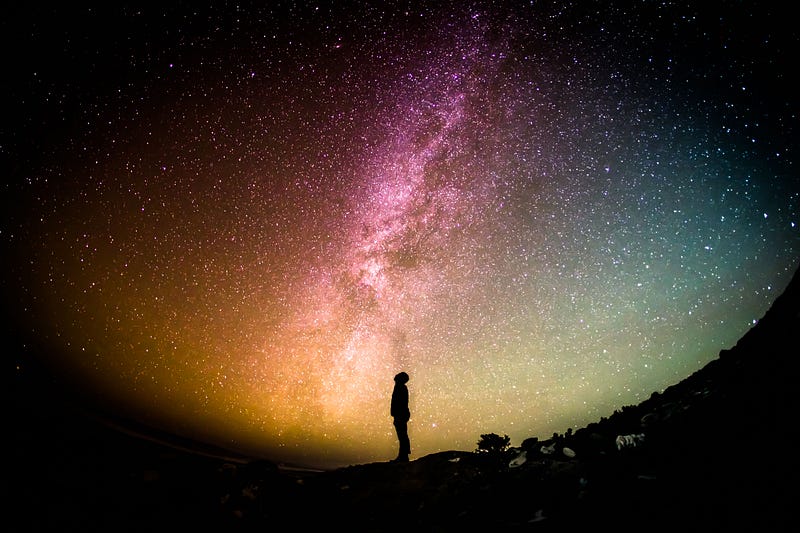
Both the ginormousness and the minisculeness of space are mysteriously fascinating and utterly relative.
The space encircled by an electron is impossibly small to a human, but just the right size — actually a little large — for the proton, while utterly ginormous for the tiny folks who’ve colonized it; while the cosmos, as we think of it, looms impossibly huge to a human, but is just the right size for a universe-sized being, say a large god or some such.
If and when we ponder space, we normally think about the universe, and what we are told about its size (which we have to take on faith since very few if any of us have experienced its size first hand) is frightening — so frightening that we rarely, if ever, try to fully grasp and face it.
For if you look up into the night sky — at some remove from the city or other serious light polluter — you will see a universe that, for all practical purposes, is infinite: Trillions of galaxies and trillions of stars in each galaxy. I’m not even sure that we are equipped to grasp the magnitude of this.
Really, can you envision a trillion, twelve trillion?
A trillion trillion?
And when we thought we had heard the last about the unbelievable size of our universe, enter the Hubble Deep Fields project — focusing the space telescope on a stamp-sized jet-black piece of the night sky for a hundred or so hours — to find, in this tiny light-less spot among the stars, another three thousand galaxies. Let me say this again (with feeling this time): another three thousand galaxies. Multiply these three thousand with the number of stamp-sized patches of night sky up there, and they add up to quite a few, and that would be the extrapolated number of newly discovered galaxies.
Way to go Hubble.
And then, quite recently, a new radio survey goes ahead and finds 300,000 additional galaxies out there — keep in mind, the word is galaxies, each with a trillion or so stars, i.e., suns. Well, a pittance really, cosmically speaking, but there seems to be no end to them.
Yes, it does seem that whenever we think we’ve seen as far as can be seen, our technology improves and we see farther and farther, with no end in sight (pun intended).
But then I must ask, donning a sort of devil’s advocate hat: what about the galaxies whose light has yet to reach us — and might not for billions of years — surely, there must be trillions of them as well, in every little part of the sky. And how many beyond those? For is there any way of estimating how much light has yet to arrive, since none of it has, as yet?
I don’t know what number might be close enough to infinity to actually rub shoulders with it, but I think that would be the number of stars in our universe. Still, I don’t believe this number is infinite because there is no such thing as an infinite number — i.e., nothing material can be infinite.
Another way to put this: I believe the number of stars is finite, because something created (and with a beginning, like our universe) can neither be eternal nor infinite, of that I’m sure, but it can be near enough eternal and infinite to suggest otherwise.
Then, turning around, if you take a close look inside your own body, you will discover that the number of cells and microbes and bacteria basketed by your skin also borders the infinite: trillions and trillions of the little things.
Then, with an even better (yet-to-be-invented) microscope, take a look at the molecular: How small is a water molecule, really? Well, I read in a book by Schrödinger that if you fill a glass with water and then, by some magical means, mark each one of these molecules — say, paint them orange — and then pour this glass of orange water molecules back into the ocean, and then, by some other magical means, mix the oceans so well that your glass of water is equally dispersed throughout the seven seas, all the way down to the 10,000 meters depths; if you did this and now used your original (now empty) glass and filled it with ocean water from anywhere in the world, at any depth, you would scoop up at least a few hundred of your original (orange) water molecules.
To me, this is beyond comprehension. We are talking so small as to be virtually immeasurable. Schrödinger goes on to discuss why they are so small — or why we are so large, rather — but that’s another story.
But here is the rub: Infinitely large and infinitely small is simply a matter of scale. The Universe is infinitely huge just because we only stand a fathom or so tall. Were we, say, the size of a solar system, the Universe would seem a little (though not much) less imposing. Were we, say, the size of the Milky Way, perhaps then we could get a handle on things, size- and universe-wise. And if, well let’s just go all the way and assume the size of the Universe and behold: it’s not big at all, just our size, actually: nice fit.
The same, of course, applies in the other direction. Were we to assume the size of a bacterium, then our body would seem galaxy-sized while all other bacteria and all those cells would seem quite normal to us, size-wise. Were we to assume the size of an electron, well, then the cell would be the size of the universe — or at least the size of a galaxy — while all these other electrons would be of normal, just-right, size.
As an aside: For some odd reason, it seems that the six or so feet here-and-now size we’ve adopted is almost perfectly (if somewhat precariously) balanced in-between (looking up and out) the infinitely large and (looking down and in) the infinitely small. To confound and intimidate? Who knows?
Mysteriously fascinating, that.
I think that we should adopt a more flexible attitude toward size and teach ourselves to assume whatever size would best suit the occasion: universe-sized to survey the outer (and still expanding, they say) rims (skin, now); electron-sized to take a closer look at the atoms and the small, small houses that their populations and their children live in.
I do not think — no, not really — that we are of permanently fixed size (yes, I am talking spiritually, now). I think we are the size we consider ourselves to be. We just have to gain some skill at changing our considerations.
And then, perhaps, dream ourselves a different (smaller? larger?) story.
© Wolfstuff


