
Regional war in the Middle East inches closer
With the deaths of three US servicemen in the Middle East, war in Gaza threatens to engulf the region.
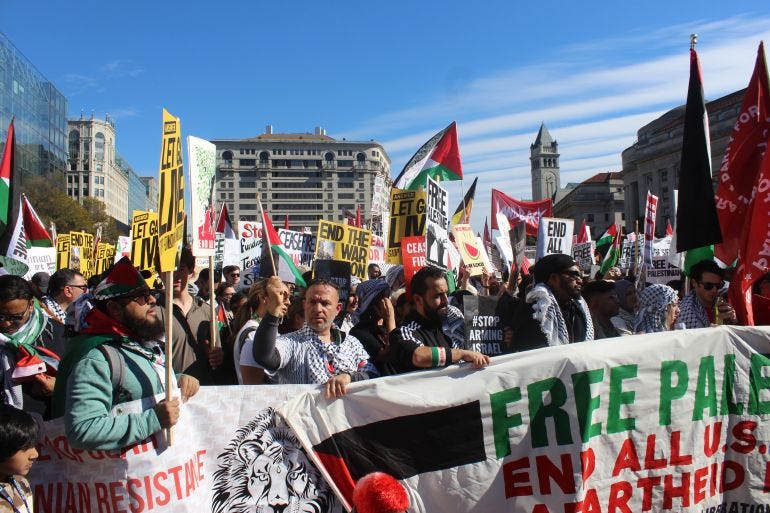
Edit: An earlier version attributed the attacks to Kataib Hezbollah, a far-right, Iran-backed militia in Iraq. The attacks were rather claimed by the “Islamic Resistance in Iraq”, a deliberately vague self-description to describe a network of Iran-backed militias.
On Sunday, 28 January, US CENTCOM announced the deaths of three American servicemen in the Middle East in attacks organized by the “Islamic Resistance in Iraq”. At first, the deaths were thought to have occurred in northeastern Jordan though later reports state they occurred in Syria.
Regardless of the location of the deaths, and the some two dozen or more injured, this is a massive escalation in the Middle East. This marks the first time since the start of the latest and most destructive iteration of the Israel-Hamas conflict—described as “plausibly” genocidal by the ICJ—that American servicemen have been killed.
Two US Navy Seals had already gone missing off the coast of Somalia and were later declared dead, but that incident did not occur in the context of drone attacks and missile strikes. The spillover is widening.
The latest, tragic news comes at a time when many voices have repeatedly warned of the likelihood of escalation, and the limits of deterrence. The decades-long, unresolved Palestinian question carries an enormous amount of emotional weight across the Arab and Muslim worlds and even the Global South, which sees Palestinian suffering as a continuance of Western colonialism. For this reason, given the massive death and destruction in Gaza, it was not going to fade into obscurity this time.
All recent events have pointed towards increasing escalation, despite the Biden Administration’s refusal to view it this way or accept this reality. Hezbollah and Israel are engaged in medium-intensity fighting, American bases have come under attack some 150 times, and Yemen’s Houthis have threatened international shipping—the lifeblood of the global capitalist economy.
No party has stood down in the face of threats, even when matched by American firepower. Hamas, Hezbollah, and the Houthis—the HHH entente—have proven resilient and, in the last case, thrived. Having witnessed American defeat in Afghanistan and its institutional instability, and having defeated the Saudis, the Houthis no doubt realize they hold most of the cards.
President Biden has assured that there will be a response to the latest attacks, claimed by Islamic Resistance in Iraq, a deliberately vague wording to designate a network of Iran-backed, far-right Shiite militias groups in Iraq. This will no doubt be a military response. The question is this: how far will the United States go in punishing this “Islamic Resistance” and, more importantly, Iran? Will Joe Biden order strikes on Iranian assets throughout the Middle East, or even in Iran itself?
I shudder to consider the consequences of strikes on Iranian targets, especially inside Iran. This is an outcome that Israel has long been seeking, and recently in light of its poor performance in the Gaza Strip. Israel and Iran both are ruled by megalomaniacs with messiah (or mahdi) complexes. In other words, there are limits to rationality. Indeed, if you hold the worldviews common to Israeli leaders and Iranian leaders, believing you are on the just side in an existential battle, then pursuing wider conflict could be considered rational. It must certainly feel thrilling.
In addition to this, President Biden himself is reportedly dismissing advice from his advisors, making autonomous judgments in his approach to Israeli behavior in Gaza. This is another downside of gerontocracy—old dogs cannot learn new tricks. They are set in their ways, even when the needs of the world demand change and alternative outlooks.
President Biden clings to the worldview that Israel must be protected at all costs, even if it means making Israel less safe; even if support for Israel means aiding and abetting a genocide; even if it means that support for Israel means lunging the United States headlong into yet another Middle Eastern conflict; even if it means potentially losing the election. Why?
I believe it comes down to the power of the Israel lobby in the United States, in addition to Biden’s belief that this is what older Americans want. There is some truth to that. I also believe that Biden may genuinely believe this is right—after all, he was lukewarm at best on racial equality during his early days in the Senate (e.g. desegregation). It is not a big jump to conclude that he may not see Palestinians as fully human—his behavior indicates that. Nevertheless, Biden’s actions will also fuel antisemitic conspiracy theories around the world, and in American society itself, and their populist friends.
More pressing is what Biden’s refusal to even consider a ceasefire means for myriad other issues, not the least countless lives at home and abroad. Military conflict is carbon-intensive, and the world is on the verge of breaking the 1.5-degree threshold. Military conflict is financially taxing, and the United States is still reeling from the debt of two major wars in Afghanistan and Iraq. Military conflict is globally destabilizing and, as the Pax Americana unravels, we could expect more conflict and economic disruption.
That is an incomplete list, and all of those considered consequences interact with one another. Suffice to admit to ourselves, war with Iran will make Iraq look like a walk in the park, and Afghanistan too—where we lost.
It is clear to me that Israel desires such a conflagration to carry out a definitive expulsion of Gazans into Egypt, likely initiating war with Egypt, as well as annexation of the West Bank. President Biden would be “forced” to side with Israel due to “common interests”—fighting Islamists and Iranian-backed militias who are only opposed to us due to our support for Israel. Ethnic cleansing and genocide would get a pass.
The state of the world is grave. Increasingly, we look as if we are purposely setting the stage for Armageddon. Whatever truth there is to that prophecy is self-fulfilling and, as such, if we survive it then it will join the long list of literary tropes where human behavior brings about what otherwise would not have occurred.
In these times, it may appear as if everything is written, as if we are being drawn or sucked toward the black hole that is our fate. This could not be further from the truth. Every action we take matters; we can oppose the steps taken that march all of humanity toward ruin. The most important thing is that we do not squander the off-ramps presented to us. The clearest off-ramp is still a ceasefire. It is also the most moral. We should steer towards it. We should mobilize for it.