
Regenerative Business? Shifting from Extractive Economies to Sustainable Growth
Redefining Value in a World Hungry for Environmental Renewal and Ethical Profit
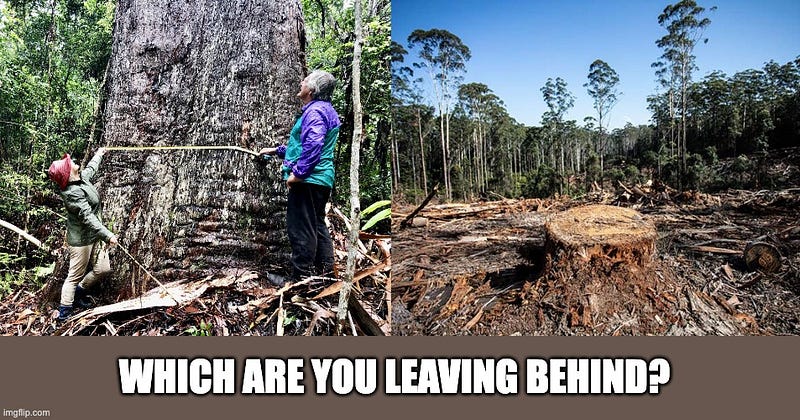
Throughout history, the prevailing Western economic model has aggressively championed a culture obsessed with resource exploitation. Under this regime, the very essence of our planet — nature, indigenous populations, women, children, our waters, forests, soils, minerals, and the animal kingdom — have been ruthlessly commodified, their intrinsic value overridden by the blind pursuit of profit. This paradigm has stripped them of their inherent rights, autonomy, and agency. It’s a travesty — and tragedy — of incalculable proportions.
A consequence of this perspective is evident in our deteriorating environment. The economy has perennially hinged on loans and interest, compelling successive generations to owe more and hence, exploit more of the world’s resources. The inexorable demands of inflation exacerbate this.
But there’s a catch-22; as we deplete the world’s natural balancers, we find ourselves on the precipice of environmental collapse.
Venture capitalists, and investment funds, created from and dominated by this paradigm, often gauge projects based on potential monetary returns. Consequently, regenerative endeavors that could renew the world frequently appear as foolish non-profit acts rather than lucrative investments.
Yet, regeneration embodies the planet’s only sustainable and thus genuine source of value.
It’s time for a revolutionary approach, transcending mere economic monetary gains as defined by a degenerating culture. The goal should be to discern authentic value across time and place, understand humanity’s shared values, and sculpt a model that proliferates value for all.
We need an economy rooted in regeneration instead of extraction.
Climate disruption is undeniably linked to human activities, and estimates predict a worrying temperature increase of 2.2 to 3.8°C. While the climate crisis is critical, the devastation of nature stands as a silent but catastrophic threat. Shockingly, since 1970, over half of Earth’s life forms have vanished. This number swells to a staggering 80–90% loss since 1900.
Addressing carbon emissions is crucial, but not enough. We must detoxify the planet and rekindle life on land and in oceans. Let’s resonate with a fresh ethos: “Prioritize Life Over Profit!”
In the grand tapestry of human history, our current era will undoubtedly be defined by our response to the intertwining challenges of climate disruption and ecological degradation. The stark statistics underscore a sobering truth: we are not just custodians of our planet but also the architects of its fate.
Carbon management — and carbon credits — are but a single piece of this intricate puzzle. As we stand at this pivotal juncture, it becomes imperative to reimagine our economic and cultural paradigms.
A shift from mere profit-driven endeavors to regenerative and life-affirming ones is not just a noble pursuit; it’s an existential imperative. It’s a call to action — for businesses, communities, and individuals alike — to redefine wealth, value, and success. For in the end, our collective prosperity lies in championing life in all its myriad forms.


