avatarDarren Weir

Free AI web copilot to create summaries, insights and extended knowledge, download it at here

2871

Abstract

iny nation.</p><figure id="6f0c"><img src="https://cdn-images-1.readmedium.com/v2/resize:fit:800/1*bD8jnoLixEJOzu_tl1zLvA.jpeg"><figcaption>author’s photo of beheaded Buddhas</figcaption></figure><p id="9cd3">I spoke to Cambodians during my visit, about this period in their history. They appeared willing to talk about it, although I could see the light go out of their eyes as they remembered.</p><p id="77d1">My Tuk Tuk driver told me that he was in his early teens in the mid-70s so he remembers what it was like. He recounted the terror that everyone felt, not knowing if they or their loved ones would be killed next. He and his mother survived, but his father was murdered.</p><figure id="4a56"><img src="https://cdn-images-1.readmedium.com/v2/resize:fit:800/1*LyER_OtaxPlO33hCB_faMA.jpeg"><figcaption></figcaption></figure><p id="0e27">The main commemorative site is just outside Phnom Penh, and while I didn’t get a chance to visit that location, there is also a memorial site in Siem Reap that pays tribute to some of the victims of this tragedy. It is Wat Thmey, a former school that was turned into a prison and is now a monk’s school. When the Khmer Rouge was overthrown, by the Vietnamese in 1978, mass graves of some of the prisoners who died there, were found.</p><p id="2d5e">In the 1990s the site became a Buddhist temple with a stupa (a Buddhist structure that often contains relics and is often used for meditation) that was filled with the bones and skulls of some of those victims.</p><figure id="d6b0"><img src="https://cdn-images-1.readmedium.com/v2/resize:fit:800/1*YTcZRDFeILPZ0n7P0Koc_Q.jpeg"><figcaption>Author’s photo of the stupa at Wat Thmey</figcaption></figure><p id="b941">As you approach the stupa, you are drawn to the glass windows on all four sides and as you get closer you see they are filled with human skulls and bones. It is a very difficult thing to see, especially when you consider how these people died, and the families they left behind.</p><figure id="e188"><img src="https://cdn-images-1.readmedium.com/v2/resize:fit:800/1*hTnShluyjVEo9T0llyislQ.jpeg"><figcaption></figcaption></figure><figure id="8907"><img src="https://cdn-images-1.readmedium.com/v2/resize:fit:800/1*4hOCol4OeLqIRrIzFVztVg.jpeg"><figcaption></figcaption></figure><figure id="c190"><img src="https://cdn-images-1.readmedium.com/v2/resize:fit:800/1*o6G4lVzfulqeUDjzPgs8rA.jpeg"><figcaption>author’s photo — skulls and bones in the stupa</figcaption></figure><p id="ab87">There are also photos of some of the victims on bulletin boards and a letter saying, “Dear Tourists, the collection of bones that you see in the stupa were bones that have been collected from the nearby field. These were from the innocent people who died at the hands of the savage Pol Pot Regime in 1975–79.”</p><figure id="889c"><img src="https://cdn-images-1.readmedium.com/v2/re

Options

size:fit:800/1*mzYWykopA4LLPS2IE88Daw.jpeg"><figcaption></figcaption></figure><figure id="a2ef"><img src="https://cdn-images-1.readmedium.com/v2/resize:fit:800/1*xqQeoFiEpl15lZu3Fwbd5w.jpeg"><figcaption></figcaption></figure><p id="5890">This memorial represents only a tiny fraction of the millions who were killed and is a solemn place for reflection. At the site, you can also visit the Buddhist temple, light some incense, and say a prayer (if you are so inclined) for the victims you have just seen. It doesn’t take long to visit, but it is something that will stay with you forever.</p><figure id="f916"><img src="https://cdn-images-1.readmedium.com/v2/resize:fit:800/1*yTChEu5icgVKbTrumXETeQ.jpeg"><figcaption>author’s photo of the Buddhist Temple at Wat Thmey</figcaption></figure><p id="d9f6">There is also another way to honor some of the survivors. When visiting any of the tourist sites, from Angkor Wat to Pub Street, there are small groups of musicians who get together to play their traditional music. They are all victims of landmines. Some are missing limbs or are blind. They told me they don’t want to beg but are simply trying to make a living to send their children to school and are playing their music for their personal dignity. How can you refuse?</p><figure id="11bb"><img src="https://cdn-images-1.readmedium.com/v2/resize:fit:800/1*BUcx4nRiscXGyqxdgkuh4w.jpeg"><figcaption>author’s photo of landmine survivor’s street band</figcaption></figure><p id="a494">Another reminder of the horrors of the Pol Pot regime includes a warning. Do NOT stray from the paths set out, especially around the smaller temples. There are still landmines scattered around the sites, there are still accidents and people are still maimed and killed every year. The effort continues to try to clear the unexploded ordnance, but until that happens, it is still hazardous.</p><figure id="810c"><img src="https://cdn-images-1.readmedium.com/v2/resize:fit:800/1*hRI8ZMhEZvClHjgSdJHi6g.jpeg"><figcaption>author’s photo of Landmine survivor</figcaption></figure><p id="7c50">Whenever the world is forced to face up to the atrocities that humans are capable of, they often use the words, “never again” but as we continue to witness, the horrors never end.</p><p id="1709"><i>“First they came for the Communists And I did not speak out Because I was not a Communist</i></p><p id="674c"><i>Then they came for the Socialists And I did not speak out Because I was not a Socialist</i></p><p id="649a"><i>Then they came for the trade unionists And I did not speak out Because I was not a trade unionist</i></p><p id="1b93"><i>Then they came for the Jews And I did not speak out Because I was not a Jew</i></p><p id="389c"><i>Then they came for me And there was no one left To speak out for me”</i></p><p id="9ba2"><i>German Lutheran pastor Martin Niemoller</i></p></article></body>

Reflections of a Genocide

(Warning: Graphic images)

Remembering Cambodia’s Hellish Past
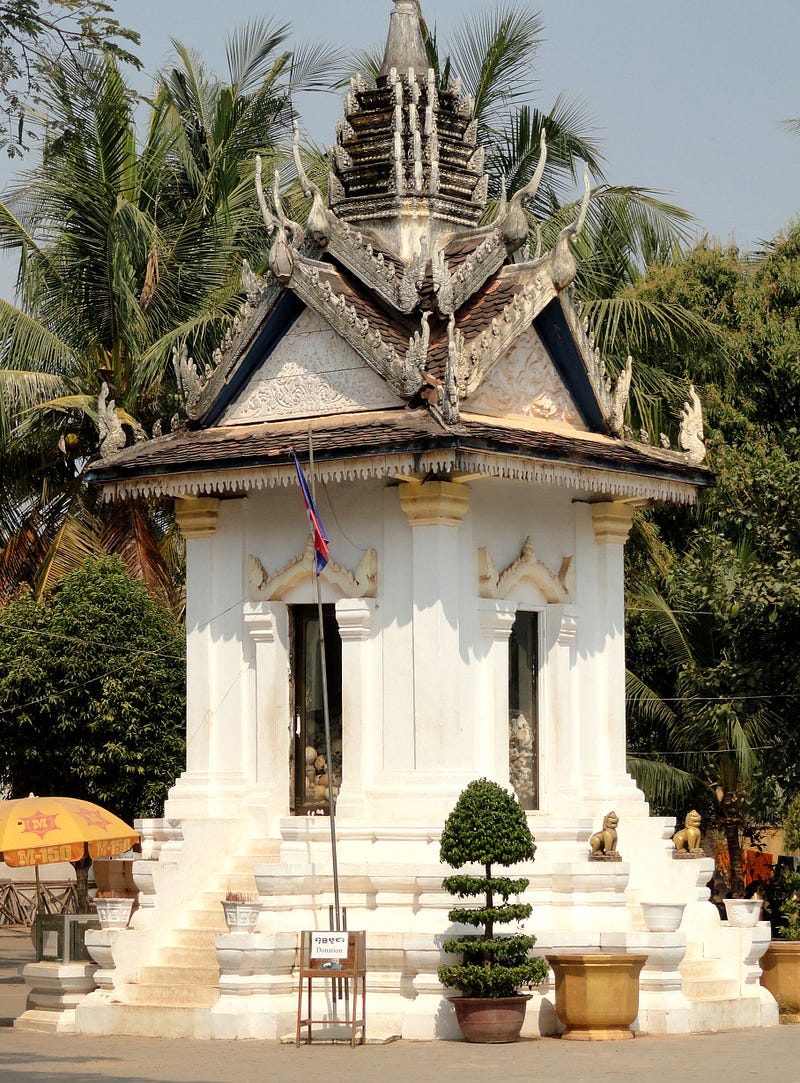
author’s photo of the stupa in Siem Reap, Cambodia

“For the dead and the living, we must bear witness.” Elie Wiesel, Holocaust survivor, activist, writer

As we witness what is happening in Ukraine, as Vladimir Putin tries to wipe out the population of that country and destroy Ukraine’s language and culture, we are reminded about other dark periods in history and genocides that have taken their toll.

The Holocaust during World War II, the bloody massacre in Rwanda in the mid-1990s, and the atrocities that took place in Cambodia in the mid to late 1970s have demonstrated clearly that genocides are not simply something from the dark ages.

“Of all the varieties of violence of which our sorry species is capable, genocide stands apart, not only as the most heinous but as the hardest to comprehend.” Steven Pinker, Harvard Psychology Professor/author

I couldn’t visit Cambodia without trying to learn more about the hell that is a part of the country’s relatively recent history.

It was less than 50 years ago that the Asian country’s leaders embarked on a campaign that left an estimated 2 million people dead, about a quarter of the country’s population, between 1975 and 1979.

By now most people have heard of The Killing Fields, which refers to the genocide by the Pol Pot regime of its’ people. Pol Pot and his communist leadership wanted to transform the country, renamed the Democratic Kampuchea, into a peasant farming cooperative. Within days of his genocidal campaign, the entire population of Cambodia’s cities and towns were evacuated, some people were killed and the rest turned into slaves.

Intellectuals were the first targets, which included anyone who could read and write, who spoke another language, or even people who wore glasses. They were singled out and killed on the spot or imprisoned, tortured, and then killed. Those that survived, mainly the elderly, disabled, women, and even children were sent to the countryside where they were used as slave labor, surviving on what little rice they were given, hundreds of thousands died from starvation.

It was a horrific atrocity, and to think that it happened within my lifetime is unconscionable.

Religion was abolished and the regime went into the temples and beheaded the statues of Buddha and tried to destroy the same temples that have become iconic in this tiny nation.
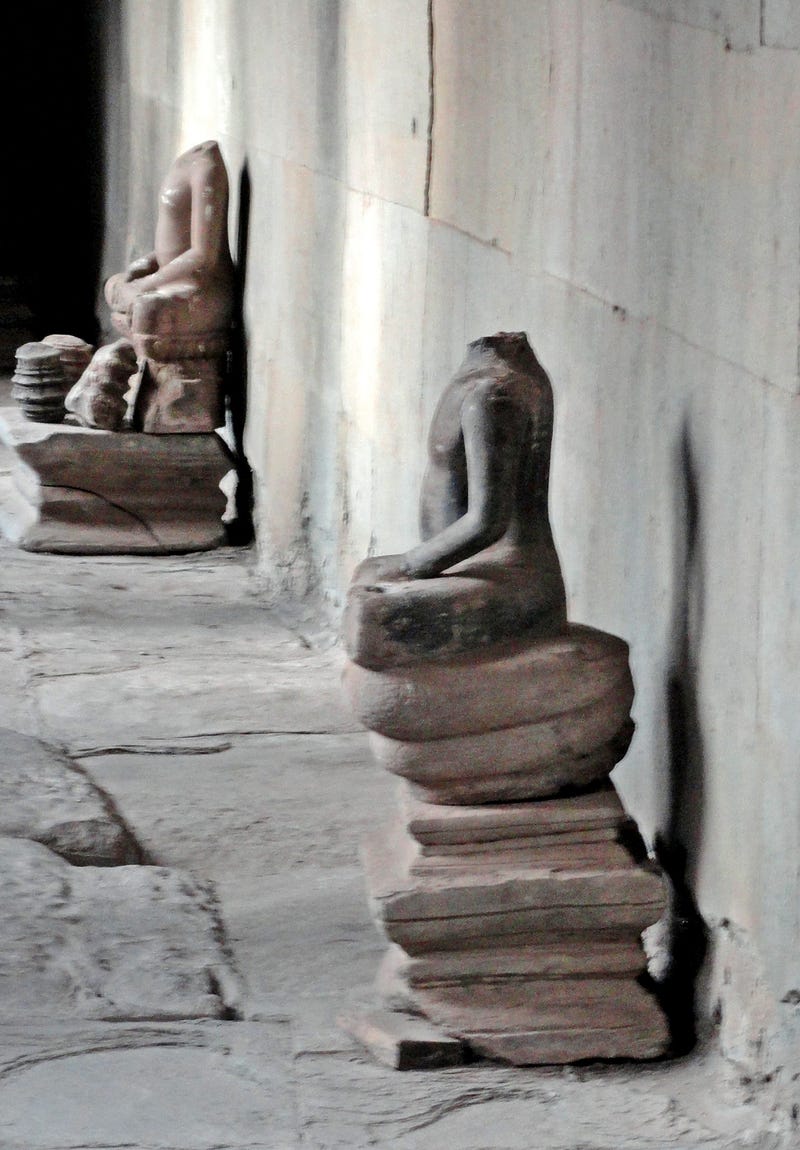
author’s photo of beheaded Buddhas

I spoke to Cambodians during my visit, about this period in their history. They appeared willing to talk about it, although I could see the light go out of their eyes as they remembered.

My Tuk Tuk driver told me that he was in his early teens in the mid-70s so he remembers what it was like. He recounted the terror that everyone felt, not knowing if they or their loved ones would be killed next. He and his mother survived, but his father was murdered.
The main commemorative site is just outside Phnom Penh, and while I didn’t get a chance to visit that location, there is also a memorial site in Siem Reap that pays tribute to some of the victims of this tragedy. It is Wat Thmey, a former school that was turned into a prison and is now a monk’s school. When the Khmer Rouge was overthrown, by the Vietnamese in 1978, mass graves of some of the prisoners who died there, were found.

In the 1990s the site became a Buddhist temple with a stupa (a Buddhist structure that often contains relics and is often used for meditation) that was filled with the bones and skulls of some of those victims.
Author’s photo of the stupa at Wat Thmey

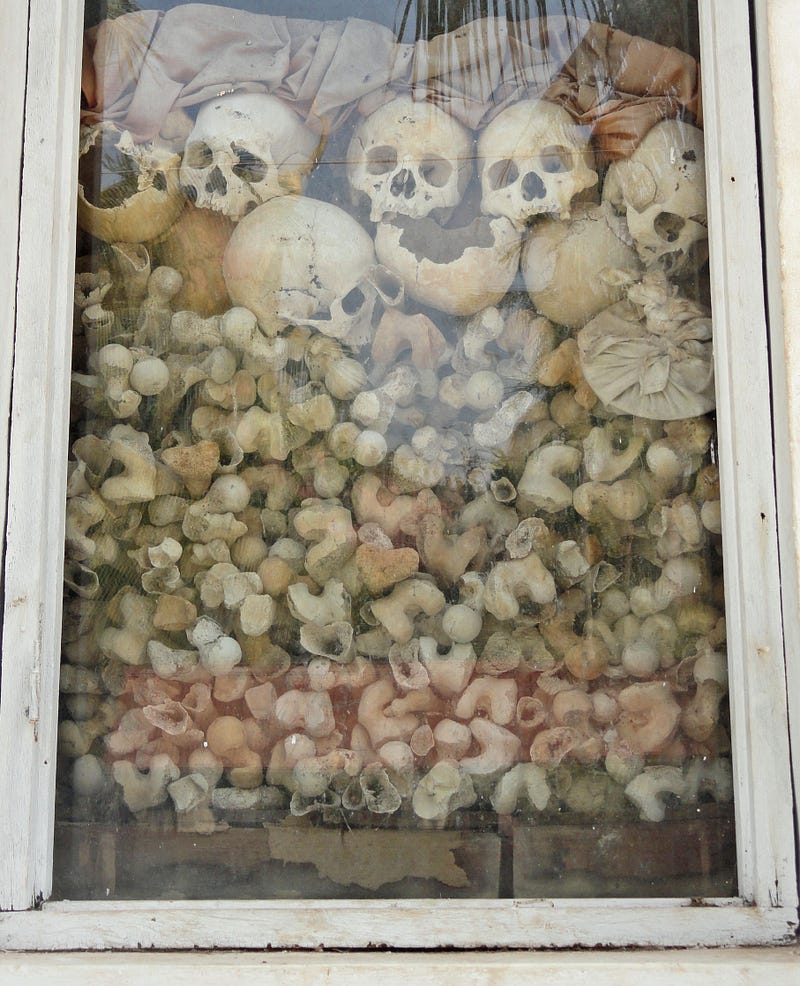
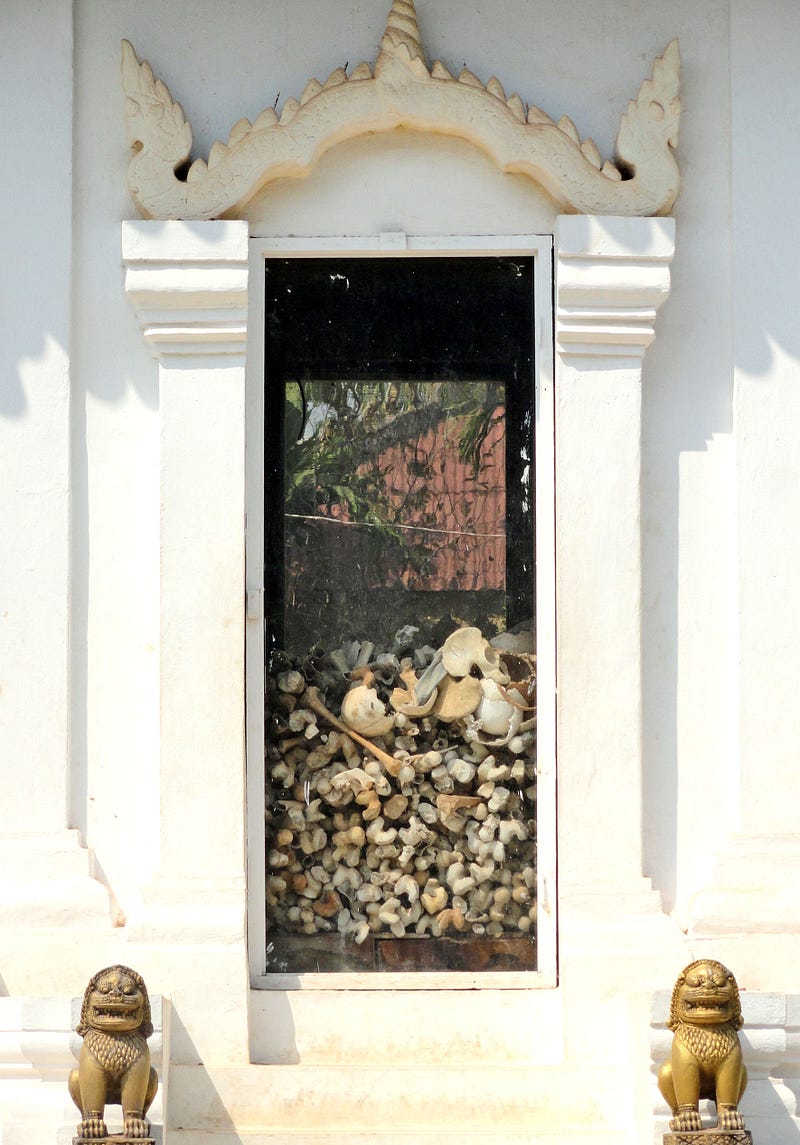
As you approach the stupa, you are drawn to the glass windows on all four sides and as you get closer you see they are filled with human skulls and bones. It is a very difficult thing to see, especially when you consider how these people died, and the families they left behind.
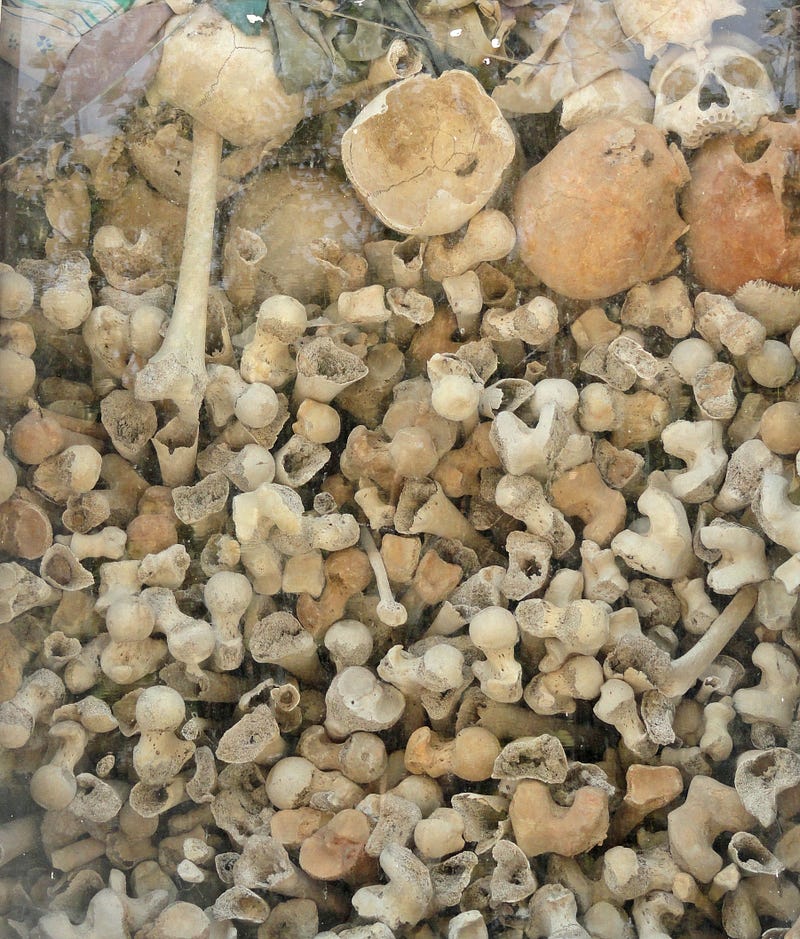
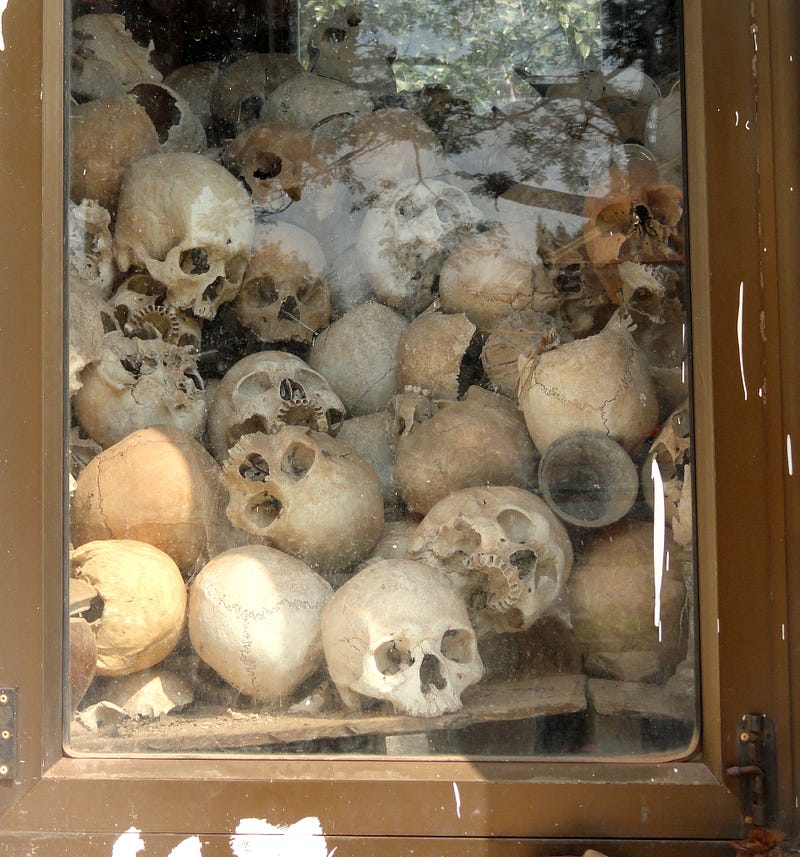
author’s photo — skulls and bones in the stupa

There are also photos of some of the victims on bulletin boards and a letter saying, “Dear Tourists, the collection of bones that you see in the stupa were bones that have been collected from the nearby field. These were from the innocent people who died at the hands of the savage Pol Pot Regime in 1975–79.”
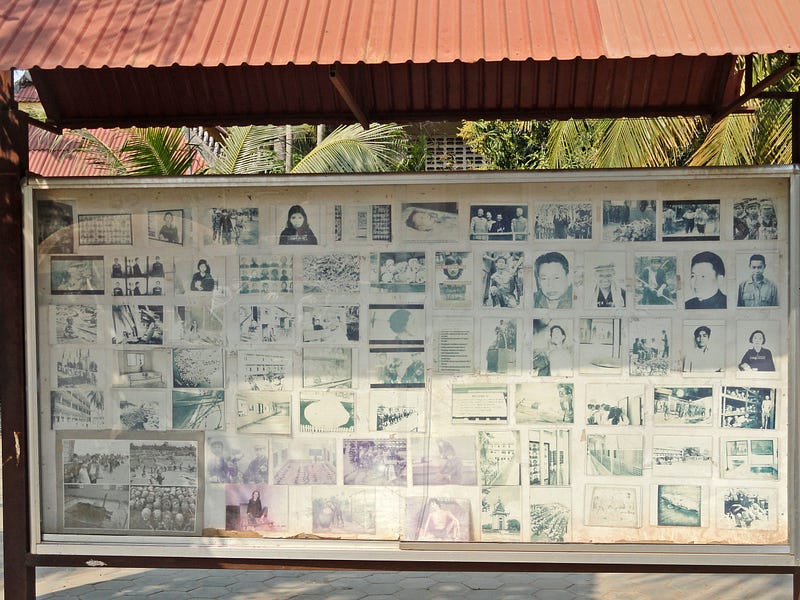
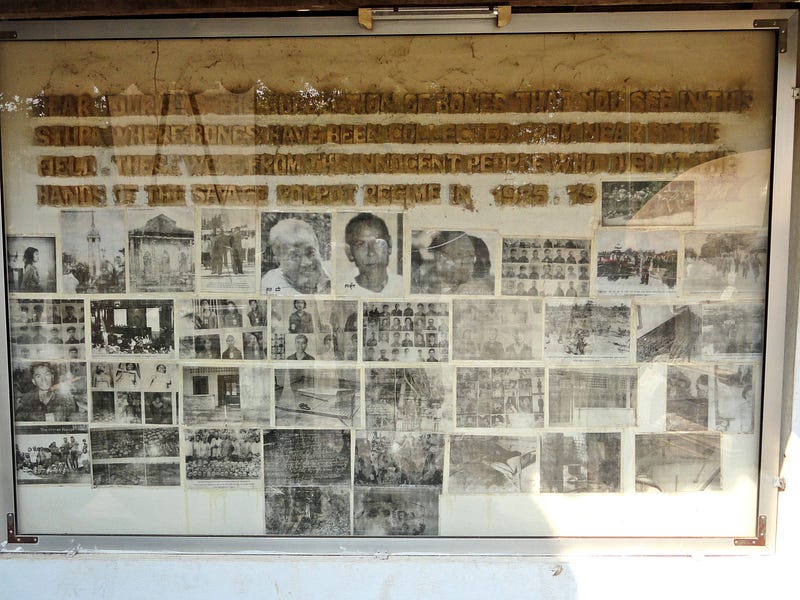
This memorial represents only a tiny fraction of the millions who were killed and is a solemn place for reflection. At the site, you can also visit the Buddhist temple, light some incense, and say a prayer (if you are so inclined) for the victims you have just seen. It doesn’t take long to visit, but it is something that will stay with you forever.
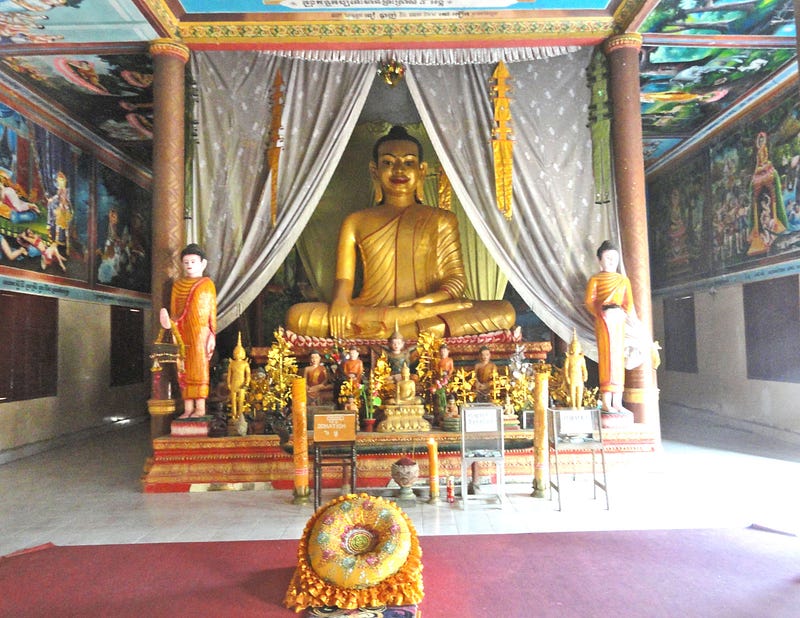
author’s photo of the Buddhist Temple at Wat Thmey

There is also another way to honor some of the survivors. When visiting any of the tourist sites, from Angkor Wat to Pub Street, there are small groups of musicians who get together to play their traditional music. They are all victims of landmines. Some are missing limbs or are blind. They told me they don’t want to beg but are simply trying to make a living to send their children to school and are playing their music for their personal dignity. How can you refuse?
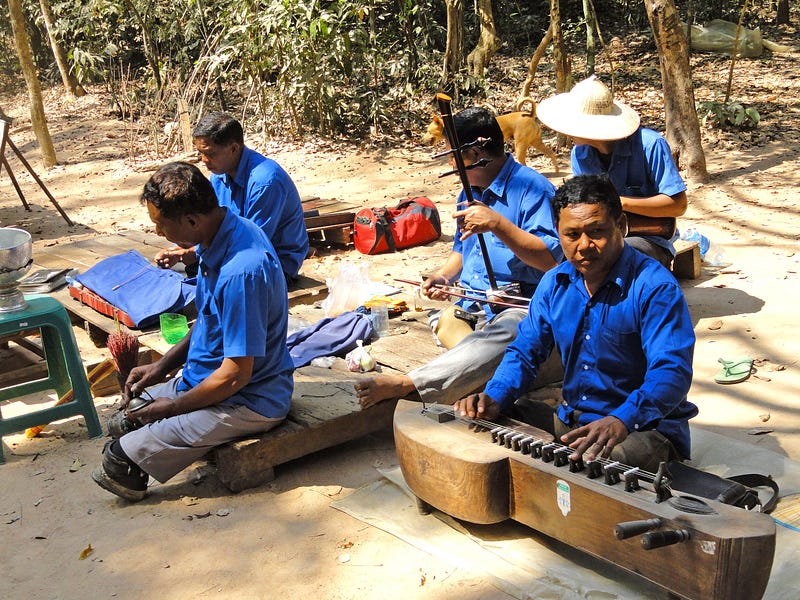
author’s photo of landmine survivor’s street band

Another reminder of the horrors of the Pol Pot regime includes a warning. Do NOT stray from the paths set out, especially around the smaller temples. There are still landmines scattered around the sites, there are still accidents and people are still maimed and killed every year. The effort continues to try to clear the unexploded ordnance, but until that happens, it is still hazardous.
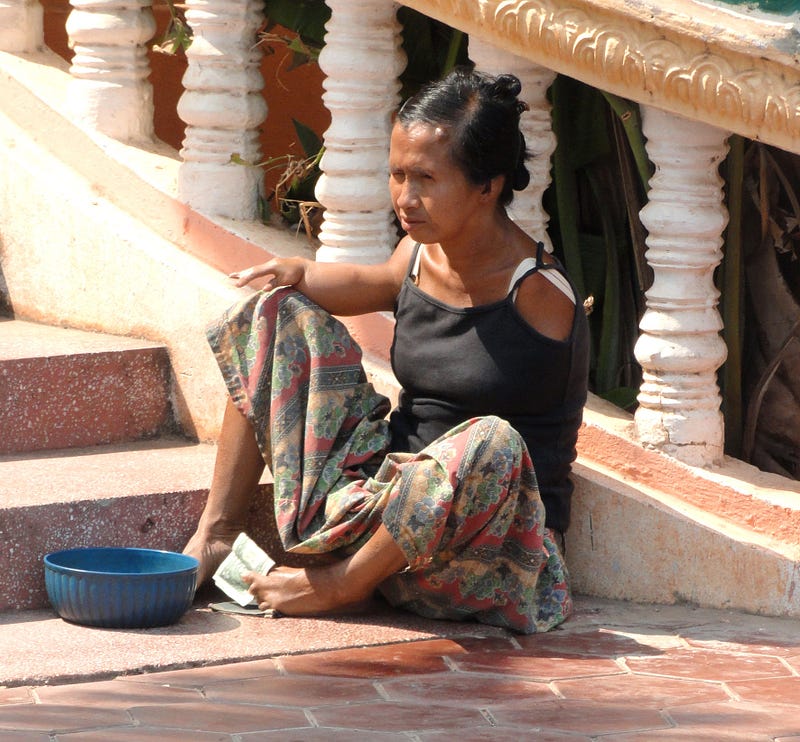
author’s photo of Landmine survivor

Whenever the world is forced to face up to the atrocities that humans are capable of, they often use the words, “never again” but as we continue to witness, the horrors never end.

“First they came for the Communists And I did not speak out Because I was not a Communist

Then they came for the Socialists And I did not speak out Because I was not a Socialist

Then they came for the trade unionists And I did not speak out Because I was not a trade unionist

Then they came for the Jews And I did not speak out Because I was not a Jew

Then they came for me And there was no one left To speak out for me”

German Lutheran pastor Martin Niemoller

Cambodia
Genocide
Pol Pot
Stupa
Travel
Recommended from ReadMedium