
Health, Nutrition
Better Eating Habits: Reducing Snacking Through Interoception
Get Lean By Mastering Your Hunger
In a previous article “Learn Interoception,” I provided general background on what interoception is, how to learn interoception, and how to use it to modify your reactions.
Learning to use interoceptive awareness has been a powerful tool for me in reducing my snacking habit and as a result, decreasing my waistline. I have long struggled with continuously snacking most of the day. The most difficult time for me is the time between lunch and dinner. In the past, no matter how much I committed to NO SNACKING between 1pm and 5pm, I would consistently find myself breaking my promise to myself and eating… and then going back for one more… and one more. It was adding hundreds of calories a day to my diet and keeping me above a healthy weight.
Through practicing techniques like mindful eating and hunger awareness, over time I increased my understanding and awareness of my internal state. My interoceptive awareness of what hunger felt like and didn’t feel like improved substantially. At first, I was uncertain what hunger felt like — I snacked all the time and was never really hungry! I thought I was a lost cause. But with consistent practice, I’ve come to master what hunger feels like in my body, and what other sensations in my body and mind can drive snacking. I use that information to reduce unnecessary snacking, and I’ve lost 10–15 pounds as a result.
You, too, can learn to master your hunger and avoid snacking by following a similar path. I’ve outlined my recommendations below.
Improve Interoceptive Awareness of Hunger and Fullness
As I was, you may be a little unsure of exactly when your body is hungry. Your first step is to start paying attention to your body and learn what your hunger signals actually feel like. For some people, this may only take a few days, for other people like me who are slower learners on this subject it may take months or longer. Keep at it — this is a skill you can learn. Be persistent.
Indicators of Hunger
First, it’s important to know what true physiological hunger feels like in order to be able to identify it. Scientific studies consistently identify two things that indicate true hunger:
- An “empty-hollow” sensation in the stomach. Some people might call this a “hunger pang.” This is a physical sensation experienced in the abdomen and indicates readiness to digest.
- Inanition is the term used in scientific studies to refer to “fatigue, light-headedness, and general weakness.” Inanition indicates the need for nutrition. You might experience both the empty-hollow sensation and inanition at the same time, or one may come first. I consider the empty-hollow sensation a more reliable indicator of hunger, because “fatigue, light-headedness, and general weakness” can be sensations caused by many other things.
Troubleshooting Identifying Hunger
If you are having trouble feeling hunger in your body, I suggest you consider whether you are eating a high-quality, healthful diet. Scientific studies show that diets high in refined fats and sugars make it more difficult to sense internal fullness.
“In a laboratory-based test of food intake, the high refined fats and sugar (HFS) rich diet groups were less accurate in recalling what they had previously eaten and evidenced reduced sensitivity to internal signals of hunger and satiety, relative to a group consuming less HFS rich diets.” — by Francis & Stevenson in “Higher reported saturated fat and refined sugar intake is associated with reduced hippocampal-dependent memory and sensitivity to interoceptive signals.”
Practicing Identifying Hunger
There are several exercises you can do to help you learn to recognize hunger. I recommend you commit to practicing the first two exercises every day for at least two weeks and try the third exercise one day a week for two or three weeks. After that, go back to them once in a while to refresh your awareness.
Mindful Eating Exercise. Choose a meal each day that you will practice with. In this exercise, you will take a break mid-meal. To make it easier to remember, divide your food in half before you start eating.
- Before eating, use your interoceptive awareness to feel into your abdomen and then describe to yourself what you feel there. Is it heavy? Light? Full? Empty? Hollow? Then sense into the rest of your body and describe to yourself how you feel. Are you relaxed? Tense? Tired? Light-headed? Energetic? Weak?
- Then, with no distractions (no TV, no phone, no book, no work), slowly and mindfully eat your meal, closely observing what you eat and how your body feels as you eat.
- Halfway through the meal, stop eating for 5 minutes. In that time, observe how your abdomen feels, and then how your whole body feels. How has it changed?
- Finish your meal, and then once more use interoceptive awareness to observe sensations in your stomach, and then in your whole body.
- If you have time, spend a few minutes writing about your experience.
- Hunger Scale. Choose one meal each day and rate your hunger before and after the meal on a hunger scale. A hunger scale is a way of estimating how hungry or full you are to give you a better sense of your body’s state. The hunger scale I like to use is below, but if there is another one you prefer, use that.
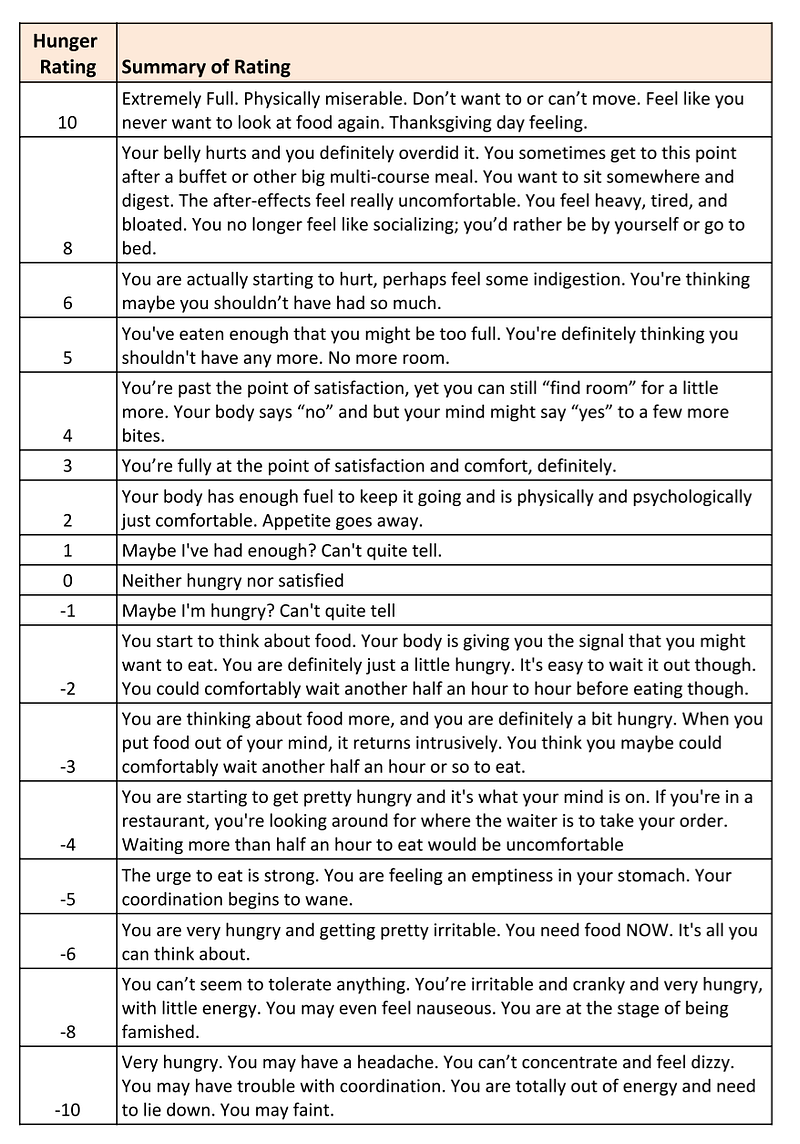
3. Skipping A Meal. This exercise will help you explore the different kinds of hunger and fullness. Many people do not regularly feel hunger, so it’s difficult for them to identify. In addition, even if they do feel hunger, they may not feel like they can wait it out very long, so they may rarely have felt hunger past -1 or perhaps -2 on the hunger scale.
- In this exercise, you are encouraged to skip a meal.
- When you do so, stop every half an hour and feel inside your body and describe what you feel. Write down the sensations.
- Rate the hunger on a hunger scale like the one above.
Applying Your Interoceptive Awareness
Now that you have the interoceptive awareness to know what your body’s true physiological need for food feels like, how can you use that information to cut back on snacking?
- Every time you want to eat something, stop and use your newly developed interoceptive awareness to determine if you are physically hungry.
- If you are hungry, eat an appropriate amount.
- But if you are not hungry, use the information about what you’ve sensed in your body and the surrounding context to guess what might really be going on. The #1 thing that can cause sensations in your body that you may confuse with hunger is stress. Stress is a biological and psychological response experienced on encountering something that is perceived to threaten our body’s homeostasis. It can be caused by frustration, anger, boredom, work demands, conflict, and many more things.
“Claude Bernard noted that the maintenance of life is critically dependent on keeping our internal milieu constant in the face of a changing environment. Cannon called this “homeostasis.” Selye used the term “stress” to represent the effects of anything that seriously threatens homeostasis. The actual or perceived threat to an organism is referred to as the “stressor” and the response to the stressor is called the “stress response.” Although stress responses evolved as adaptive processes, Selye observed that severe, prolonged stress responses might lead to tissue damage and disease.” — by Neil Schneiderman et. al. in “Stress and Health.”
- Once you’ve identified what is driving the sensations that you were going to address by eating when not hungry, pick out something else that better addresses the underlying need — without added calories.
- I recommend keeping a list of “quick fixes” for stress or other underlying causes triggering your overeating. These are activities which you can fit into a short window of time, and which help lower your stress response or address other demands driving your urges. When you’re in the moment, grab this list and do that action.
- You may not be great at choosing an alternative activity at first. Practice, and keep practicing — this is a skill, and you will get better if you practice.
Once I learned what hunger felt like in my body, I was surprised to realize how often I was snacking without any hunger. As I observed the sensations in my body, I realized these snacking instances were usually triggered by feelings like: Tension in shoulders and abdomen, elevated heart rate and breathing, or a feeling of restlessness. Eventually, I realized these were sensations associated with stress.
As I examined my day, I realized I frequently experienced stress in the afternoon. It especially arose after I had had a busy work morning, or when I was procrastinating completing a task in the afternoon. I found myself avoiding more work by looking around for a snack. Sometimes, I would go back for snack after snack all afternoon. When I snacked, I ate so many calories at a time when my body just didn’t need fuel!
After I had diagnosed that the sensations in my body really were indicators of stress, I thought about other ways I could address stress quickly. I put together a list of ideas. Here’s my personal list:
- 5–10 minute nap
- Watch a short funny YouTube video
- Draw, paint, or color for 5 minutes
- Listen to an audio recording of a poem
- Self-massage my shoulders
- Find a plant in the yard I’m not familiar with and try to figure out what it is
- Meditation
- Bath
- Listen to a podcast for 5–10 minutes
- Look at photo albums
- Write in my journal
- Short walk
- Listen to a favorite song
- Use foam roller
- Do a yoga pose
- Drink tea
When I had an urge to eat, I used the interoceptive skill I had build to determine what sensations I felt. If those sensations indicated hunger, I ate. If not, I picked one of the things on that list to do.
At first, it was hard to be consistent because I had the urge to eat when I wasn’t hungry so often. Honestly, I thought frequently I would never get good at it! But persistence paid off and eventually I developed the skill of recognizing when I wasn’t hungry, and using one of the other tools on that list to address my need.
Initially, I got the urge to eat when not hungry frequently, and I had to do things off that list frequently. But now I feel the urge to eat when I’m not hungry much less often. I’m not perfect — I still give in to snacking when I’m not hungry occasionally, but it’s rare now, rather than a several times a day occurrence.
But here’s the crazy thing: I still do the activities on that list often because they do a much better job of addressing the stress than eating ever did! Eating was an ineffectual way of addressing stress. It distracted me, but didn’t do a lot for the underlying needs of my body and mind. The activities on that list do a much better job of changing my underlying physiology and neurochemistry in a way that has improved my happiness, mental presence, and focus. I lost weight, and was happier and better able to concentrate on what I wanted to do.
If you, too, struggle with a persistent urge to snack when not really hungry and that is resulting in your body having an unhealthy weight and your mind being obsessed with food, I urge you to give this technique a try! I look forward to hearing if it works for you as it did for me.
Further Reading:
“Lean Habits For Lifelong Weight Loss: Mastering 4 Core Eating Behaviors to Stay Slim Forever” by Georgie Fear
Francis HM, Stevenson RJ. Higher reported saturated fat and refined sugar intake is associated with reduced hippocampal-dependent memory and sensitivity to interoceptive signals. Behav Neurosci. 2011;125(6):943–955. doi:10.1037/a0025998
Ciampolini, Mario et al. “Hunger can be taught: Hunger Recognition regulates eating and improves energy balance.” International journal of general medicinevol. 6 465–78. 17 Jun. 2013, doi:10.2147/IJGM.S40655
Schneiderman, Neil et al. “Stress and health: psychological, behavioral, and biological determinants.” Annual review of clinical psychology vol. 1 (2005): 607–28. doi:10.1146/annurev.clinpsy.1.102803.144141