
Redis vs. KeyDB — My Performance Test and Conclusions
Is KeyDB faster than Redis?

KeyDB is a fork of Redis. KeyDB project claims that the Redis implementation approach is not correct and can be better, in terms of performance.
KeyDB can run more than one thread, compared to Redis approach which only runs one.
The KeyDB website claims that it’s faster than Redis. I did some quick tests to check the performance as cache server (it means that I tested commands like GET / SET) and in this post I’ll share my results.
How Did I Test?
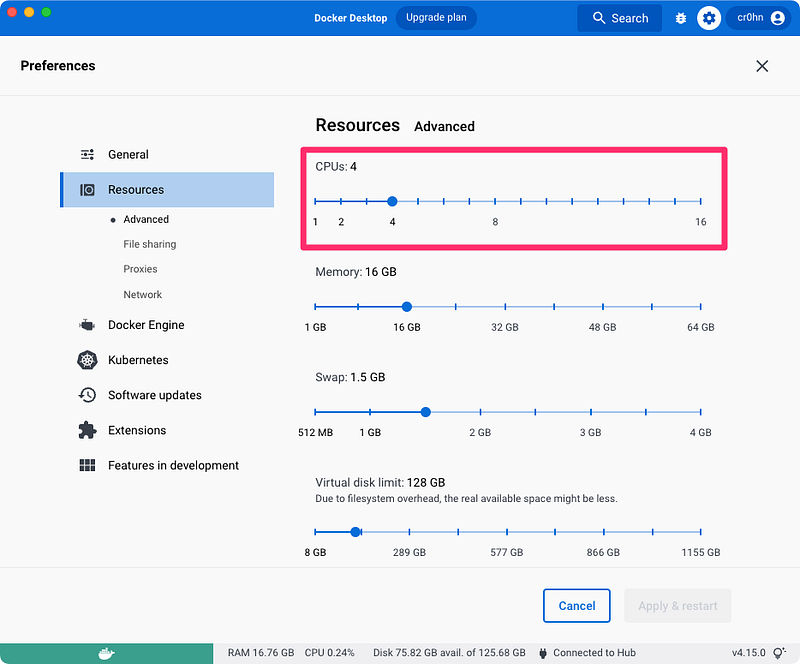
For my test, I used Docker for running Redis and KeyDb. I configured my Docker Engine with 4 vCPUs to take the advantage of KeyDB multithreading:
I also increased the OS limits to allow a high number of concurrent connections for the tests:
> ulimit -a
-t: cpu time (seconds)              unlimited
-f: file size (blocks)              unlimited
-d: data seg size (kbytes)          unlimited
-s: stack size (kbytes)             8192
-c: core file size (blocks)         0
-v: address space (kbytes)          unlimited
-l: locked-in-memory size (kbytes)  unlimited
-u: processes                       11136
-n: file descriptors                256
Tests Conditions
I did a test with these parameters:
- Total queries: 50.000
- Command tested: GET / SET
- Concurrent clients: 500
- I executed the same test 5 times.
KeyDB results
KeyDB Version: 6.3.1
Server with 4 threads
> docker run -p 6777:6379 eqalpha/keydb keydb-server --server-threads 4Executing tests:
> redis-benchmark -p 6777 -t get,set -q -n 50000 -c 500
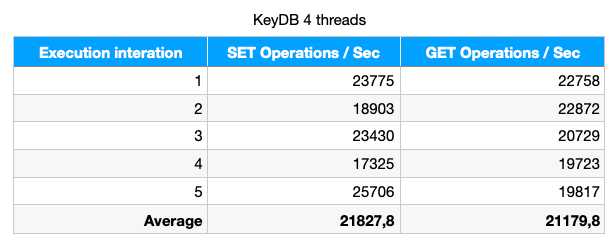
SET: 23775.56 requests per second, p50=14.559 msec
GET: 22758.31 requests per second, p50=13.439 msec

> redis-benchmark -p 6777 -t get,set -q -n 50000 -c 500
SET: 18903.59 requests per second, p50=16.247 msec
GET: 22872.83 requests per second, p50=13.359 msec

> redis-benchmark -p 6777 -t get,set -q -n 50000 -c 500
SET: 23430.18 requests per second, p50=14.583 msec
GET: 20729.69 requests per second, p50=14.687 msec

> redis-benchmark -p 6777 -t get,set -q -n 50000 -c 500
SET: 17325.02 requests per second, p50=19.263 msec
GET: 19723.87 requests per second, p50=16.591 msec

> redis-benchmark -p 6777 -t get,set -q -n 50000 -c 500
SET: 25706.94 requests per second, p50=13.191 msec
GET: 19817.68 requests per second, p50=14.839 msec
As a summary:
Server with 2 threads
> docker run -p 6777:6379 eqalpha/keydb keydb-server --server-threads 2Executing tests:
> redis-benchmark -p 6777 -t get,set -q -n 50000 -c 500
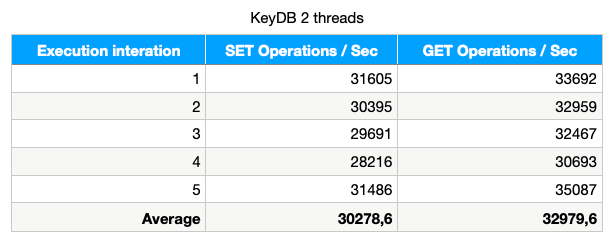
SET: 31605.56 requests per second, p50=11.095 msec
GET: 33692.72 requests per second, p50=10.815 msec

> redis-benchmark -p 6777 -t get,set -q -n 50000 -c 500
SET: 30395.14 requests per second, p50=12.271 msec
GET: 32959.79 requests per second, p50=13.639 msec

> redis-benchmark -p 6777 -t get,set -q -n 50000 -c 500
SET: 29691.21 requests per second, p50=13.087 msec
GET: 32467.53 requests per second, p50=13.159 msec

> redis-benchmark -p 6777 -t get,set -q -n 50000 -c 500
SET: 28216.71 requests per second, p50=14.295 msec
GET: 30693.68 requests per second, p50=14.103 msec

> redis-benchmark -p 6777 -t get,set -q -n 50000 -c 500
SET: 31486.14 requests per second, p50=12.543 msec
GET: 35087.72 requests per second, p50=12.543 msec
As a summary:
Server with 1 thread
I did tests with only one thread, but the results were the same as with 2 threads.
Redis Results
Redis Version: 7.0.2
Executing server:
> docker run -p 6379:6379 redisExecuting tests:
> redis-benchmark -p 6379 -t get,set -q -n 50000 -c 500
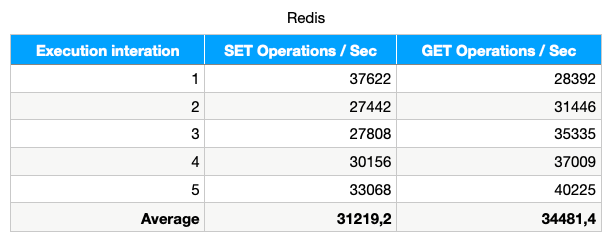
SET: 37622.27 requests per second, p50=12.527 msec
GET: 28392.96 requests per second, p50=12.919 msec

> redis-benchmark -p 6379 -t get,set -q -n 50000 -c 500
SET: 27442.37 requests per second, p50=13.439 msec
GET: 31446.54 requests per second, p50=15.527 msec

> redis-benchmark -p 6379 -t get,set -q -n 50000 -c 500
SET: 27808.68 requests per second, p50=13.751 msec
GET: 35335.69 requests per second, p50=13.391 msec

> redis-benchmark -p 6379 -t get,set -q -n 50000 -c 500
SET: 30156.82 requests per second, p50=14.631 msec
GET: 37009.62 requests per second, p50=12.711 msec

> redis-benchmark -p 6379 -t get,set -q -n 50000 -c 500
SET: 33068.79 requests per second, p50=13.359 msec
GET: 40225.26 requests per second, p50=10.999 msec
As a summary:
Conclusion
Ok. Results are curious:
- KeyDB says that they are faster than Redis because they can run in a multithreading way, but in tests, results appear that it runs faster when the number of threads tens to 1… like Redis.
- This means that KeyDB needs more resources to reach the same performance as Redis.
- KeyDB threads need to count your hardware resources; otherwise, Redis.
We also have to keep in mind that KeyDB has a great feature that Redis doesn’t have (at least in their Open-Source version) like:
The “On Flash” feature. This feature uses SSD disks as an extension of RAM, spending less RAM with very similar performance.
- Redis on flash: https://redis.com/redis-enterprise/technology/redis-on-flash/
- KeyDb on flash: https://docs.keydb.dev/docs/flash/
I tried to run KeyDB server with On Flash feature, but I couldn’t. It raised me the error: “FLASH Is Not yet Supported”.


