
How to design a rich life
And why turning up matters so much
How do we craft new ways of living in an uncertain world?
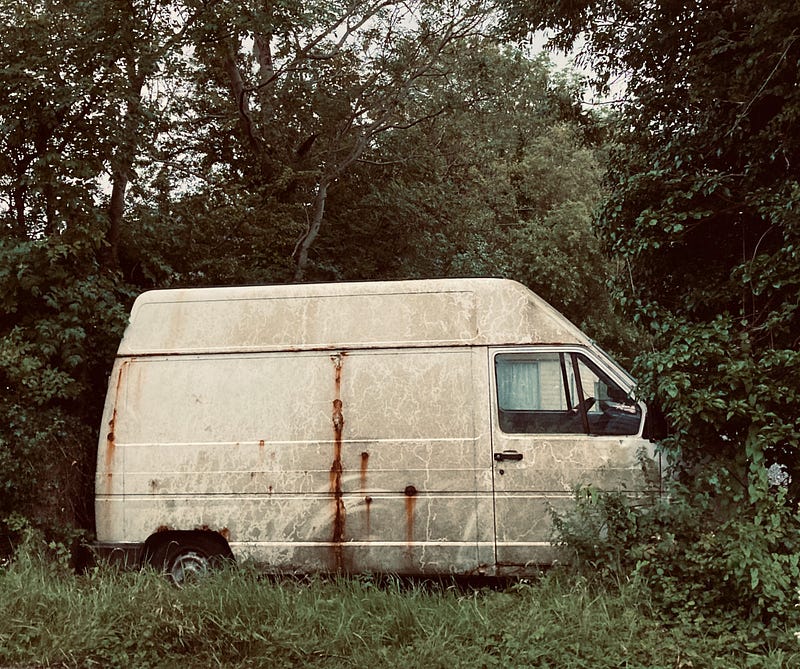
Part of my Dad still punctuates a ditch halfway between the town I come from and the farmhouse where we spent school holidays. His first camper van still leans at an angle, dirty and creased with rust, pointing west.
Eternally stuck in time and space.
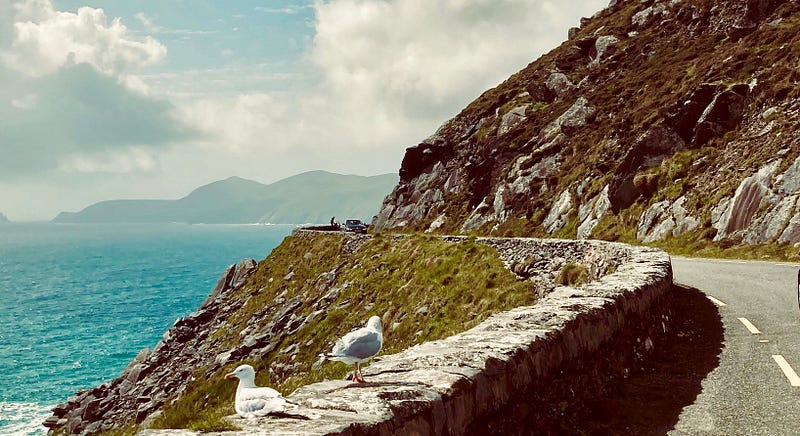
We spent many hours bombing along that road, sweeping in the mountain, and sea, driving towards the beach, or some other urgent mission. There was no expectation of more: a simple pleasure tinged with silent satisfaction. But the world has taken several turns since my Dad last roamed the earth at van-height.
This turn is one we all share: we are all in an in-between space where one way of being has ended — with no idea what happens next. How do we find within ourselves a sense of ease in our COVID weary lives?
Designing a life
How do we now begin to craft new ways of living when we are surrounded by so much instability and uncertainty?
“All men are system designers, and each man tries to determine what, in his world is the largest system and the smallest.
For each human, the system he designs is his life, i.e., his self. The question all of us face is what is the largest and smallest system which constitutes the self? Where does self-designing begin and end?”
W C Churchman
Churchman wrote this in 1971, and while the sense of possibility he conveys still holds, we need to recalibrate the implications of his question.
Being able to “design a life” may have been a luxury of western white, middle-class men, but this liberty was not available to all. And it still isn’t. So this too needs our attention.
So how do we tackle this question at this time? We have come to understand our inherent interdependency on each other: our health is not our own. It relies on the behaviour of all those around us as well as people we have never met.
Are we brave enough to lean into this liminal moment in history and throw out the word “normal”? And accept that we are not going back there? And another future must be possible?
Finding the gold
When we strip away all those glossy bits that no longer distract us, we might just have greater access to the really significant moments of our lives. Could it be, that within the micro-moments we got so used to casting aside, we find the gold, we now need to design spaces for?
Seamus Heaney captured such a moment so beautifully in his poem about his mother. They were peeling potatoes for Sunday dinner while everyone else was at mass:
“I remembered her head bent towards my head, Her breath in mine, our fluent dipping knives — Never closer the whole rest of our lives”.
Turning up
There is something to be said for creating spaces and turning up for those moments. Even though we struggle with what we think are the “big” questions we should be asking ourselves right now. They are significant because they are charged with a timeless connection, and perhaps they form the real substance of our lives.
As Geoffrey Vickers writes: “Human contacts are dangerous (because) they matter so much, and no one knows how much they matter. Even the most trivial meeting makes a difference, slight or lasting to one or both. Intimate contacts make heaven and hell, they can heal and tear, kill, and raise from the dead.
These contacts are the fields in which we succeed or fail. I believe they matter far more than anything else in life. What we are is written on the people whom we have met and known, touched, loved, hated, and passed by. It is the lives of others that testify for or against us, not our own.”
Vickers’s words act as a reminder of the importance of paying attention to our relationships and interactions. But his words also point clearly to our responsibility to take all costs associated with our living into account when designing the size of our lives.
Designing the size of our lives
A systemically viable life is one that robs neither life nor opportunity from other people or the earth.
“Shifting from global to local is a systemic strategy”,according to Helena Norberg-Hodge, who has written about the need to move away from our immersion in “a fragmented and confused world dominated by almost invisible, distant economic forces, towards an interconnected and diversified world”.
This shift is not just about restricting our geographical reach in the immediate term. It is about ethical consumption. It is also about reigning in our need for recognition, power, or control. And our tendencies to share with others how we think they should be, and how we might “fix” them. So our lives need to expand into the moment, as well as contract in our outward reach.
It is time to hold the people that touch us. To touch the walls that hold us. And feel the labour poured into all our belongings. It is time to practice being alive in the liminal space and find the moments that live within the cracks. And know that this is enough. By turning up here, a corresponding expansion of imagination and possibility can arise.
My Dad lived within a geographical and time-bound domain, yes, but one he pushed to its limits. He turned that van into a camper van by cutting the roof off and raising it: he built his own boat, a ham radio tower higher than the church spire, a domestic wind turbine he had to dismantle fast as it produced too much electricity.
To this day I love climbing up into a van and inhaling the smell of diesel. It smells of my Dad’s eternal essence, and of adventure and possibility, by design. And that moment – is pure gold.
About the Author:
I am a doctoral researcher in psychology and lecturer in systems thinking. I am interested in how we learn to live in our bodies whilst engaging with technology. I am an advanced embodiment practitioner, thinking partner and facilitator, with an interest in finding our way through messy systemic issues using body wisdom. I live with my husband, son, cats, hens and bees in Dublin, Ireland. I also edit https://medium.com/living-in-systems
References: C West Churchman (1971) The Design of Inquiring Systems, Basic Books.
Seamus Heaney (1990) “When all the others were away at Mass” from “Clearances” from Selected Poems 1966–1987 by Seamus Heaney.
Helena Norberg-Hodge(2019) Local is our future, Steps to an Economics of happiness , Local Futures.
Geoffrey Vickers (1924) in a letter to his son. Quoted in (2020), Ramage, M. & Shipp, K. (2020) Systems Thinkers, Springer, London.


