
Redefining Focus for the Distracted Entrepreneur
In a world bombarded with distractions 24/7, let’s face it: traditional focus is a myth. But what if I told you that as an entrepreneur, especially one with ADHD like myself, focus could be reimagined as a potent creative well that even includes distraction — and ultimately could become your greatest strength?
The Problem With Fixating on Focus
We’re told to be successful, we’ve got to zero in on each task like a laser. But with about 6.8% of adults having ADHD worldwide — around 366 million people, roughly equal to the US population — and countless more grappling with tech-induced “acquired attention deficit,” that old-school definition misses the mark.
And here’s the truth: even back when I was a kid, a decade before the internet became mainstream, focus was an elusive unicorn… and not just because of how my mind works. Everyone’s brain is wired to favor new stimuli, as it’s a trait crucial for survival. Novelty induces dopamine release in the hippocampus, so in many ways, we’re rewarded for distraction.
Cut to today, and there are countless studies about how the people who design online experiences are adept at dopamine manipulation to keep us attached to our phones, social feeds, and other digital distractions. That’s why things like reading for pleasure — which takes dedicated attention — have experienced a significant drop-off, down to just 16 minutes daily on average, according to the World Health Organization.
Do you know who that doesn’t apply to? Ironically enough, me. That’s the focus paradox of those of us with ADHD: we might struggle with conventional concentration, but we have an uncanny ability to hyper-focus on things we’re deeply interested in. This aligns beautifully with the demands of our digital age, where deep, concentrated effort can lead to innovation.
So, as an entrepreneur with ADHD, I’ve flipped the script on distractibility and impulsiveness, turning them into my superpowers.
The way I see it, focus isn’t one set thing. It’s a complex process that involves a dynamic interplay of managing multiple streams of information while staying true to your primary objectives.
Given the firehose of information blasted at us daily, there’s no linear way through the deluge. You’ve got to first hone in on what you want to do. And as an entrepreneur, that specifically means addressing the problem you want to solve. Then, it’s all about getting into a flow that takes a more multi-dimensional approach to uncovering, designing, and actualizing your unique solution.
The Art of F.O.C.U.S.
Focus for me is an acronym: F.O.C.U.S. It’s a process I have to use to get shit done and not let my neurodivergence knock me on my ass.
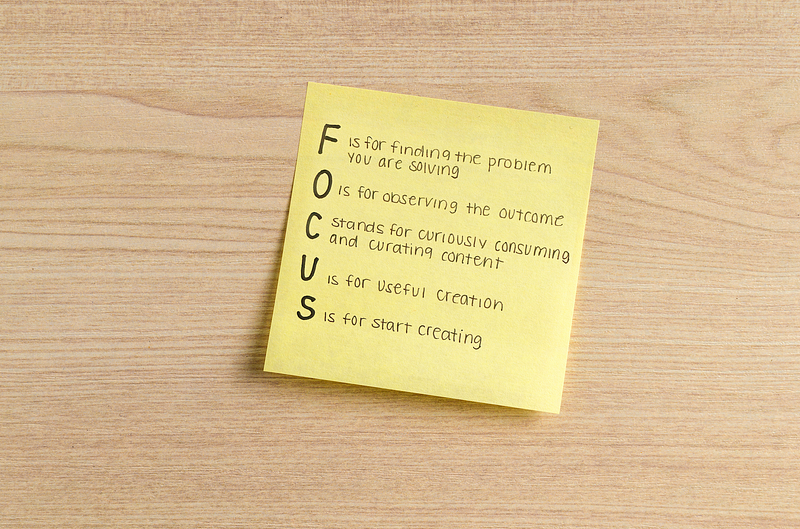
Let’s break that down:
F is for Find the problem you’re solving for
Sounds simple, right? Not so fast — consider what Einstein reportedly once said:
“If I had only one hour to save the world, I would spend fifty-five minutes defining the problem and only five minutes finding the solution.”
Similarly, Lincoln supposedly said:
“Give me six hours to chop down a tree, and I will spend the first four sharpening the ax.”
You get the picture — the world’s most acclaimed minds say slow down and take a deep dive into the problem space. That isn’t just focus; it’s strategic targeting.
Ask yourself:
- Am I solving the right problem?
- Can I keep reframing it?
In other words, find your focus and understand the issue fully before jumping into solutions.
O is for Observing the Outcome
I have a favorite expression of my own:
Inputs drive outputs, and outputs drive outcomes.
It’s not too soon in this process to imagine how you want things to turn out. When I say “Observing the Outcome,” I mean getting specific about how it hits you and, more importantly, your customers or clients on a visceral level.
Ask yourself:
- What do I want to manifest? (Define it.)
- What does the outcome look like, feel like, and act like? (Visualize it.)
Roll up your sleeves; this is an active part of the process. Often, I’ll sketch my vision in a notebook, much like fashion and car designers do. Similarly, legendary inventors like Leonardo da Vinci were famous for musing on their ideas through sketches, like his iconic anatomical drawings.
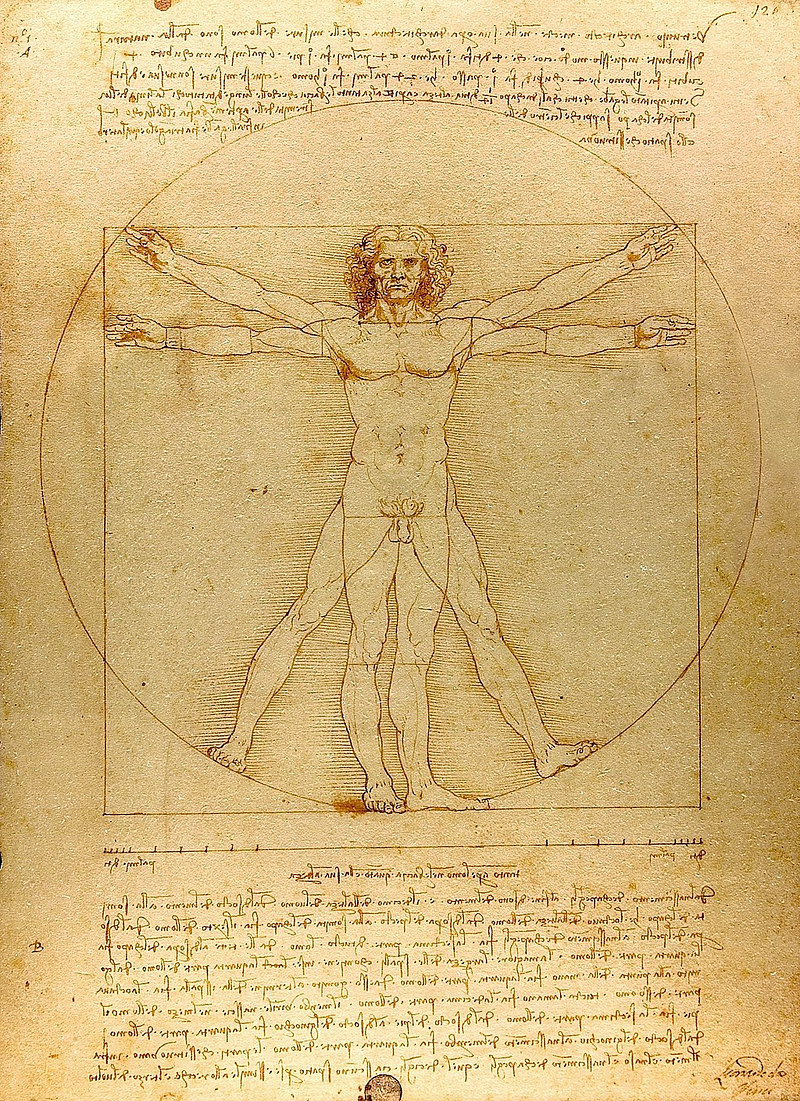
You don’t need to be a Da Vinci to envision your outcome — stick figures work just as well, as all you’re doing is getting the ideas out of your head and onto paper to help concretize your abstract concepts into tangible objectives.
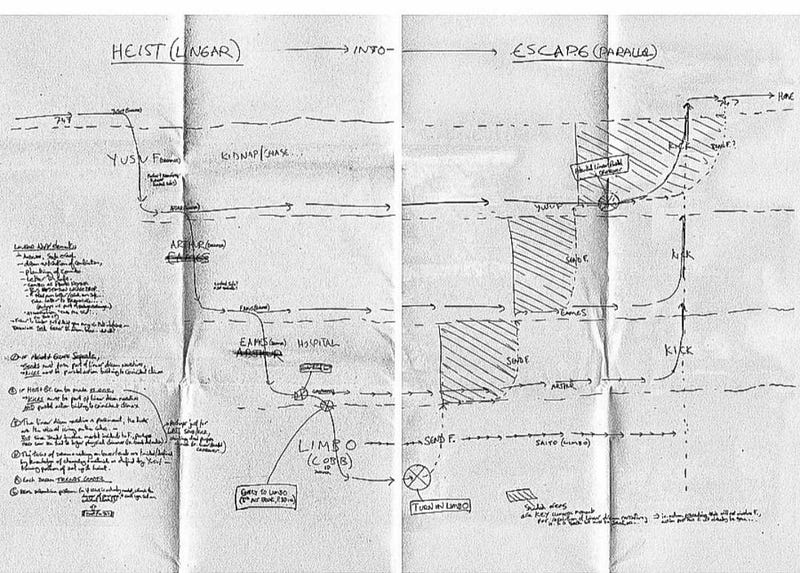
Trust me, this works. Need a more modern example? Here’s Christopher Nolan’s sketch for the plot map which ultimately became the movie Inception, which grossed over $837 million worldwide, becoming the fourth-highest-grossing film of 2010 at its release. If this kinda thing doesn’t come naturally to you, that’s ok. Check out Dan Roam’s book “Back of the Napkin” to learn how to use sketches to solve problems and sell your ideas with pictures.
C stands for Curiously Consuming and Curating Content
Once you’re clear on the problem and how you want the outcome to look, it’s time to do some research to see what’s already out there for inspiration and motivation. This is where “distraction” comes in — but you’re not going to let it take you so far down the rabbit hole that there’s no return. Instead, guided by curiosity and with the help of a clearly defined system, you’ll consume and curate content.
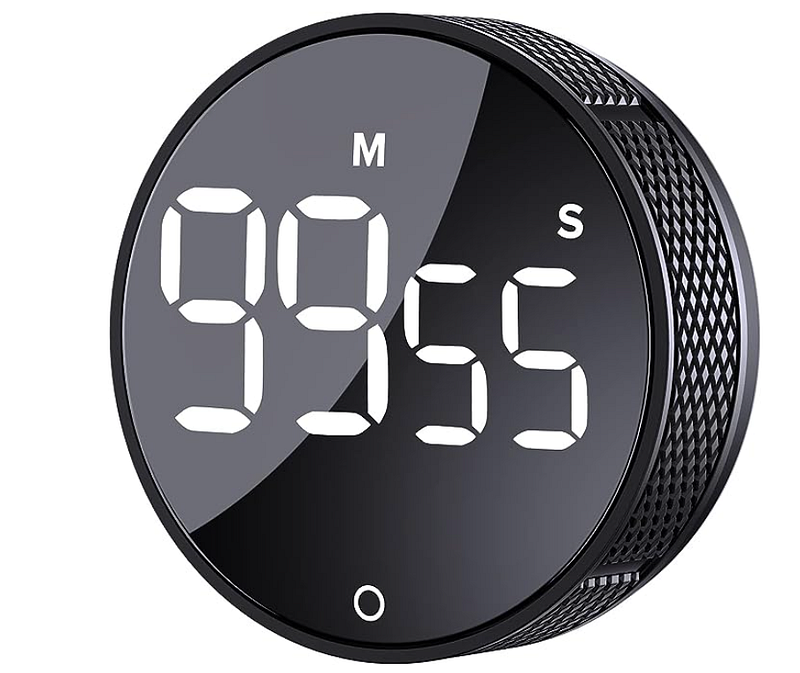
Important: Use a timer — I suggest one to three hours to keep you on track and safe from becoming overly distracted. I don’t use my phone, as it’s just another distraction. I use a cheap digital timer I found on Amazon that I like the design of. So I spin the dial and stop when it goes off.
For the consumption and curation phase, ask yourself:
- Where can I find inspiration?
- What tools will I use for collection?
Here are my suggestions:
- Select a vision bookmarking tool (I use - MyMind) of your choice.
- Pick a tool that allows you to gather text and URLs (I use: Notion)
- Use an eReader so your books have digital bookmarks that are easy to gather and sort (I use Kindle app)
- Try some new AI-driven tools for more expansive searching (I use: Perplexity)
Now that the consumption phase is over, you’re ready to move into the creation space.
U is for Useful Creation (or Use what stands out to you)
Post-curiosity, take a break. When you’re ready to resume your work, it’s time to use that fresh perspective to focus on what still stands out. This phase is about connecting the dots and seeing which of those rabbit holes you just went down leads to treasures.
Ask yourself:
- What tools will I use to make useful connections?
- What still stands out to me?
Again, a few suggestions to get crystal clear on what works to solve the problem (and what doesn’t):
- Do some mind-mapping to get a clearer understanding of the connections and relevance of the materials you’ve gathered
- Try tools like Miro or Figma to visually map your ideas and, critically, start noticing what stands out to you.
S is for Start creating
Congrats! You’ve gone through all the stages of honing in on a problem, envisioning your outcome, exploring possible solutions by sifting through stimuli, deciding what’s most relevant, and now you’re finally ready to begin innovating.
Here’s where some old-school focus comes in: the rule I set for myself at this stage is no new information. You can only pull from the initial info you’ve already gathered.
Again, keep in mind that what you’re effectively doing with this F.O.C.U.S. framework is separating consumption from creation. This constraint forces you to utilize the wealth of knowledge you’ve already acquired, enhancing creativity within boundaries — and making it safe to explore divergent paths. By segregating consumption from creation, you ensure that your focus is undiluted, driving toward the solution with precision and innovation.
Is Everything in F.O.C.U.S.?
Whether you’re an entrepreneur, a creative professional, or anyone looking to enhance your focus in this fast-paced world, I invite you to try my F.O.C.U.S. framework. It’s a journey of understanding, observing, curating, reflecting, and ultimately creating — a process that transforms the daunting task of maintaining focus into an exciting exploration of possibilities.
What do you need help focusing on? Let me know in the comments, and I can give you some ideas about how the F.O.C.U.S. framework can help.