
Memoir, Life Lessons, Friendship
Red Shorts, Yellow Tube Tops & The Weird Girl Downstairs
And how she became my best friend.
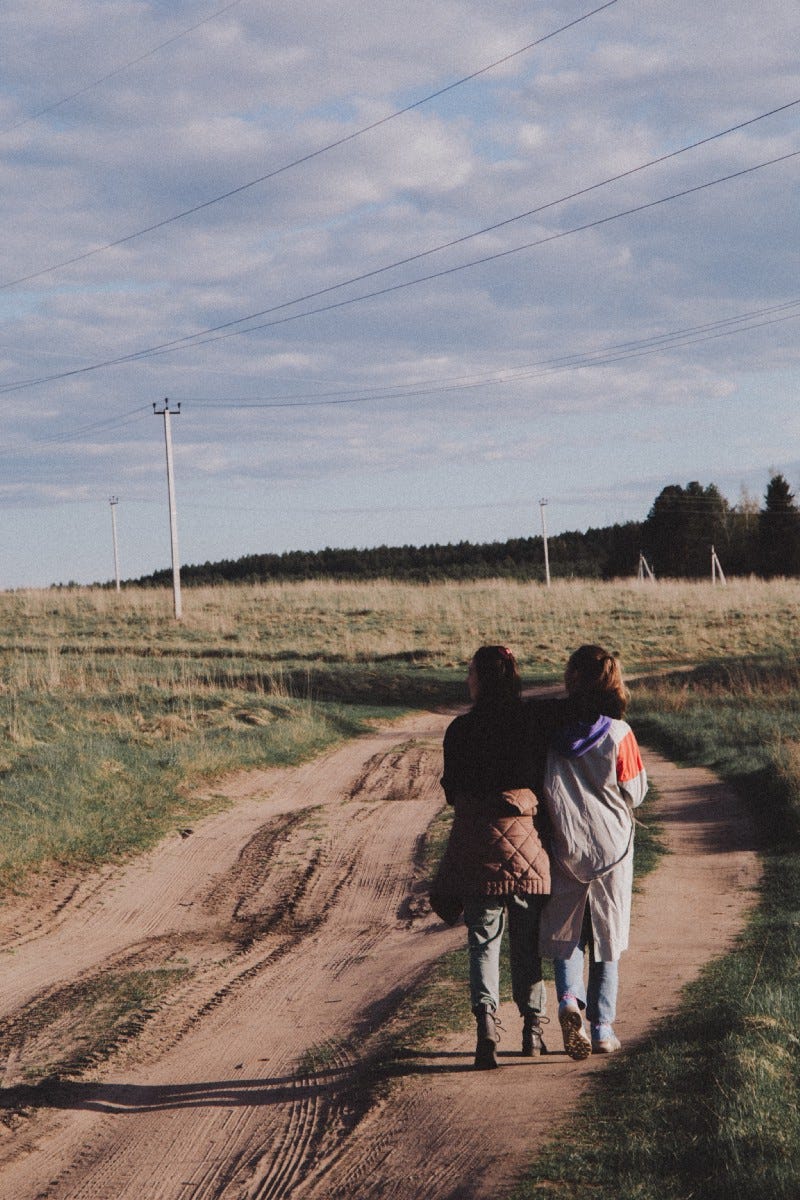
The weird girl who lived downstairs.
During the summer of 1977, a family moved into our basement suite when I was seven years old. The parents had three daughters and a son. I ignored the teenaged brother; I already had three older brothers who teased and tortured me constantly, but I was in awe of the two eldest teenage sisters. They were pretty, friendly and I wished for my own sister to play house with and teach me how to make cupcakes. I was curious about the youngest sibling, Nina (age 9), but she was bigger than me, aloof and disinterested. With her arms crossed firmly over her chest and no smile, she looked mean, angry, and ready to pick a fight. When my mother asked me why I never wanted to play with her, I shrugged and replied, “She’s weird,” because I didn’t want to admit that I was scared of her.
The teenaged sisters were busy daily with homework and chores, and I sense they forced their little sister to play with me. Nevertheless, we were bored of playing alone and discovered common ground when we realized we were both anxious to get away from our pestering brothers. I learned that Nina was nervous because she’d start at a new school that September and moved over 500 miles away from home, leaving her best friend behind. She felt alone, upset, and unhappy about her family’s “big move to the city.”
I was lonely too, shy, and afraid to speak, and when I did, my voice was barely a whisper. Nina was brave, loud with a bossy attitude, and loved to talk. We decided to stick together, and over that summer, a friendship blossomed between us, but I don’t know the exact moment we bonded.
Maybe it started at the playground where we built sandcastles and swung from monkey bars or the day my mother invited her upstairs to join us for homemade pork dumplings or when her father offered me a slice of freshly baked apple pie. Because she talked a lot (and I didn’t), I got used to her questions, boisterous laugh, and body language. After a while, she didn’t seem weird or scary anymore, and Nina got me talking more every day.
The ways our mothers talked.
My mother was delighted to have a Chinese companion to converse with when their family moved into our predominately white suburban neighborhood located just south of Vancouver. Neither of our mothers spoke the other person’s dialect fluently, but they found a way to communicate. Common ground was exchanging recipes (my mother’s Taiwanese chicken or Mrs. W’s law-bok-gow), listening to Chinese radio programs, or talking about where to shop for the freshest produce or find the best salon to get one of those “stinky” Chinatown perms. I don’t remember what our fathers talked about; maybe it was about the cost of raising a family “nowadays,” the articles they read in the Chinese newspapers or disciplining hot-tempered boys.
When children from school teased us because of our slanted eyes or flat noses, called us “chinks” or laughed at our parent’s broken English or peculiar Chinese words, it gave us fuel to stay closer, protect each other, and respect our mothers and fathers even more. By experiencing the hurt and discomfort of racism together, her family became an extension of my own.
Nina showed me black and white wedding photographs of her mother, a porcelain-skinned beauty with delicate features. She was the same woman we watched pace the hallways wearing old house slippers or stirring a pot of foul-smelling herbal soup that she swore cured eczema and any skin condition.
I showed Nina an old Polaroid of my own mother taken by my father; she was dressed in a floral one-piece swimsuit wearing high heels as though she was gracing the cover of a fashion magazine. She was the same woman who wore her food-stained apron all day and scolded her four children whenever we were misbehaving.
While my mother was busy cooking, we tiptoed into her bedroom to play with the dozens of scarves she owned and adored. Vibrant colors made from silk, satin, and cotton; we waved the fabrics through the air to make them dance, wrapped them around our bodies, or wore them over our faces as veils.
When Nina’s mother was doing laundry or sweeping the floor, we took turns reading from Aesop’s fables, looked at the illustrations, and either laugh or talk about the lessons we learned. If we got bored, we’d jump on her parent’s bed as high as we could, counting the number of jumps before we got caught.
Playtime in the 1970s until it got dark.
We didn’t use our rotary phones to call each other. Nina opened her door and shouted, “Mary, Mary, Mary!” I’d hear her voice, run downstairs to greet her and play. We assembled the canvas tent in the backyard, making it our playhouse, created obstacle courses on our driveway, and doubled each other on the banana seat of my purple bike as our flip-flops splashed through rain puddles. We captured bumblebees in jars, made mud pies, and invented games. We sat outside the corner store chewing Dubble Bubble gum, sucked on dripping popsicles, or shared a two-inch Tootsie Roll and played outside until we were hungry or it got dark.
On rainy days, we listened to songs on the transistor radio or danced to disco music in our bedrooms. We recorded songs off the radio onto cassette tapes, making sure our index fingers were geared for “ready, set, go” when we pressed down the black “play” and red “record” buttons simultaneously the second after the deejay announced the next song from “Grease.” We watched Scooby-Doo, Little House on the Prairie, and Happy Days and read Encyclopedia Brown, Pippi Longstocking, and Nancy Drew. Sometimes I’d ask Nina to meet me at the top of our staircase. When nobody was watching, we’d slide down the stairs on cushions or our butts giggling on the way down and race back up the landing to do it again.
If I heard a thunderstorm before bedtime, I’d beg my mother if I could visit Nina, and I’d run downstairs and knock on the door. We’d light the candles, make snacks, and play card games. The house was quiet except for my brothers’ footsteps on the ceiling, our breath, and the shuffling of the deck. When the sky rumbled, we rushed to the window, hoping to catch a flash of lightning.
Hot August evenings, our parents sat outside on patio chairs on the driveway sipping jasmine tea, talking endlessly while we ran through the sprinkler in between sips of orange Tang.
“Why do parents talk so much about nothing?” Nina asked.
I replied, “I don’t know, but it’s totally boring!”
Little girls grow up fast.
Nina evolved into a big sister more than a best friend throughout the years. She tried to shelter me from things she thought I was too immature to understand. We passed through that awkward phase of our friendship where I was a flat-chested girl wearing my favorite red shorts covered in dirt, aching to be her best friend still, but she’d developed those two big bumps on her chest underneath her yellow tube top and was ready to move on with her cooler, mature high school friends.
She became more interested in boys than Barbie dolls but taught me about purple eye shadow, feathered hair, and curling irons. She talked about music, her first period, high school gossip, and handed down her clothing as I approached puberty. I was awestruck when I saw her riding on the handlebars of a boy’s BMX bicycle when she was twelve and kissing her first boyfriend at the bus stop during her teens.
We each claimed our own series of “best friends” throughout elementary and high school. Still, the bond between us was beyond friendship, “not-quite-blood,” but close enough. Back in the 1970s, we pricked our index fingers until they bled and pressed them against each other — a common ritual that we used to proclaim us as “blood sisters.”
During our wild, naive 20’s, we cried over coffee and cigarettes over bad boyfriends (that we met at nightclubs while dancing to 90’s music), found our own individuality and passion in our 30’s, embraced our husbands, and welcomed motherhood when our children were born. We struggled, survived, thrived, and cried through the challenges of parenthood and our marriages in our 40’s. As our children grew and became more independent, we each, in our own individual ways, began reclaiming our “dusty high heels” and those “me pieces” of ourselves that we lost upon motherhood because we forgot that we were more than just the caretakers of our children or women wearing aprons.
There were phases of our friendship where we were mad at each other and expressed our anger through hair-pulling, pouting, and the “silent treatment” during childhood or emotionally charged conversations, messy texts or emails, and “I need time away from you” during adulthood. We wouldn’t speak or make eye contact for days, months, and once over the stretch of a year, but somehow, we always found a path to forgiveness back to each other.
Perhaps there’s truth to the ancient Chinese folklore that we have invisible strings tied around our ankles that destined us to meet and be together (as friends, rather than romantic partners that the myth implies), and “no matter how much the strings are strained and tested, they are not meant to break.”
A hot pot of tea.
Today we connect alongside our school-aged children exploring playgrounds, splashing ocean waves, or hiking forests. We share our children’s photos when they were babies and toddlers and marvel at how the years disappeared. We miss our mothers, wished we spent more days with them when they were still alive, asked them more questions, or possessed more Polaroid snapshots, and wonder what they were like before they became our mothers. We realize we can’t stop time, but we can make the time and effort to visit each other. If we’re north of the bridge, we’ll head back to my house for my apple pie. Next time we’ll head south to Nina’s for homemade dumplings.
Wherever we meet, there’s a pot of hot tea with endless talk, laughter, or tears about our everyday life, pursuits, struggles, and successes. Our children may see us as their boring, ordinary mothers preparing food in the kitchen, “talking so much about nothing” over tea. But we see the playful little girls building sandcastles, the rebellious feathered-hair teens, and the bold young adults we once were in the faces of the weathered, spirited, vibrant women we are today. We’ll tell our children the stories of “us” before they were born because we know they’ll appreciate learning our history even if they don’t ask us all the questions — and it hits us hard that we can no longer ask our own mothers — about theirs.
People come into your life for a reason, a season, or a lifetime. When you figure out which one it is, you will know what to do for each person. — Unknown
Friendship for a reason.
I’ve developed many beautiful friendships over the decades, and I’m thankful for the role each person played or plays in my life. Some developed because we connected through similar purposes, beliefs, passions, or common interests; some were revived because of our friendship history; and some were created during childhood, at the workplace, or upon motherhood. Others have come and gone — “timing out” without question because they were here for a particular reason.
When someone is in your life for a REASON, it is usually to meet a need you have expressed. They have come to assist you through a difficulty; to provide you with guidance and support; to aid you physically, emotionally or spiritually. They may seem like a godsend, and they are. They are there for the reason you need them to be…then something brings the relationship to an end…what we must realize is that our need has been met, our desire fulfilled; their work is done. — Unknown
Friendship for a season.
During the pandemic, I realized I needed to let go of a friendship, and a different friend needed to let go of me due to our different perspectives, beliefs, or communication styles that I believe we could not overcome if we continued seeing each other.
There were many joyful moments in both friendships filled with laughter and kindness, but there were upheavals, misunderstandings, and tense moments over time. When I saw the impact of the stress, anxiety, and drama that these relationships were causing me (and likely theirs), I realized these friends were here for a season.
Some people come into your life for a SEASON, because your turn has come to share, grow or learn. They bring you an experience of peace or make you laugh. They may teach you something you have never done. They usually give you an unbelievable amount of joy. Believe it. It is real. But only for a season. — Unknown
In either case, we may or may not have unanswered questions about the specific reasons behind letting the friendships go and that each of us experienced hurt feelings. But I believe respect, truth, and kindness stood behind our last messages. Although I’m saddened by the loss and “letting go,” the takeaway is that I learned something from them, learned about myself, became more self-aware, and I’m grateful for the seasons I spent with these women.
Friendship for a lifetime.
I don’t know today how long my current friendships will last. Still, whenever I embark on a new friendship, I imagine it could be for a lifetime, and in retrospect, there are many more friendships borne for reasons and seasons.
LIFETIME relationships teach you lifetime lessons; things you must build upon in order to have a solid emotional foundation. Your job is to accept the lesson, love the person, and put what you have learned to use in all other relationships and areas of your life. — Unknown
But I trust that my friendship with Nina that stemmed from my childhood during the summer of 1977 is extraordinary and one that I can count on for a lifetime.
Our sisterhood friendship endured and will continue to shine over laugh lines, wrinkles, and white hair. Perhaps if we outlive our husbands, we’ll be living together again, rocking back and forth in those creaky matching rocking chairs on our front porch, just as we imagined ourselves we would — when we were little girls.
Because now — over forty years later, I can still hear Nina calling my name, but now it’s her chatty voice over an iPhone, instead of a triple shout at the foot of the stairs.
Questions from the author:
Do you have an extraordinary or lifetime friendship in your life? If so, what makes that relationship thrive?
Did you let go of a friendship? If so, was it for a “reason” or a “season”? How did you feel about “letting go,” and how did you move on?
Did you grow up in the ‘70s or ‘80s? If so, did this story resonate with you? If not, what part(s) of the story resonated with you?
About the Author: Mary Chang is an award-winning short story fiction writer, published memoir article writer, blogger, and Medium newbie writer. Fueled by cartwheels, laughter, and friendships that last for different reasons, seasons, or a lifetime. Read her blog at www.marychangstorywriter.com


