
Recurrence
Variations on the theme that life repeats itself
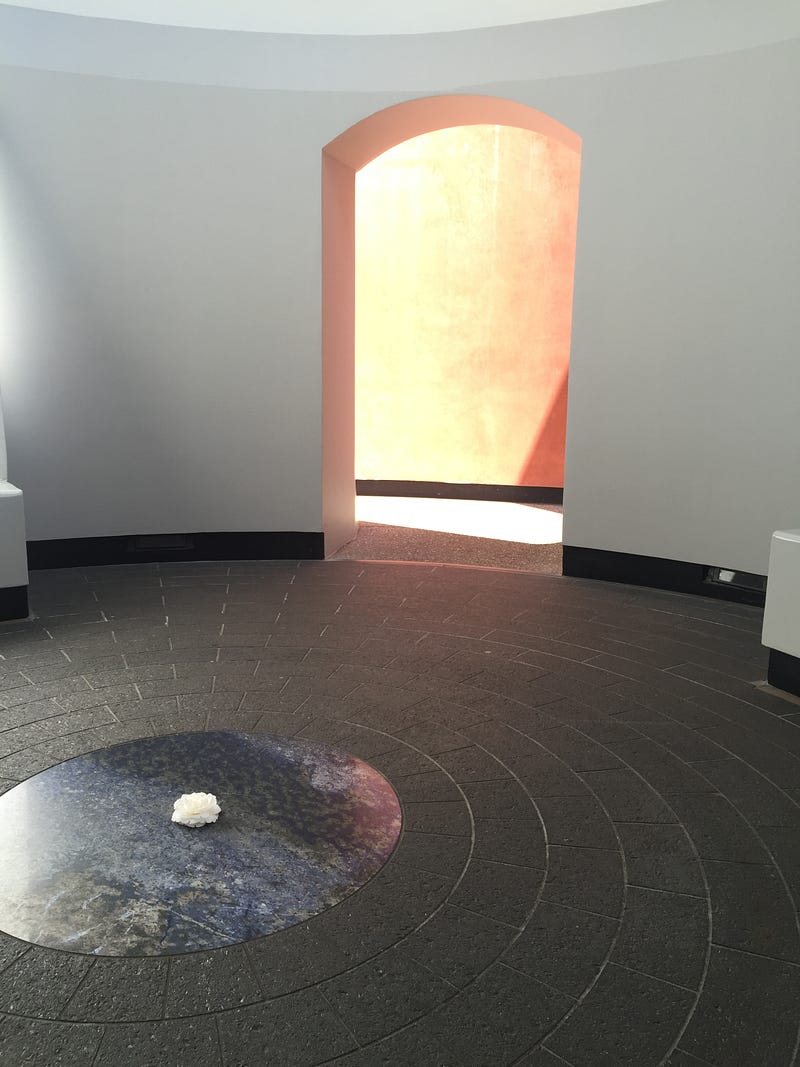
“Behind your thoughts and feelings, my brother, there is a mighty lord, an unknown sage- it is called Self; it dwells in your body, it is your body.” ― Friedrich Nietzsche, Thus Spoke Zarathustra
It was a very peculiar feeling I had in the library that day.
Maybe you’ve had it happen, too, that you are moving with a purpose which is not known to you. Something more authoritative has taken over and you are without the illusion of agency. That was how it felt. I was reading classic literature in my twenties. I was going through the stacks an author at a time. I had no conscious desire or even thought of shifting focus.
I was shunted across the room by an unknown force, directly to a specific book. I reached up to the high shelf and it fell into my hands from the stacks. It was about the philosophical system of Gurdjieff and Ouspensky. That was my introduction to the concept of eternal recurrence. I opened it and the passage read: If you find this work in one recurrence, you will be looking for it, and find it earlier in the next.
Not exactly a come to Jesus moment, but a synchronicity which got my attention. I read the book and continued with my literary education. A couple of years after that I decided I should read it again, if I could find it. It seemed to have an attraction for me. I found the book, to my surprise, in my neighborhood bookstore in San Francisco’s Laurel Village. I bought it and took it home. I opened it and stared at the title page, “Volume 2.” I had not known there was more than one, but there were five volumes at that printing. It was a collection of lectures from British psychologist Dr. Maurice Nicoll. He knew Jung and his work, and gravitated to the Asian mystery school of Gurdjieff, whose father was a storyteller in the oral tradition, and P.D. Ouspensky, who lectured on The Fourth Way.
Would everything happen in exactly the same way? What would be the point of that?
I began to think about recurrence, and what difference would it make how many times you lived your life if it all unfolded in exactly the same way every time, like in Groundhog Day, where Bill Murray stepped in the same puddle every day. Then one day he remembered himself and didn’t step in it. The goal of the philosophy is self-remembering. It’s not ordinary memory though.
I hear discussion on the concept of recurrence more often these days, by Joe Rogan for example, without much explanation of it other than it means we live the same life over and over again.
The thought of it occurred to Nietzsche when he was walking in Switzerland somewhere around 1880. He wrote about it not as something he believed, but as a thought experiment. What if a demon told you that you have to live your life over and over again as you are living it right now? Later on he embraced the idea more seriously in Thus Spake Zarathustra.
The intellectual issue with the concept of life repeating itself is, so what? Who cares? It’s one thing making copies of itself and if you can’t tell the original from the copy it doesn’t matter does it? The intellectually palatable way to express it is in terms of probability, that if the chance of recurrence is not zero, given infinite time there will be infinite recurrences. Regardless, Nietzsche championed the concept as the ultimate affirmation of life, what he called amor fati, a love of one’s fate. If you can’t change it, then change what you can, which is your attitude toward it as the only life you have.
I mentioned the concept of one thing, making copies of itself, which connects to a different concept of eternal recurrence, which has to do with ritual. The ritual is to erase linear time, so that the ritual carries the same energy as it had in its first expression. I was introduced to this concept by Mircea Eliade, a Romanian novelist, anthropologist, philosopher, and reportedly a fascist. My first contact with him was reading about tribal rituals, that the ritual space is outside of linear time.
Carl Jung described the Self as being outside time, extending into time. This is similar I think, to Eliade’s concept that there is a mythological realm, which is much like Burroughs’ western lands, where the originating event is a sacred impulse which splits time.
Eliade’s concept is very much like the concept in physics of a wave function collapse, or at least one interpretation, which says that the observation of the spin up or spin down particle is entanglement, not collapse. It splits into two universes which are opposite facing and move away from each other and so cannot ever meet. But in this model the original wave function appears to collapse on observation, but does not, in fact. It continues in an uncollapsed state.
In much the same model, but in different language, Eliade said that a hierophany, or, sacred impulse, splits time. The model is that when time is split, it is analogous to the wave function collapse. You have material polarizing right and left which is negatively charged, because it is half of something when observed. The uncollapsed function remains as it exists prior to measurement, but, obviously, can’t be observed without splitting it. Thus the sense of balance when one is aligned with the center, instead of with the polarization on either side.
It is the same with ego and shadow. It is one field which shifts energy to compensate polarizing movements. That is why the shadow can’t be just gotten rid of, and in fact, will be chosen over the ego if one of them has to go. It has more unused energy, and energy is life. The flow of the tao, or the zen moment, the yin yang balance, all refer to the practice of not identifying with the post entanglement opposites, but with the balance point, which, says Eliade, remains both in and out of time. It is the uncollapsed wave function which only appeared to collapse when it became entangled through observation in time.
The recurrence outlined in Nicoll’s Commentaries, which fell into my hands in a way that separated these lectures from ordinary knowledge, differs from Eliade’s concept, in which ritual accesses the sacred impulse in its first appearance. In Nicoll’s mode, each life is created in one moment, and unfolds like a film which can be shown and then goes back in the can until the next showing. No matter how many times you show it, it’s the same movie. The teaching is that by remembering this, we awaken into full consciousness.
As I have explored this idea I have no interest whether or not I have a reward from it that I haven’t already received. The reward is what Nietzsche said it is:
“The good life is that which succeeds in existing for the moment, without reference to past or future, without condemnation or selection, in a state of absolute lightness, and in the finished conviction that there is no difference therefore between the instant and eternity.” (Thus Spoke Zarathustra)