Recovering from Depression
An interview with author Maggie Kelly

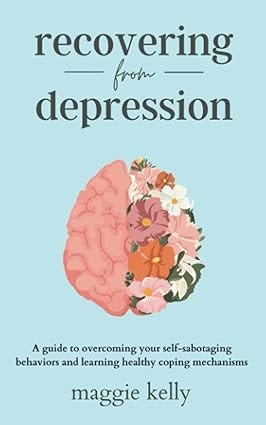
My guest is Maggie Kelly. She’s written a must-have book for anyone dealing with depression:
Recovering from Depression
A guide to overcoming your self-sabotaging behaviors and learning healthy coping mechanisms.
She’s willing to share her very own personal story just to help others.
Phyllis: Maggie, I’m so glad to have an opportunity to talk with a young author someone who’s making a difference in the world to help other people.
So, you know, this is a topic that usually experts, people with doctorates. Not many people who have experienced depression talk openly about it.
So what made you decide to write a book on the subject?
Maggie: I had to go through some horrible mental health issues. I’ve been struggling with depression since I was a young teenager. Like, I remember back when I was in 8th grade, I started to experience signs of depression. And even my mom noticed it, so it started young and I’ve experienced it like up until now in my life.
I’ve gone through really rough episodes and some okay times, but depression is weird like it goes up and down. So you have your highs and you have your lows. I had it really bad in college and it caused me to take a semester off and come home.
Phyllis: So you experienced this, but now what gave you the courage to go public with it? Why are you doing this?
Maggie: After I had my mental health crisis, I started to go into recovery. I got help from a psychiatrist a doctor and a therapist. I did like the whole nine yards and I started writing about it on Medium. I told my story in short bits and short tales and I started to realize:
Hey, like, this is enough that I could probably write a book about it.
So I decided to put it together and write some to fill in the gaps. And it was a very cathartic process. Talking about your depression like that in a very open and vulnerable manner is definitely difficult.
But I felt so good after it and I want to let other people know that they’re not alone because for most of my depression, I felt so isolated and alone.
Phyllis: I think reading your book is going to help a lot of people move on and I think that there’s going to be a need for more writing that you’ll have to do in a greater extension because this is like an early memoir and you’re going to have more to say as you continue to grow.
How do you, how do you find relationships with other people your age? Do you have friends your age in your community, or do you have to seek outside, to find just the right friends?
Maggie: I’ve had to seek outside of my age group, and I think that was also a huge part of my depression, was that I’ve never been a very extroverted person.
I’ve always kept myself and been quiet. So I didn’t have a large friend group, and those friends that I did have, I wasn’t particularly close with. So as I’m older now, I’m making it a priority. To kind of reach out to other people, even if they’re not in my age group like I’m just opening myself up.
And that is the nice thing about technology nowadays is that I can connect with people anywhere in the world.
Phyllis: And you can lead also. I mean, not only do you connect. But my experience of you is that you step right up and take leadership roles like you’ve run our conversation groups. So you’ve, you’ve taken what your experience has been and you’ve turned it into a set of positive actions.
Maggie: And something about it just kind of clicked in my brain, like, I can do this too. Like, Having someone just normal, living their life and sharing it said to me that I had a story worth telling too.
Phyllis: Well, your book is really easy to read and how have other people around you reacted to your talking about your being depressed?
Maggie: Overall, it’s been a really positive response. In our society, depression is still so stigmatized that people don’t always know how to react. You have a very explicit vision of what depression is and it’s that person lying in a bed curled up underneath the covers crying just awful.
Phyllis: Well, you were making a good point that society has a particular perspective. About what depression looks like, and it’s false because you can have a day where you’re really suffering inside, but you look like you’re okay to everybody else. It’s not that person curled up on the bed, right? It’s not the person necessarily crying. So teachers don’t necessarily catch it. If a student is suffering from real depression.
Parents can miss it. You were lucky your mother caught it, but some parents don’t realize their children might be depressed. . Let me ask a layman’s question first. How did you know you were depressed?
Maggie: There was kind of just an entire shift in my body. And I was young at the time, so a lot of it was I didn’t really know what I was going through. Like, I could have very easily wrote it off as, I’m becoming a teenager, I’m a tween, and this is just some weird hormonal process in my body, but I could also tell, a very distinct shift, like I just felt down all the time, and it felt like there’s this emptiness forming in the pit of my stomach.
Phyllis: So, you recognized something was a little bit off. Were there any events in your life that triggered depression? Mistreatment by friends? a broken heart, anything like that causes your depression?
Maggie: No, I’m not really sure what it was. I think there’s a genetic component to it and an environmental component to it.
There’s really no rhyme or reason why you get depression. Sometimes it’s life events and sometimes it just happens.
Phyllis: So there’s no situation. What you can point to that triggers your depression?
Maggie: No, although when I was a little bit older, I started to notice triggers for what could cause bigger episodes.
I would say surround yourself with friends and family. It’s so weird that, like, Christmas is a time that people are normally around their families anyway, and yet they experience seasonal depression.
But something that I’ve come across recently that has made a huge difference, is that your community is so important.
So to surround yourself with people who love you and who you love, even if they’re sometimes problematic. That’s an important part
because people are just the bedrock of life.
They hold you up, they might push you down sometimes. But I, personally, I found that my life is better when I have, real close connections with people, and have meaningful relationships, and I make it a point to maintain those relationships.
Phyllis: I’m thinking about the times when I was a young person like you and someone would say to me:
“Well, what are you going to do with the rest of your life? Or what kind of work are you going to do?Or who are you going to be?”
You know, there’s a lot of pressure to answer that question. And today’s economy is not the same as when I was young. So, you know, how do you handle that kind of adult saying,
“Okay, Maggie, you know you went to college. What are you going to do now?” What do you say?
Maggie: That’s a good question.
Phyllis: Do you push back at them? Do you have a way to protect yourself from that kind of pressure? That’s why I’m asking because a lot of young people are going to go home for the holidays and they’re going to get that question, right?
Maggie: Yeah, like I’ve gotten to a really stable point in my life, which I’m so thankful for. When you’re experiencing things like that and having your family just like constantly down your neck asking those kinds of questions it is overwhelming and it can kind of make your experience a little bit more daunting, but if you’re experiencing that, I would say just deflect it, I would change the conversation, talk about something else.
Phyllis: I’m really enjoying what I’ve observed from you. I highly recommend that people give your book as a gift this year. It’s really worth reading. Thank you Maggie, for your time.
Maggie: Thank you, Phyllis. It means so much that other people have read my book and are supporting me.
See and hear the entire interview with author Maggie Kelly on Profonde TV