
Reconsidering Environmental Ethics Using Buddhist Concepts
What Can Zen and other Buddhist Ideas Tell Us About Protecting Mother Earth?

“How can we deal with our environment in a better way”?
To begin with, this question is incorrectly asked, because “we” and “environment” are not separate beings. Therefore, the environment is not “ours,” but “us.” Ogyen Trinley Dorje, the 17th Gyalwang Karmapa (leader) of the Kagyu school of Tibetan Buddhism, says in his talk at Yale University in 2015:

“We often feel at some distance from our environment. We divide the world into subject and object, and we feel that the external environment is an object separated from us by some kind of boundary and some distance from ourselves as subjects. We need to dissolve this artificial boundary and decrease the distance from ourselves and our environment.”
If the environment and we are not actually separated as the Karmapa claims, how have we come to separate them from each other? Besides humans, do other animals do the same thing? I am not sure, but I guess it is only what humans do. Why and how?
First of all, we can find the fundamental reason through the Buddhist doctrine of the twelve links of dependent origination. According to this doctrine, because we are ignorant, we come to believe that everything, including our selves, permanently exists. Through the habitual (karmic) force, we then consider that our selves are central agents/subject who can control the objects of experience.
Subsequently, our use of language reinforces this subject-object dichotomic cognitive scheme. Language makes us believe that something that doesn’t exist actually exists by some magical power.
Stibbe, his article “Zen and the Art of Environmental Education,” points out that English has more tendencies to fabricate the subject-object dichotomy. He gives the example of one scene from the film “My Neighbor Totoro” by the studio Ghibli. Mei, one of the protagonists who is a four year-old girl, screamed with joy when she discovered an acorn falling in a room of the new house in the suburb they moved into:
“Heya no naka de donguri ga ochiteruno!!”
When we directly translate this Japanese sentence:
“Acorns are falling in the room!!”
However, the Fox version of dubs translates this sentence as:
“Acorns! WE found THEM! And I found a bunch of them right near the back door!”
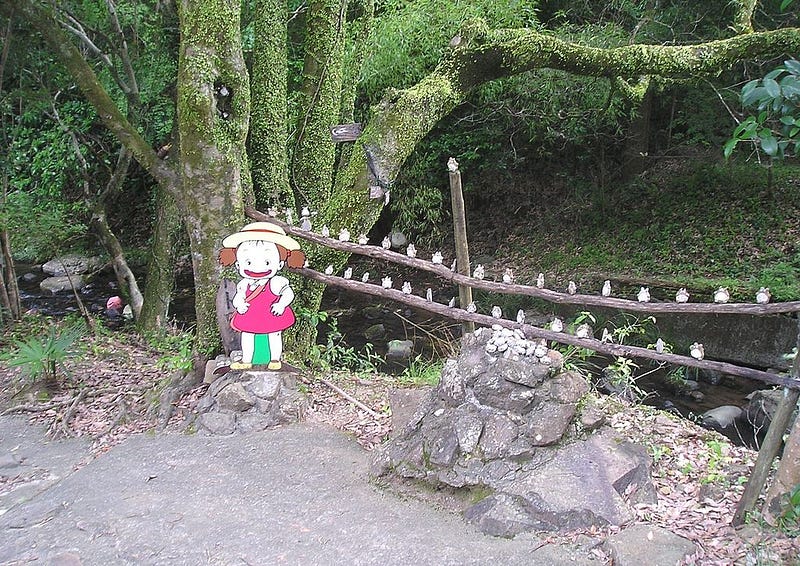
In this way, English tends to forge the subject and object in the sentence, whereas Japanese often omits the subject. Stibbe, by providing this and other similar examples, contends that “the girls in the English version fail to achieve this Zen state of egoless absorption in the world” (Stibbe, Zen and the Art of Environmental Education, p. 479).
Furthermore, the objects of experience are divided more complicatedly through the use of language. Aristotle (384–322 BC) was one of the earliest people who started to categorize living things in the world. Carl Linnaeus (1707–1778) then developed the categories in more detail and has been called the “father of modern taxonomy.”
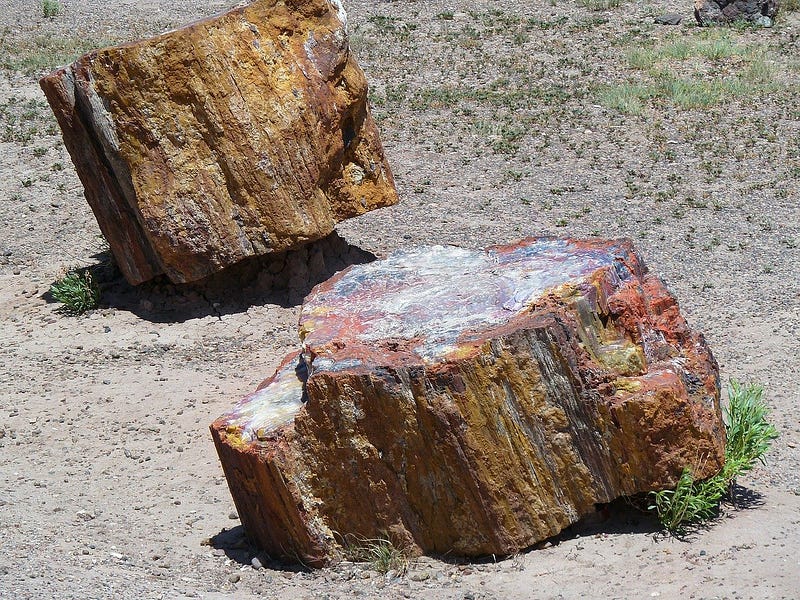
They did a great job categorizing living things according to different biological features. However, their classifications are just their interpretations, so they are arbitrary. For example, what about petrified wood, which we can see around here in Arizona? Is it categorized as wood or rock? According to Charles Darwin (1809–1882), the borders of the species are always changing throughout the ages as well …
Loss of Interconnectedness
Having said all this, if we detach from all those preexisting categories of things, isn’t it clear that we are interconnected with each other? Without the earth, we can’t even have a base to stand on. Without plants, we can’t breath. Without other creatures, we can’t eat.
Despite this fact, why do we misunderstand and regard human beings as distinctive among all other species? Besides the dichotomic cognitive scheme caused by the function of language mentioned above, greed reinforces our isolation from Nature. Greed removes our awareness of the sense of unity between us and Nature.
By attaching ourselves to a utilitarian concern, we destroy Nature while ignoring the possible damages to it. We built nuclear plants everywhere in the world and caused permanent, devastating pollution to Nature (like what happened in Fukushima ten years ago). We lack compassion towards Nature because we are blinded by material benefits.
Because of this sleeping and apathetic state, caused by excessive selfish desire, humans have been conducting over-cutting and over-killing. We have been doing this “unnatural” behavior more than we need to, while other animals usually don’t. We, human beings, are the only animals who can’t feel Dao, the principle of harmony flowing throughout Nature.
Recovering Interconnectedness
How can we awake from such a sleeping state and live with the principles of harmony so we can recover our compassion to others? Zen ethicist Christopher Ives says:
From the Zen perspective, only by eliminating entrapment in dualism and realizing Awakening can one truly overcome the fundamental cause of socio-political problems and work compassionately in the ethical and religious arena …. if one is not grounded in subjectivity that realizes the interconnectedness of all things and can see the “other” as oneself, one’s ethical efforts will ultimately fail. (Zen Awakening and Society, p. 109).
As Ives mentioned above, we need to recall the interconnectedness of all things, which is a central tenet of Buddhism. The Buddha states:
This existing, that exists;
this arising, that arises;
this not existing, that does not exist;
(Majjhima Nikāya iii. 64. Trans. by Robert Gethin. Foundations of Buddhism, p. 141).
According to this Buddhist theory, I can be “I” only in a relationship with “you” or “others.” Without premising other existences, “I” can’t exist as well. When we realize the “interdependence” of all things, we can detach from either “I” or “others” as substances and behave according to the context. In other words, we don’t act from a selfish standpoint but think and act from no standpoint (like a Beatles song).
Buddha Nature
But, if we become the “Nowhere Man” who sits in his nowhere land, how can we avoid succumbing to relativism or nihilism? In order to have a sense of unity, we need to have some common ground lying beneath us.
In Mahāyāna Buddhism, this common ground is called “buddha nature,” which is the original nature of the mind. When we detach from our conventional self, what remains is not nihilistic emptiness, but buddha nature. We then realize the fact that we were already a buddha and enjoy an awakened mentality that is the exact same mind as when the Buddha achieved enlightenment under the bodhi tree.
Then we realize that our original nature is not different from others’ original nature. With this understanding, it is logically impossible to harm others because it is the same act as harming ourselves. Thích Nhất Hạnh also says:
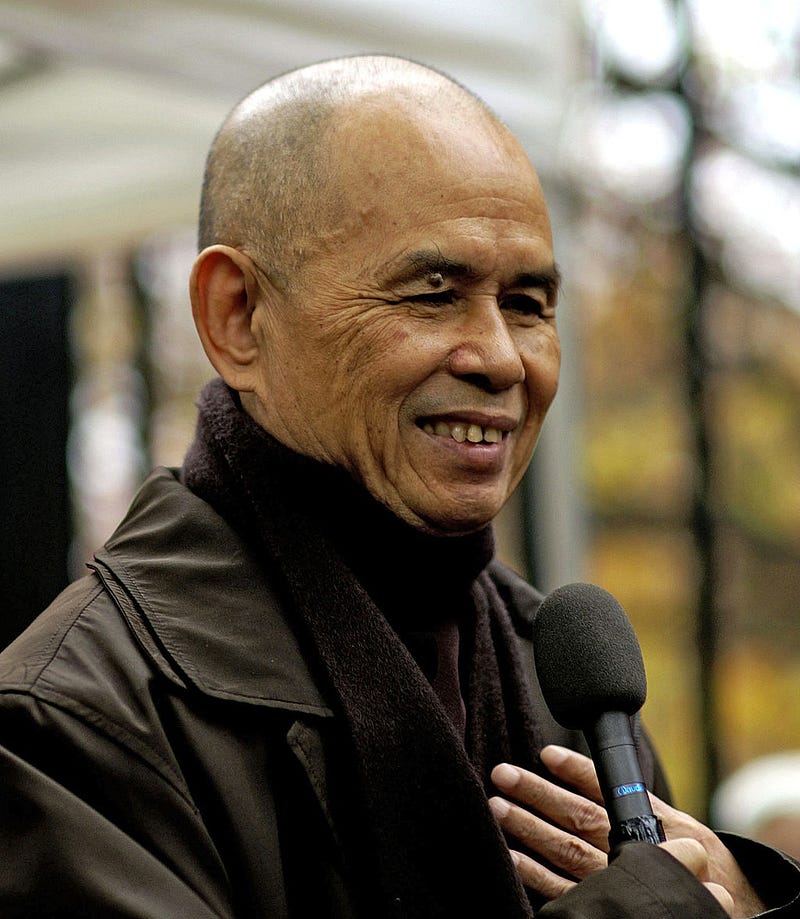
“You are me, and I am you. Isn’t it obvious that we “inter-are”? . . . How should we deal with Nature? We should deal with nature the way we should deal with ourselves! We should not harm ourselves: we should not harm nature . . . Human beings and nature are inseparable.”
Does the idea of buddha nature sound somewhat mysterious? Not at all. It is not something extraordinary, or a metaphysical experience beyond our comprehension. In fact, it is the same experience as what we usually call “love” in our daily life. When we feel love for someone or something, we are touching the buddha nature permeating everything.
We are all mediated by this love or buddha nature, whatever it is called. We all know what it is like to love, but we don’t realize the “Love” itself, as it is often hidden by a cloud of defilement and shines only occasionally. We need to clear up the cloud to reveal our buddha nature/love so that we can spontaneously feel true compassion to Nature and thus practice genuine environmental ethics.
Conclusion/Takeaway
Here is a summary of the above arguments about how we can learn from Buddhism to have better environmental ethics:
- We, as human beings, are interconnected with all others.
- When we realize this interconnectedness, we realize that everything is interdependent, so we acknowledge that we can’t survive without help from others.
- When we realize this interconnectedness, we understand that everything is conventionally divided in context, arbitrarily determined by the function of language based on a dichotomic scheme. Therefore, a self is just a name, but not a permanent existence.
- When we recognize the “No-Self,” we come to realize the “real Self,” which is buddha-like nature.
- When we see the buddha nature that is shared by everything, we realize that “we ARE others.” Then we can’t harm others because it is the act of harming ourselves.
- Only when we realize this sense of unity can we have genuine compassion towards Nature and thus enact real environmental ethics.


.jpg)