
Recognizing Boredom as a Signal for Going Inward, Not Outward
You’re not bored: How to dig deeper into moments of vulnerability
“When you pay attention to boredom, it gets unbelievably interesting.”
— Jon Kabat-Zinn
Enter the Hermitage
“Why would you want to stay alone in a hermitage?” my friends asked me, confused. “Don’t you get bored?”
My answer: Not in the slightest.
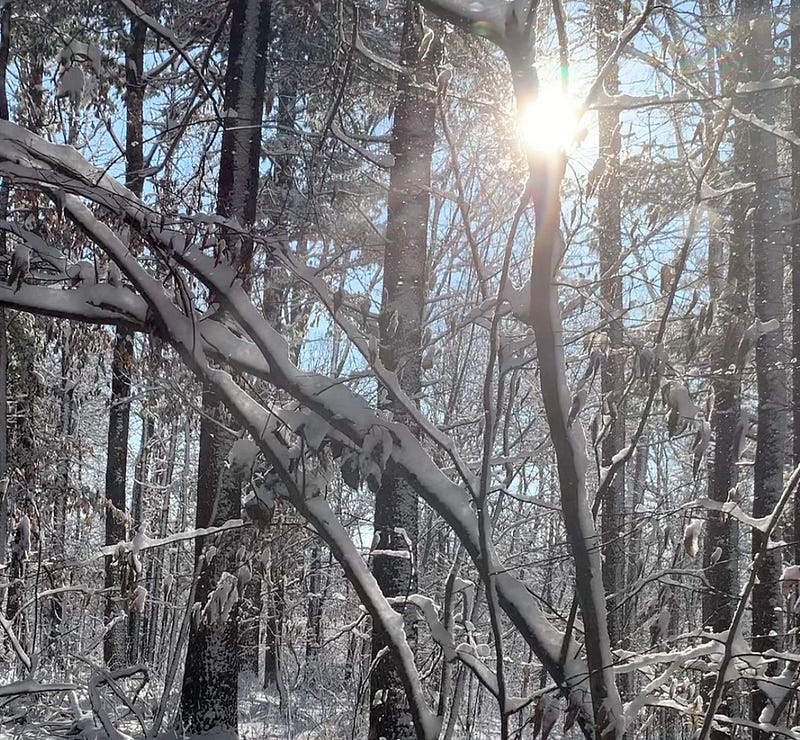
Ever since I took my first silent retreat over a decade ago, I have embraced the idea of being alone with myself. My favorite place to go is a retreat center in the middle of Minnesota. My favorite time to go is in the winter when the trees are bare and the weather is frigid cold. There’s something about the stillness in nature that supports the stillness in me; while I am taking a pause, nature seems to be, too.
I stay in a tiny one-person cabin called a “hermitage.” The people who stay there for a weekend or longer are called “hermits.”
If the hermit chooses, a staff member will bring meals out to the hermitage in a basket, knock quietly on the door, and leave the basket outside. I always choose.
Also upon request, one can “hermit” in silence, and be unburdened from even small talk. I always request.
When I first open the squeaky door and breathe in the scent of old wood, cozy quilts, and left-over pinecones from previous guests, I sink into the rocking chair and just…sit. I gaze out the window at the trembling aspens. I greet them like the old friends they are.
Embrace the Silence
Plopped in a rocking chair and my first cup of tea cupped in my hands, I take in the beautiful silence.
Silence, I’ve learned, is much different than quiet. Quiet is the result of suppression, forcing, or shushing. Silence is what’s left when even quiet goes away.
In the silence of the woods and the hermitage, I reflect on all that’s changed in my life since my last visit. This last fall, I thought about how much the world had changed because of the pandemic. I thought about the book I’d published since my last visit and how it felt to call myself a “real author.” So much had changed in my life and in the world, and yet, there were those aspens, quaking as always. Something about their presence steadies and comforts me — like the soul of the trees communes with the soul in me.
I leaf through the guest book to see who’s recently shared their story. I read stories of healing and rest. Of connecting with nature and renewing energy, or convictions, or relationships. I read stories about the gratitude people feel toward the earth, the staff, and, especially, the silence. Most guests end with a written blessing for the next guest, and I will do so as well at the end of my stay.
One thing I never read about is boredom. Hermits are never bored. Neither are the trees or the deer and other critters that stroll through the woods. And neither am I ever bored — not if I stay for a weekend, not if I stay for a week.
What is this boredom that people talk about anyway? What’s really happening inside us when we say we’re bored?
Boredom — a Cultural Malady?
From childhood on, boredom is a malady we seek to correct as soon as possible. To make it disappear, we turn on the television or scroll through social media. We might call up a friend or grab some food or drink. Any distraction will do, as long as we’re not bored anymore.
We do this so often I don’t even think we question it. If we’re bored, we seek to get un-bored. That’s it, end of story.
But through my experiences of sitting in silence with myself, I’ve come to believe that boredom is not a sign that we need a distraction. Instead, I think boredom is pointing to our discomfort sitting with ourselves — usually just about the time things might be getting interesting. Perhaps this — our discomfort with sitting with ourselves — is the real malady in need of healing.
What if boredom is not something we’re supposed to fix by grasping for something outside of ourselves? What if, instead, it’s a signal that we need to turn more deeply inward?
Boredom is not a signal that we need to be entertained, informed, or enlightened. It’s a sign that we are feeling vulnerable.
Into Our Vulnerability
We can assume that when people say they are bored, they are uncomfortable with their situation or sensation. But what is that current sensation? Do they even know? Have they even asked? Could it be that something is waiting to open itself up for investigation?
What would happen — what are the possibilities? — if we sat with the discomfort of our boredom a while longer? Perhaps we’ll realize that:
Boredom is a ploy of our mind to get us to seek outside of ourselves instead of turning inward.
Boredom is an excuse we give so we don’t have to be alone with our thoughts and emotions.
Boredom is a gimmick employed by our ego to change the subject from our vulnerability.
Keeping ourselves constantly occupied bypasses the deeper healing that emerges from moments of vulnerability.
Exploring Boredom
The next time you feel bored, try these four steps:
- Hear yourself saying it, feeling it, or thinking it. We are so conditioned to “fix” boredom we might not even notice that’s what we’re doing. Catching ourselves in the state of mind we call boredom takes mindfulness and practice, but it won’t take long before you notice it every time.
- Get curious about it. Settle a little more deeply into your body and mind, like a comfortable old rocker at a hermitage. What’s going on inside? What might the ego be trying to distract you from? Is there an uncomfortable thought or emotion that wants to be expressed?
- Follow where the emotions and thoughts lead. Write them down, dance them out, cry them loose, or find a pillow to throw or punch. Or, maybe it’s nothing so dramatic as all that, but instead, you hear the gentle tug of your soul, seeking connection, attention, and expression.
- Wait for the silence. This is the reward. It’s not suppression; it’s not shushing ourselves. And you don’t have to go to a hermitage to find it. But after whatever needs to be expressed is released, the silence will be all that remains. And you’ll probably find that nothing is boring about this profound place of silence.
Redirecting Boredom
I’ve done much of my best healing work in silence. When there are no distractions, when there’s only nature, time, and me — my life begins to make more sense. I find clarity, direction, and purpose. It’s like finding a bookmark in my own book but re-reading the past few chapters to remember where I left off.
I’m never bored in silence and stillness because sitting alone with myself is how I regain my footing in life.
I’m not bored, because when the computers and phones go away, I settle into a different kind of time and rhythm, one based on the movement of the sun and stars and by that quiet knock on the door letting me know that my next meal is sitting outside.
I’m not bored, because I’ve grown comfortable getting vulnerable with myself.
Boredom is not a signal that we need a distraction. It’s an invitation to walk deeper into ourselves — into healing, reflection, or simply resting. The more we can redirect our boredom in this way, the less we immerse ourselves in unnecessary distractions, the more we will remember ourselves as manifestations and mirrors of Nature — quaking in the winter breeze, hopping through fresh-fallen snow, or sipping a cup of tea in a cozy rocker in a tiny cabin in the middle of the Minnesota woods.


