
Recession-Proof Your Life — Part 2 (Your Money)
Money’s too tight to mention

Part 1 of Recession-Proof Your Life dealt with your work life. This time…it’s personal (finance).
I was reminded of the timeliness of this by a sub-headline last week in The Washington Post:
“Matt Miller thought he was getting a promotion when he met with his boss on Tuesday. Instead, he got laid off.”
The Great Resignation was real. But we’re now seeing a reality check. The employment world is course correcting.
Anyway, back to Part 2.
When it comes to money, keep in mind personal finance is always “personal”. Anything you read here is just a guide, a perspective, an opinion. It’s not an objective truth.
Yes, there will be best practices and rules of thumb. And fundamental principles don’t change — strategies and tactics do. But we all bring different emotional complexities to our relationships with money.
Still, whether you leave your job through choice or not, one thing you need to have sorted in advance is your financial picture.
Let’s start with a sobering fact about the financial insecurity facing many US households, as was seen during the partial government shutdown during the pandemic:
According to research by the economic advocacy group Prosperity Now, millions of middle-class Americans are just one missed paycheck away from poverty. 40% are considered “liquid-asset poor,” or without enough money put away to cope with even a sudden disruption in income.
This isn’t intended to be all doom and gloom. Simply a reality check.
So let’s consider the basics. In a nutshell, to improve your financial situation you need to spend less, make more, or achieve some combination of the two. It’s that simple. The trouble is simple isn’t the same as easy.
But people don’t appreciate that if they control the controllable and work on the fundamentals they can get ahead in their finances.
Spend less / save money
Take the “spend less” part of the equation. Things have changed. Hello, inflation!

It’s all well and good wanting to cut your expenses, but things have gotten tougher.
The important thing is to ignore the headline inflation numbers you hear in the media and focus on your personal inflation picture. In other words, how much has your personal cost of living risen? Where can you cut back?
To get a better sense of that you need to note things down on a scrap of paper, app, or spreadsheet, so you really know what you’re dealing with.
I would recommend breaking the information down into a few sections: fixed costs (costs that won’t change from month to month, such as rent), variable costs (costs that can vary, such as utility bills) and discretionary costs (spending that’s essentially at your discretion, such as a vacation).
The most obvious area to control is the discretionary space. Let’s be honest, you know that in a recession that trip to the Maldives might have to wait. At the very least, having all this information gives you more clarity and you can budget accordingly.
Debates rage about the “latte factor”. This is the idea that if you cut out your regular latte (365 days x $5 is a fair sum) and put that money to good work you can be on the road to prosperity. There are plenty on the internet that are dismissive of this — “you’re focusing on the wrong thing,” is the standard cry. They have a point, to a degree.
Look at your biggest expenses (usually aligned with housing and transportation) and see whether you can lower them. Get a better mortgage rate, buy a cheaper car, find a cheaper place to rent, cycle rather than drive. One decision rather than the need to make daily latte choices. Addressing those should give you more bang for your buck than your coffee infusions.
But there is a point about lattes. It can fall into the realms of another concept: “sidewalk money”. This is money that you metaphorically leave on the sidewalk because of a lack of awareness, a lack of intention. The money you “waste”.
If saving money is vital (and in a recession, it may well be), any emotional connection you have with your daily latte may have to be put aside. And, let’s face it, a “latte” is simply a metaphor for unintentional consumption.
There are so many areas that fit the bill for sidewalk money:
• Subscriptions you’ve forgotten about
• Insurance policies, where you pay for coverage you don’t need
• Buying lunch daily when there’s plenty of food in the fridge
• Money sitting in an account earning no interest when it could be in one earning 0.1% (ok, that’s part in jest, but the principle about being more intentional with where your money goes rings true.)
You should also:
• Get an emergency fund. This is meant to be your backstop in times of, well, emergency. Generally, the principle is for three to six months of expenses saved. But in a recession? Double that if you can. I genuinely think you need to be as prepared as possible. If you have a job that is always in demand (e.g. a nurse) you can be a bit more flexible. But the rest of us, be conservative.
• Pay down expensive debt. If you are sitting on big credit card debts get rid of them. This is an albatross round the neck you do not need. Check out the debt snowball method for as good an approach as any.
• Still have access to credit. Yes, clean up your credit cards. But make sure you can still access credit somehow. In real emergencies that could still be your credit cards, but it should preferably be something with a lower rate of interest — like a rich uncle…
These are just pointers. You can go down a rabbit hole surrounding frugal living, meal planning, extreme couponing, minimalism, comparison sites, card points, upcycling…the list is endless.
Make sure you start recording down different ways in which to cut back on spending. And apply them. I’ve got my own spreadsheet of ideas to apply — it works for me.
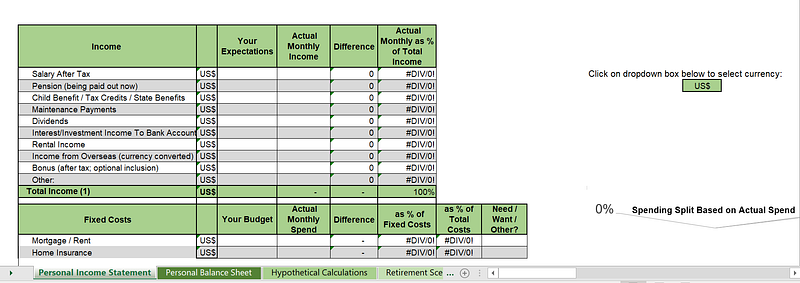
I’ve also used spreadsheets in financial coaching to allow clients to get a better understanding of their overall picture.
But don’t forget there’s only so much you can cut back on anyway. There is a limit.
Make more
I talked previously about how to navigate your money from a work environment perspective. And it’s important you find ways in which to maximize funding opportunities through your work.
Depending on where you are in the world and the type of role these could include:
• Overtime
• Matched pension contributions
• Training courses paid for
• Free or subsidized canteens
• Free tickets to events
Over the years, I’ve tried as much as possible to take advantage of what’s available. I’ve won tickets to concerts, got the firm to pay for Spanish lessons, maxed out the food and drinks at work events, got free medicals, and so on. If it’s there, make the most of it.
Let’s now touch on side hustles.
Now, I’ve dabbled a bit in this space over the years. Freelance content writing, resume writing, multi-level marketing, affiliate marketing, coaching, selling ebooks, selling stuff on eBay, and so on.
I’ve also done some of the easy money gigs out there — surveys and testing, for example. Some are better paying than others (for example Respondent).
The point is, there are so many ways in which to make a few extra dollars. Check out marketplaces like Fiverr, PeoplePerHour and Upwork to sell your skills. Look at books like Beginner’s Guide to Online Side Hustles or websites like Side Hustle Nation.
The important thing is to try to get the best return on your time, money and energy. Surveys were fine but they’re not going to make much of a dent in your monthly rent.
So how do you find the right hustle? Start where you are.
One simple way to frame side hustles is to consider how you’re actually generating cash. Perhaps I’m oversimplifying, but the way I see it, there are three overarching approaches:
- Sell something (a product). That covers everything from selling your old sofa in a yard sale, all the way to pimping a private label product on Amazon.
- Sell a service. Maybe you want to do consulting, coaching, ghostwriting, freelance web design, bartending, or driving for Uber?
- Create, build or buy an income-generating asset. This can include renting out a property, collecting income from dividend stocks, running a membership site, building a fully-fledged business, or writing on Medium.
The quickest cash will likely come from selling what you already have. The approach that is likely to take the most time, but potentially is the most lucrative, is having an income-generating asset.
Find what works for you.

And, don’t get me wrong, if you want to try out something new, there’s nothing wrong with that. Pivoting into a space that’s piqued your interest, like selling crafts on Etsy, makes life interesting.
But if money is tight and you need quick bucks, leverage your existing competencies and resources as soon as you can. If for example, you’re a trained accountant, pitch that skill to small businesses. There’s less learning required, and by bringing such authority to opportunities you should also be better placed to charge more.
A nod to the FIRE community
There’s a lot to be said for the “FIRE” (financial independence, retire early) movement. It engenders a mindset geared around a higher savings rate, more intentionality with your spending, and more focus on where money is being leaked.
At the same time, you can’t just rely on a cookie-cutter “one-size-fits-all” approach.
Stress test your assumptions. Don’t simply default to a “4% rule” (the idea of saving enough to retire early and live off annual 4% withdrawals). It may take you a lot of the way there. But life happens. You need conservative assumptions. You need margin for error. There will be unknown unknowns you need to prepare for.
The goal is to be ahead of the game. You don’t want to be behind and remain at the mercy of your boss, the government, the economy.
If you are talking about the FIRE approach, also keep in mind a few things. Only 16% of Americans retire in their 50s or younger (according to the US Census Bureau). In other words, many of you either need to beat the odds if you are taking the FIRE route or find a way to adjust to the reality of the working world. And in a recession, that gets harder.
Where next?
I’ve consciously avoided talking about investments, conventional or otherwise. That can be for another time.
In Part 3, I’ll touch on the importance of mental, physical and spiritual resilience.
I’m a finance man by trade with an Executive Diploma in Corporate Coaching.
Essentially, I created Spiritworth with the ambitious goal to help others “raise their spirit and raise their (net and self) worth.” A bit grandiose, perhaps, but you’ve got to shoot for something.
You may find affiliate links within this article.
Join me on the journey by joining as a member to support Medium writers https://medium.com/@spiritworth/membership
Connect with me on Twitter for insights on life, career and finance.