
Reboot Your Mind in Just a Few Minutes
In the office, in the car, or the shower, this easy mindfulness practice can help change your life for the better.

Work is stressful. Bosses and customers are demanding, and deadlines are tight. Meeting goals and expectations takes a lot of focus, time, and energy. Sometimes your actions do not reflect your best self. In the age of the Covid-19 pandemic, whether you are working with the public, telecommuting, or unfortunately for many, unemployed and searching for a new job, you are subject to incredible stresses.
Whether we realize it or not, we are subject to stress in our daily lives. We carry that stress in our bodies and our mind. It can affect how we perceive the world, how we feel, how we react to events, and how we accomplish our day-to-day tasks. Just like a computer becomes fragmented, slow to respond, and buggy, your mind can become sluggish or over-reactive under stress.
By becoming aware of how you carry your stress and how it affects your body and mind, you can begin to mitigate its adverse effects and increase your focus on critical issues.
This process is called mindfulness. According to the American Psychological Association, mindfulness is a “moment-to-moment awareness of one’s experience without judgment.” In layman’s terms, you pay attention to the present moment, usually sitting still while focusing on your thoughts and your breath, and how they affect body parts and feelings. While you focus on your thoughts, you notice them without judging them. They are neither horrible nor wonderful. They just are.
Studies from 2005 show that mindfulness correlates to the growth in brain thickness of the pre-frontal cortex, which is responsible for reasoning and thought. Put another way, mindfulness may grow the part of the brain responsible for higher-level thinking.
Further, studies show that mindfulness can reduce stress and anxiety, increase focus, and even help people sleep better and better manage pain. A study of practitioners in work settings indicated that participants had significant decreases in perceived stress as well as increased mindfulness, resiliency, and vigor.
Another study from 2013 examined “whether a 2-week mindfulness-training course would decrease mind wandering and improve cognitive performance.” The findings “suggest that cultivating mindfulness is an effective and efficient technique for improving cognitive function, with wide-reaching consequences.”
In other words, this study in which subjects participated in a short, 2-week course of mindfulness showed that participants improved their ability to focus their thoughts and perform at a higher level. For anyone whose workday consists of back to back meetings and phone calls, and struggles with an overflowing email inbox, having a tool that helps you focus quickly and perform at a higher level, is beneficial.

About eight years ago, I embarked on a self-improvement journey. I read many books on the best ways to generate more success personally and professionally. Some of the books mentioned mindfulness. I had heard of mindfulness or it’s synonym: meditation, but it made me think of the 70’s era hippies, crystals, and flower children. I was not sure how something like that could help me become a more successful professional.
I decided to join a local mindfulness group. I figured I had little to lose, and I could always quit if what I learned was not helpful.
The group mindfulness practice typically lasted thirty minutes. Over the course time, I learned that twenty-five to thirty minutes is optimal for me. I attended groups who conducted longer sessions of an hour or more, but other than a sore behind, I didn’t notice a significant difference from the shorter version. I also learned that I don’t need the full thirty minutes to experience many of the benefits.
Mindfulness doesn’t always require a long period of time
Many days I did not have the thirty minutes of free time. So, I developed a three-minute practice, which I started to do at work. I wedged it in between meetings and other tasks. It is called a focusing exercise or a body scan practice.
The three-minute exercise often leaves me feeling refreshed and relaxed. More able to change my emotional state from stress, frustration, or anger into something more helpful and able to focus on the task at hand. The feeling does not always last, and I often find myself stressed again later in the day, but I can always return to this technique. Even if I use it for a few seconds, I will receive some relief and increased focus.
The effects of the practice are cumulative. The more often you do it, the easier it is to do it again, and the results of the practice become more powerful and last longer.
I believe it can be used by anyone, anywhere, at almost any time. It can be done in work settings or personal settings too. Even in the shower, while driving your car (make sure to keep your eyes open!) or sitting on your couch.

If you are new to mindfulness, you can download a free mindfulness app such as Insight Timer or Smiling Mind. They provide hundreds of free guided meditations and tracking diagnostics to view your progress over time.
Below you will find an example of the three-minute guided mindfulness exercise I practice regularly. You can also listen to an audio version.
Three Minute Meditation Script:
Find a comfortable chair. You can also lie on the ground or in your bed, but for most people who are practicing during the workday, a chair is more reasonable.
Place your feet flat on the ground and sit as straight as possible. Allow your hands to rest on your legs or folded within your lap.
Close your eyes.
Take a deep breath in through your nose counting to four, notice the cool air in, and then push the warm air out of your mouth counting to five. Repeat — cool air in and warm air out.
Now, pay attention to your head. How does it feel? Does it feel heavy or light?
Pay attention to your face and relax the muscles in your face. If you’ve clenched your jaws, relax them.
Notice your shoulders. Are they hunched up and tight? If so, breathe deeply in and out and relax them.
Notice your stomach. Does it feel knotted or tight? Let it soften and relax.
Take a deep breath in and then out.
Notice your behind and how it feels sitting on the chair. Feel how you are supported. The world is holding you up.
Notice your legs how they connect to your feet. Relax your leg muscles.
Notice your feet on the ground. Imagine roots extending from your feet into the soil, supporting you. Stable and powerful.
Inhale and feel the cool air as you breathe in and the warm air as you breathe out.
Whenever you feel tension or stress throughout the day, all you need to do is breathe in and breathe out.
Now sit quietly for a little while. Notice how you feel now compared to when you began.
Open your eyes and go about your day, knowing that you can always return to your breath and body to relax and regain your focus.
End of Three Minute Meditation Script
Audio Version — Click below to play
Three-minute guided meditation audio file
There is no wrong way to meditate
Don’t worry about doing it wrong. There is no way to meditate wrong. Setting your intention to sit still for three minutes and attempt to focus on your breathing and body is a good thing. You’ll likely clearly see your thoughts in a way that may startle you.
Thoughts like: “I need to call my co-worker,” or “I need to leave to pick up my kid,” or “I’m hungry. What’s for dinner tonight?” or “how is paying attention to my breath going to make me less stressed?”
Relax. These thoughts are healthy.
You can say to yourself, “I’m thinking about issues, or my kids, or my hunger, or I feel stressed,” and then return to watching your breath and body.
Tell yourself, “I’m meditating.”
The practice is noticing your thoughts and return to your breathing, to the scans of your body parts. Over time you may see that when you are stressed, your jaw is tight. Or you have a knot in your stomach. Or that you hunch up your shoulders. You will begin noticing these sensations as they happen.
You can sometimes identify what caused stress. Your focus on a body part will relax it.
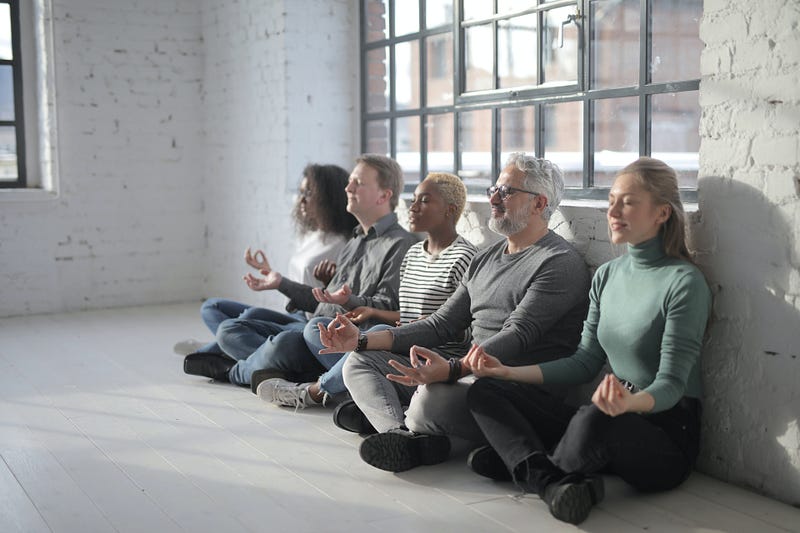
When I had a leadership position with a small team reporting to me, I used this technique with my team at the beginning of our weekly staff meeting. I’d set my timer on my phone and walk my team through the body scan.
When the practice finished, most people felt more relaxed. They felt sharper and more focused, at least for a while. Some even took the practice home and used it with their family.
The body scan practice is an investment in yourself. Over time, I think you will see patterns and recognize when you feel stress and how it feels in your body.
If you pay attention to the thoughts that preceded the stress, you can better understand what triggers your stress response, and relax the parts where you feel uncomfortable. You will focus on essential things and ignore the rest.
I hope you find value in this practice and the benefits of on-demand relaxation, modulation of your emotions, and increased focus.


