

Reasonable emotion
Peddlers of misinformation typically appeal to their audience’s emotions. But emotion also has a benign role in our cognition. How to spot the difference?
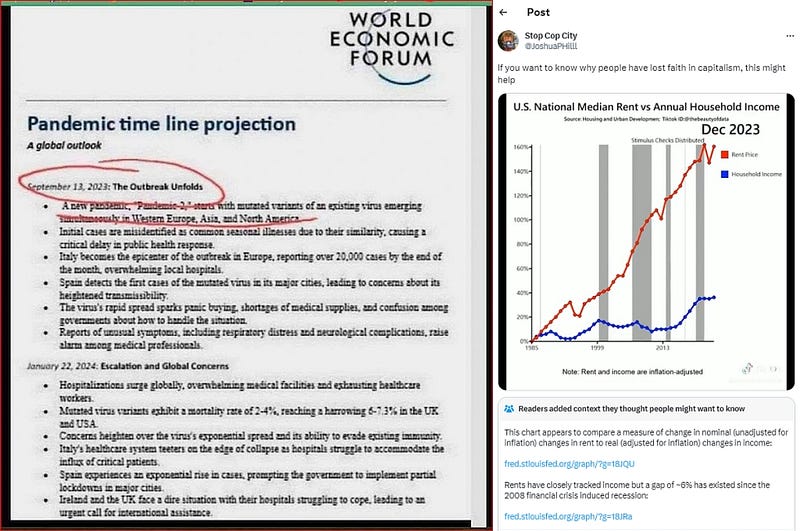
You don’t need to look far for examples of disinformation — two instances that passed through my line of sight this week were the claim that the World Economic Forum (WEF) is “planning” a new pandemic, and the claim that median rents in the US have vastly outstripped household income since 1987. Almost by definition, fake news consists mainly of falsehoods or speculation rather than of verifiable facts and testable argumentation. There is no truth to the alleged plans of the WEF (not only is the document a fabrication, but even if this organization wished to orchestrate a pandemic, the idea that such an endeavour is possible is the product of fevered imagination, rather than from robust argumentation), and while the chart showing the growing discrepancy between rents and income does use actual data, despite its claim that both lines are “inflation adjusted”, only the wage line is.
Emotion, easy to abuse
Research by Cameron Martel, a cognitive scientist at the Massachusetts Institute of Technology, and colleagues, suggests that “emotion plays a causal role in people’s susceptibility to incorrectly perceiving fake news as accurate.” It is therefore not surprising that fake news, thin on verifiable facts and argumentation as it is, seeks to speak directly to the audience’s emotions.
The WEF, representing the global elite, has been the subject of conspiracy theories for some time, and the document that circulates is presented as yet another piece of evidence of its evil purpose and intention — not just content with safeguarding and augmenting their wealth to the detriment of ordinary people, but firmly set on enslaving and oppressing the rest of us. Its aim is to confirm existing beliefs rather than shape alternative ones, stoking up latent suspicion into full-blown outrage, but also activating a certain sense of smug superiority — “Me? I am not being taken for a ride by the WEF, I see through them and won’t be fooled!” — over the poor souls who don’t get it.
The chart showing the rent rising much faster than the average household income seeks to demonstrate the landlords’ greed and the victimhood of the tenants, and — as the accompanying tweet makes clear — to lay the blame of this alleged problem with capitalism. Here too, provoking outrage would seem to be the primary aim of the messenger (a self-confessed anti-capitalist).
That is no surprise. Outrage is an emotion with the power to motivate us into strong, and potentially impulsive, action (remember the attack on the Capitol a few years ago). Even if we are not necessarily immediately ready to take up arms for the situation that so enrages us, it tends to amplify our engagement with the claim in question. The Martel study referred to above did not consider outrage, as it was concerned with the participants’ actual emotional state immediately before they were shown fake and genuine news items, and not the emotions elicited by the news items themselves. However, the study found that participants who reported heightened states of emotions as diverse as feeling hostile, scared, enthusiastic and irritable, were more likely to believe the fake news, and less likely to discern fake from genuine news. Given the intensity of outrage as an emotion, it is the perfect instrument for the purveyor of misinformation.
But is the role of emotion in our cognition specific to fake news? According to a paper by Chai Meei Tyng and colleagues at Petronas Technology University in Malaysia, emotion has a substantial influence on a variety of cognitive processes, notably those involved in learning and memory. In particular, emotions can help us focus attention onto relevant information, and facilitate the encoding of information and its subsequent efficient retrieval. We do indeed tend to have more, stronger, and more vivid memories of events that have, or had at the time, greater emotional significance. This role of emotions in cognition has evolutionary roots. Our ancestors relied on primary emotions to respond appropriately to environmental challenges and promote survival and procreation — threats from predators, the need to find nutrition, or the urge to reproduce. We, their human descendants, possess secondary and tertiary processes guided by emotion, respectively concerned with learning and memorizing, and with complex cognitive functions such as planning for the future based on past experiences. These two higher processes rely heavily on the emotional foundation — without emotion we would not be able to establish what the beneficial and detrimental choices are.
Emotions and genuine news
Also in the news, this week, was the following item. Three years ago, 13-year-old Martha Mills had a cycling accident, in which she fell on the handlebars of her bike. Her pancreas was pushed against her spine, causing a severe laceration. In hospital, she developed an infection and ultimately sepsis, which required a transfer to an intensive care unit. This did not happen, and as a result Martha died. An inquest found that there had been several opportunities to take action, but the parents’ concerns (who did suspect she may have developed sepsis) were dismissed by the doctors. Since then, her mother has worked with Demos, a pluralist British political think tank, on formulating a new policy proposal ( Martha’s Rule) that gives patients (or their parents) the right to obtain a second opinion, which was published this week. The news item, which reported how and why Martha died, clearly also elicited emotions — as a parent I can confirm this — and indeed outrage ( “That is scandalous!”, my other half exclaimed as the circumstances of Martha’s death were recounted).
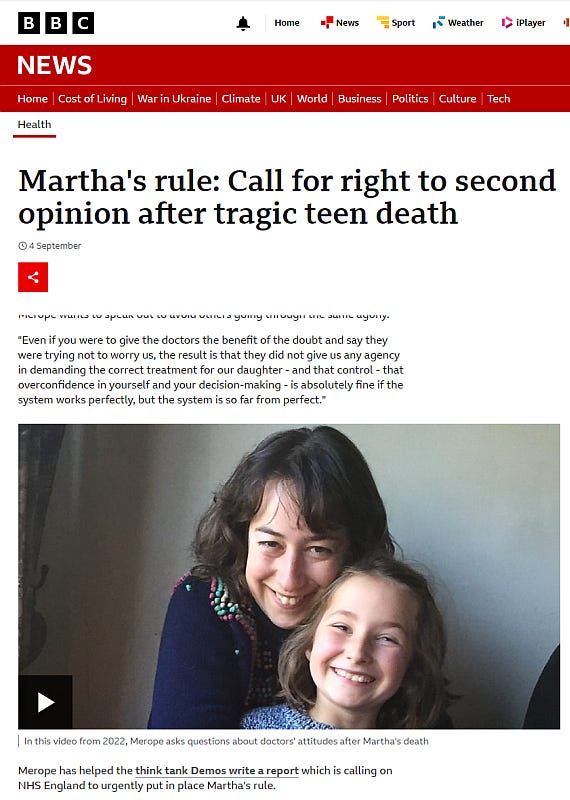
This genuine, rather than fake, story would seem to challenge the claim that emotionality is a “fingerprint of misinformation” as Dan Williams, a lecturer in philosophy at the University of Sussex, did in a Twitter thread this week. “People sometimes draw attention to important truths by activating emotions”, he wrote — alluding to a legitimate rhetorical technique, which is contingent on the subject matter being a truth, naturally. It would therefore be a mistake to treat emotionality as a robust signal of misinformation, even though misinformation often makes use of it.
What is important for you and me as consumers of information, is to ensure emotion does not dominate our judgement. Misinformation often involves the informal fallacy of appeal to emotions: accepting someone’s claim “merely because the appeal arouses your feelings of anger, fear, grief, love, outrage, pity, pride, sexuality, sympathy, relief, and so forth.” So, when an argument uses emotion, ask whether there is any factual substance to it, and whether the emotionality is used to provide context and amplify the significance of that substance. If so, there is nothing wrong. But if, instead, you find emotionality is the key premise of the argument, masking the absence of any substance, better beware.
We might see emotions in an argument akin to the seasoning of a dish. Like a well-prepared meal can be enhanced by judicious use of salt, herbs and spices, a solid argument can be strengthened by judicious use of appropriate emotional interpretation. But just like excessive use of spices can obscure the amateurish preparation and inferior ingredients of a dish so that we wrongly judge it as excellent, an emotional story can hide its mendacious background and lead us to take it for the truth.
When it comes to emotions, it is best to engage our reasoning too.
Originally published at http://koenfucius.wordpress.com on September 15, 2023.
Thanks for reading this article — I hope you enjoyed it. Feel free to share it (the ‘share’ button below or at the top has direct options for Twitter, Facebook and LinkedIn) or simply copy and paste this link. See all my other articles featuring observations of odd human behaviour (I have been publishing one every Friday since 2016) here. Thank you!