
Identity Crisis, Self-Discovery, Personality
Why You Are Always Stuck in Identity Crisis
It will help you feel fulfillment at any age

Identity crisis is a psychological conflict when someone questions their existence in this world. This is can occur at any age and I believe all of you have ever been there. Before we jump in deeper about this issue, what do you think is the meaning of “identity”? In my opinion, identity is a label that we want to pin on ourselves. This is the result of repeated pilots from how you brand yourself, what values you hold, how you want to live life until finally how you are known after death. The identity crisis issue was first coined by Erik Erikson, a psychologist from Germany.
Actually, identity crisis is a part of the process that must be faced once we grow up, especially in our 20s. There is also a lot of discussion about the quarter and midlife crisis which is more or less the same. We feel a normal identity crisis when a new chapter appears in our life such as getting into a new relationship, getting married, having a child, starting a new job, and many others things that make us have a new role. We need time to adapt and accept our new roles. This also applies to the phase of loss or the sudden arrival of a disaster such as a breakup, divorce, struggling with a new health issue like pandemic right now, losing a loved one, being fired from a job, etc.
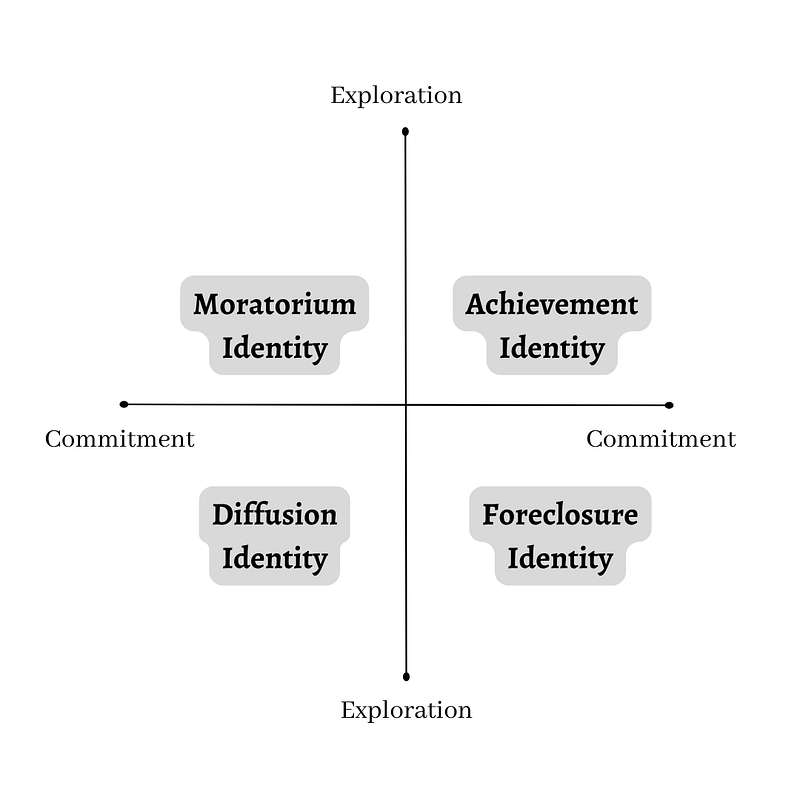
Questioning who you are can’t be underestimated, some of you probably experiencing pretty serious symptoms because it’s like feelings of hopelessness or worthlessness, sudden loss of interest in something that you enjoy, fatigue, feeling irritated, or a drop level of concentration. Identity crisis is consists of 2 pillars commitment and exploring. Based on Marcia's research, there are 4 types of identity crisis areas below. I made a simple illustration so, you can understand better each area then I tried to sort the explanation starting from the worst in my version.
Diffusion Identity
Occurs when there is neither an exploration nor commitment issue. Those who struggle with diffusion tend to feel out of place in the world and don’t pursue a sense of identity. In my opinion, this area is the worst case of identity crisis because very weak of the two constituent pillars. How can we find ourselves if even unwilling to do simple actions like open the map? a person at this point will feel time flies so fast and he feels he has done anything in life.
What you can do:
If you are in this phase I suggest you do a basic pillar first which is exploring. You can’t commit to something if you don’t even have options to choose from.
- What are your interests, passions, and hobbies?
- Are you doing what you like to do? and if not, why?
- How do you deal with pain?
- What do you do when you are very sad?
No need to hurry up find the answers. Take your time. answer as best you can first, over time some points may change, and some adjust.
Foreclosure Identity
when a person has made a commitment without doing attempt exploration as alternatives. This condition is where we usually only accept the values taught by our parents outright. We think our parents know better and have more experience in this matter, so if something works for them, it would work for you as well. In my opinion, this area is the second one, weaker than the moratorium. Having high commitment without really understanding the strong reason why you should do it is a suck like a robot. How can we be willing to sacrifice thought, time and energy for something we are not really sure whether it is right for us or not.
What you can do:
Identity develops by experimenting with different behaviors. roles, and through social interactions as well. Try to see your life from the outside. Sometimes the new beauty and ugliness appear when we see it from afar. If you are one of those who still follow the values of your parents without any buts, some things you can try include:
- Live apart
- Work or school out of town
- Travel outside city and country
- Make friends from different backgrounds.
If after exploring a lot of other things and your values stay the same it means great you’ve found yourself and it’s okay if some change. Keep respecting the values of your parents and family. Differences are unique things that make us able to complement each other.
Moratorium Identity
A person who is actively involved in exploring different identities but has not made a serious commitment. Exploration gives us a wider perception. the more you export something new, the wider the perspective and this affects how you see the world until you become more aware that this world provides you with so many options. But when we enjoy exploring too much, we sometimes forget that identity formation requires commitment and hard work to form it. But when we enjoy exploring too much, we sometimes forget that the formation of identity takes commitment and hard work to form it. We need to practice more so that we become more experts. Honestly, I’m struggling at this stage. In contrast to the commitment that takes more effort to maintain, exploring is much more fun but only makes us wander around aimlessly.
What you can do:
Consistency is quite a challenge for me, especially since I get bored easily doing the same thing for a long time. Even so, I felt I already found what kind of identity do I want in my life so I want to pick a few things that so fit me well. Because for me the results will be worth it, I am willing to sacrifice more and bounce back from failure for that. Some of the things I do below
- Build one small habit every day for my dream-like for example writing on medium at least once a day.
- Reducing distractions with the Pomodoro technique.
- Have one goal that I want to complete and become my priority every day.
- Set a new goal every month which will be the highlight of my month at the end of the year.
- Change the wallpaper on the laptop desktop with the country I want to visit. You can change it by adjusting it to your dream.
- Doing routine research in the field that I am passionate about such as how the trend is changing, what can I improve, what is outdated so that the boredom disappears because I keep learning something new.
Achievement Identity
You’re almost there. This area happens once someone has gone through much exploration enough of the variant field then finally capable make a commitment to one or more things that fit them. Usually, you reach this point after passing the age of 30 years. This point is more stable and you are in the self-acceptance phase after the long process you went through to get here.
What you can do:
I haven’t reached this point yet, so I can’t relate to the inner turmoil I felt when I reached this point. Although some research says this condition is quite stable, since we have endorphins in our bodies, one of which can be fulfilled by having goals, I’m sure that inner conflict still exists even though in different levels and portions. If I can suppose if I’m already at this level, I seem still to be exploring other things that I don’t know yet or something I’ve ever done but haven’t had time to dive more into.
Bottom Line
Identify unique traits in yourself so, you can increase self-awareness and knowledge of how you want to spend your time and the way you move forward. Learn to set your boundaries when trying to figure out who you are and what you want out of life. Setting boundaries not only with people but also with your commitments at the same time. This can help you get clearer on your path forward. Commitment and exploration dimensions will continuously develop that part of processing to shape you. Just because you experienced a period of identity exploration as a teen doesn’t mean that you are set for life. Never stop exploring your values, roles, and sense of self regardless of your age.
shoutout to Tim Denning who always writes a great article. From this post he wrote I learned the more we know the more we feel stupid


