
Reality
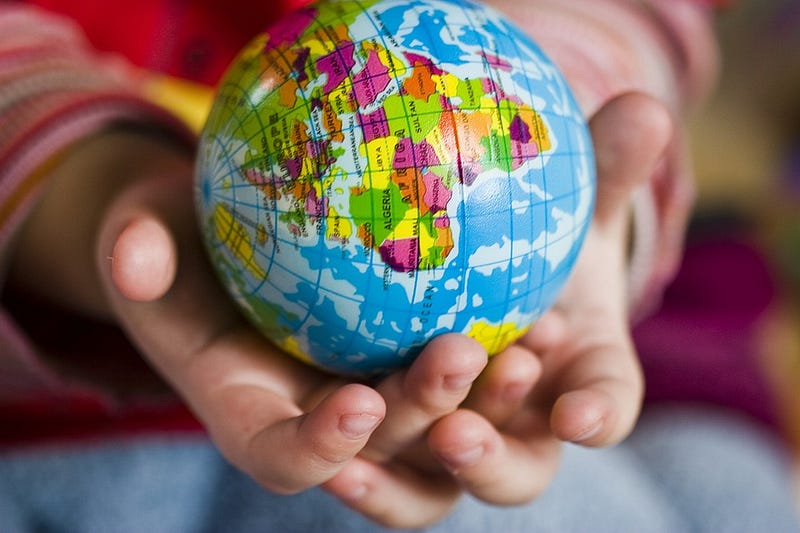
Once a little boy told his mum that he reckoned there shouldn’t be any more wars, and that people ought to take care of each other and make sure everyone gets enough to eat. She smiled, patted his head and told him he was a sweet child.
The boy stopped sharing his idea as he got older, because it made bigger kids scoff and ridicule him. He learned about economics and foreign policy, and how war is often necessary to stop bad guys from doing bad things. He took on this new understanding so that he wouldn’t be made fun of anymore. Sometimes as a grown-up he’d think back on the juvenile thoughts he used to share with his mum, and he’d chuckle at how innocent and naive he was.
Then the boy got even older, and he learned that that perspective was naive as well. Actually it’s all a pack of lies, he discovered, and the politicians and pundits are deceiving everyone about what’s going on in the world for the benefit of a few wealthy ecocidal warmongers. He came to understand that everything is fake and everyone is corrupt, and he spent his remaining days scoffing at people and smugly knowing better than those who believed what the TV told them.
On his deathbed his mind did strange things as his body failed. One day, after spending an entire weekend in a non-responsive state, the boy sat bolt upright and startled his children and grandchildren who were gathered at his bedside, screaming, “Fuck! I got it right the first time!”
We are inseparable from the world we live in. This is self-evident in the breathing of air, the eating of food and the drinking of water. Ninety percent of the cells in the human body are bacteria, upon whose ecosystems the health of the entire physiological system depends. Science tells us that what we take to be separate objects are actually relatively loose clusters of tiny moving particles with no clearly defined boundary line, and when you reduce those particles to their smallest possible components it becomes difficult to say exactly what they even are or to what extent they even exist. The cells in our own bodies are constantly being replaced with proteins, minerals and other nutrients we extract from other organisms, to such an extent that it’s difficult to claim with any authority that you’re the same creature that came out of your mother’s womb.
And yet we think of ourselves as separate. We think if we destroy the planet we live on, if we destroy the ecosystemic context in which we evolved and into which we are inseparably woven, it’s no big deal because we can just become a space-faring species like in science fiction books. This despite the fact that our only ventures into space thus far have been glorified scuba diving excursions, with all resources imported from a planet with a fully functioning ecosystem. The difference between living in space independently of Planet Earth and visiting space with imported supplies is the difference between flying and jumping. We only think we’re remotely close to the former because we erroneously view ourselves as separate from the ecosystemic context which birthed us.
A human being is a swirling eddy in a flowing stream, with a mental soundtrack playing in the background saying “This stream and I, we are separate things.” Mental noises are imbued with the power of belief which describe a separate self in a separable world, despite the complete absence of any such thing that can be observed by science or by direct experience.
In direct experience there are thoughts, there are feelings and there are sensory impressions, but in none of them can a hard, tangible thing be found that can be accurately labeled “me”, no matter how hard you look. The closest you can get is to tell a story about a particular person with a particular name and a particular history, who inhabits a particular body, and then labeling that cluster of stories “me”. But that’s all they are. They’re stories.
Mental story is the only realm in which separation exists. It’s the only realm in which it makes sense to give all the stuff to Joe because Joe figured out how to make a talking dongle widget that works a bit faster than the other ones. It’s the only realm in which it makes sense to drop explosives on a group of human organisms because they are standing on the wrong clump of dirt. Without narratives about separate organisms who need to protect their interests from other separate organisms, fear and greed lose their foothold, and thus can’t be used to manipulate people toward certain agendas. The only thing that makes sense is peace and harmony.
This is what human awakening looks like. And, in my opinion, it is where we are headed. The simple, obvious truth you saw as a child was reality. You had it right the first time.
____________________
Follow this link for a printable mini-zine that you can use to distribute this essay around your neighborhood in whatever way you like. Instructions here.
____________________
Internet censorship is getting pretty bad, so best way to keep seeing the stuff I publish is to get on the mailing list for my website, so you’ll get an email notification for everything I publish. My articles and podcasts are entirely reader and listener-funded, so if you enjoyed this piece please consider sharing it around, liking me on Facebook, following my antics on Twitter, checking out my podcast, throwing some money into my hat on Patreon or Paypal, or buying my book Woke: A Field Guide for Utopia Preppers.

Bitcoin donations:1Ac7PCQXoQoLA9Sh8fhAgiU3PHA2EX5Zm2


