
Real Housewives Of Nazi Germany
How did the women sleeping with the enemy — the wives of Hitler’s top aides — live with such monsters?
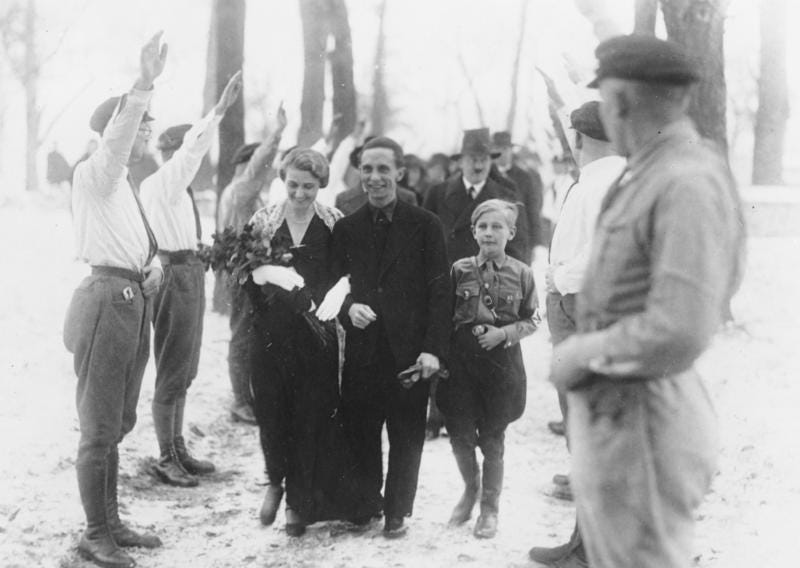
Magda Goebbels had a chilling request for one of Adolf Hitler’s doctors as the Red Army closed in on Berlin in early 1945: She wanted enough poison “for herself and her six children.”
Magda was the wife of Joseph Goebbels, Hitler’s propaganda minister, and in a letter to her absent son from her first marriage, she explained why she needed it:
“Our beautiful idea is being destroyed, and with it goes everything I knew to be fine, worthy of admiration, noble and good. Life will not be worth living in the world that will come after Hitler and National Socialism.”
That “beautiful idea” was the murder of six million people and the creation of a biologically superior “master race” of Nazis who would rule the world.
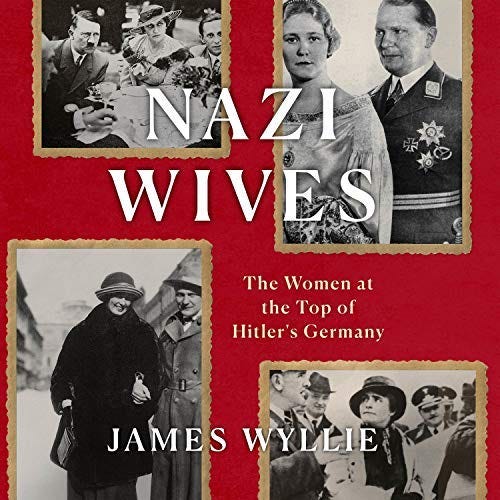
Was Magda Goebbels delusional, a woman who truly believed what she wrote? Or was the so-called First Lady of the Reich engaging in “a last piece of propaganda,” as James Wyllie suggests in his Nazi Wives: The Women at the Top of Hitler’s Germany (St. Martin’s, 2019)? The answer isn’t clear.
What’s clear is that two months later, the six Goebbels children were murdered, probably with cyanide. They were killed by Magda or Joseph, or both, or by a doctor acting on their orders, shortly before the couple took their own lives.¹
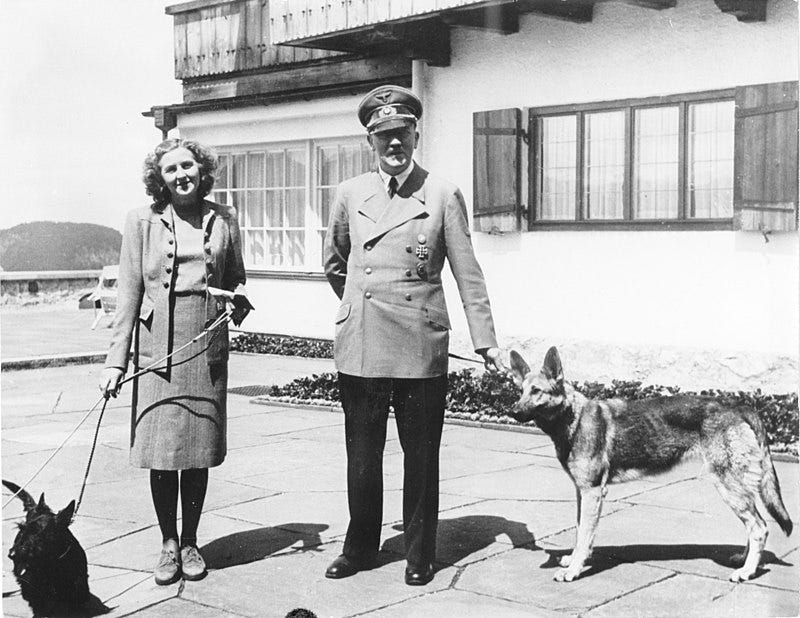
Less than two days earlier, Magda and Joseph had gone to the wedding of Hitler and his mistress, Eva Braun — a “festive” event with champagne and sandwiches in their bunker — before they, too, died by suicide.
Magda and Eva are well known, but the wives of others in Hitler’s inner circle have had little attention except from historians.
Who were these women? How much did they know about their husbands’ atrocities, and why did they stay with them, regardless? What was in it for them?
In Nazi Wives, Wyllie looks for answers in the lives of Magda, Eva, and the wives of five others in Hitler’s inner circle: Martin Bormann, Rudolf Hess, Heinrich Himmler, Hermann Goering, and Reinhard Heydrich. The women’s commingled stories can be hard to follow, and they offer scant context for their husband’s crimes. They also omit a few prominent figures, such as Adolf Eichmann.
But Wyllie gives nonetheless startling glimpses of a group who wielded a soft power overshadowed by stories of their grandstanding husbands. His book includes details about the Nazi elite rarely found in popular histories.
Who knew that Hitler’s staff brought sex workers to his vacation home in the Bavarian Alps, which had a farm? Wyllie writes:
“to give the many laborers who were employed on all the building work something to do other than drink and fight, there was a theatre and a brothel — around twenty French and Italian prostitutes — in a barracks about 4 miles from Obersalzberg.”
For all that, Wyllie argues persuasively that while the strains on the women’s marriages varied, “their commitment to Hitler’s cause never wavered.”
All of Wyllie’s wives came from conservative, middle-class families, social circles in which “a woman’s best hope was to find a good husband.”
But they had come of age amid the tumult in Germany after its defeat in World War I and the humiliating terms of the Versailles Treaty. Buffeted by the political and economic shocks, the women had lost their prewar moorings, Wyllie says:
“Cut loose, they each gravitated towards a self-styled savior who promised them the world.”
Once married, the Nazi wives kept their families together as their husbands oversaw some of the most horrific acts in human history. The women raised children, tended to palatial houses, socialized with Hitler and other Nazi elites, and met the sexual demands of men used to having their way.
Margaret Himmler carried a unique load as the wife of the Deputy Führer, the second most powerful man in the Third Reich, who oversaw its death camps. She fought loneliness during her husband’s absences by sewing, reading, making preserves, and volunteering with the German Red Cross.
“Without any work outside the house, I could not live through the war,” she wrote in her diary.
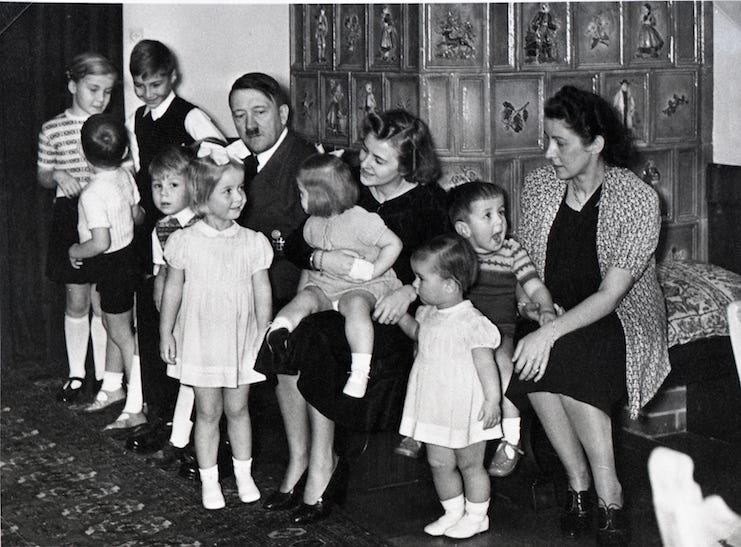
Ilse Hess faced a different burden when she and Rudolf had trouble conceiving a child.
The Nazis prized virility, and a bestselling anti-impotence potion implied that “a sexually inactive man was not a useful member of the community because of his failure to reproduce.”
Rudolf made daily trips to a pharmacy for would-be remedies, and when he and Ilse finally had a child, Hitler was godfather.
Hitler’s goodwill toward the couple vanished after Rudolf landed in Scotland on a mission to make peace between Britain and Germany that may or may not have been authorized. ² Goebbels, perhaps trying to deflect blame for the fiasco from Hitler, called Ilse one of the “evil geniuses” behind Rudolf’s bizarre act, saying:
“I’d like to give a good thrashing to that wife of his!”
Over time, at least some of the women gained a sense of their husbands’ crimes against humanity. Gerda Bormann saw in an attic furniture made from human body parts, including a chair whose seat was a human pelvis.
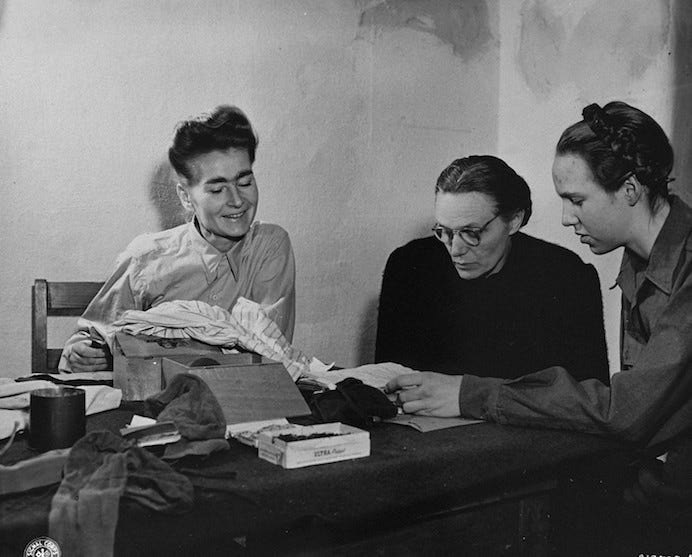
To cope, some of the Nazi wives developed what might today be called a profound ability to deny, rationalize, or compartmentalize. They included Emmy Goering, who lived with priceless art that Hermann confiscated from Jewish owners.
“Like her husband, she claimed they had no intention of keeping the art for themselves; they were its custodians, keeping it safe and secure,” Wyllie writes.
“Once the war was over, Emmy said her husband would open the Hermann Goering Museum and put it on all public display.”
If she had qualms about the stolen art, Emmy didn’t hesitate to flaunt the plunder. She and Hermann had country estate north of Berlin with a 150-foot swimming pool, a movie theater, a gym, a map room, and a vast banquet hall with uniformed footmen and curtains monogrammed with letter H in gold. Looted statues and paintings lined an entrance hall.
Emmy was rich and sensitive enough to give a weekly allowance to a Jewish friend, an actress who was no longer allowed to perform. When the woman’s husband faced deportation from Berlin, Emmy made an indirect appeal on his behalf to death-camp overlord Himmler. She was assured that the man would go to Theresienstadt, “one of our very best camps.”
Emmy’s effort backfired when the couple went to the gas chambers.
How did the Nazi wives enjoy such lavish perks even as Germans starved and defeat in World War II loomed?
Perhaps the most valuable point in Nazi Wives is that the women met a social and emotional need for the unmarried Hitler. Wyllie writes:
“The top Nazi wives were able to enjoy their many privileges and their gilded lifestyles because Hitler allowed them to. His interest in them was bound up with his need for an extended family — he took great care in choosing Christmas and birthday presents for the wives and their children — and the fact that he was more comfortable in the company of women, as long as they openly and unconditionally adored him, didn’t discuss politics and conformed to the stereotypes he found attractive.”

That bit of pop psychology points to something deeper, suggested in an article on mob wives by the priest and moral theologian Alexander Lucie-Smith. He wrote that a Mafia wife never asks about her husband’s work:
“Of course, she knows, but she has chosen not to know. This is the most powerful omertà of all, the silence one practices with oneself.
“If you’ve killed 200 men, it might be hard to live with the memory, and here the mafia wife performs her greatest task of all. With her, you are an attentive husband, a doting father to the children….You are not a monster; you are the man she loves. She, the mafia wife, makes it possible for you to delude yourself.”
Much the same appears true of the wives of the Nazi elite. They found ways not to know what they knew.
These wives performed many services for Hitler, but perhaps the greatest was this: Along with his other adoring fans, they helped him delude himself. They made it possible for him to deny what the all the world eventually would learn: that he was a monster.
Source notes:
- Historians disagree on who gave the poison to the Goebbels children. Wyllie says there’s general agreement that a Nazi doctor was involved, but it’s unclear whether Magda or Joseph helped or was present.
- Hitler professed to be furious and confused about the Hess flight. But, as Wyllie notes, some thought he knew about it and that his reaction was “a performance by a gifted actor.”
@JaniceHarayda is an award-winning critic and journalist whose articles have appeared in many major print and online media. She is the daughter of a U.S. Army interpreter at a prisoner of war camp for captured Nazi soldiers.
You might like another of my stories for History of Women:


