
Read These 4 Books To Know The Mental Models You Need To Know
Navigate your life 10x better with new systems.

We've all felt stuck and uninspired at some point in our lives. I have felt it several times during my work in all domains of life.
I used to spend time thinking that this was a transition period and that I'll be focused once this passed.
But sometimes, it takes a mental shift, such as focusing on the long-term outcome rather than the short-term pains of achieving that goal.
Here are four books that will definitely help you when you are stuck in a mental rut —
1. Thinking in Systems
by Donella H. Meadows, Diana Wright
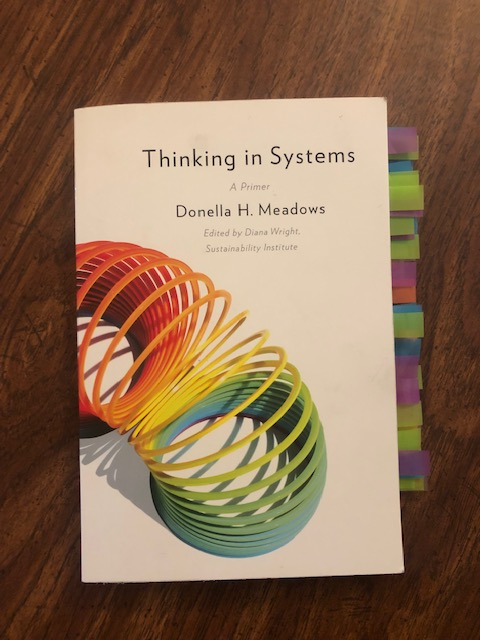
The book provides readers with a comprehensive introduction to the principles and concepts of systems thinking.
Meadows emphasizes that many of the challenges we face in the world today, such as climate change, poverty, and social inequality, are complex problems that cannot be adequately understood or solved through traditional linear thinking.
Instead, she argues that we need to adopt a systems perspective, which involves understanding how various components of a system interact and influence each other.
The book explores key concepts such as feedback loops, stocks and flows, leverage points, and resilience. Meadows explains how systems thinking can be applied to various domains, including environmental management, business, public policy, and personal decision-making.
Favorite parts from the book —
“Remember, always, that everything you know, and everything everyone knows, is only a model. Get your model out there where it can be viewed. Invite others to challenge your assumptions and add their own.” ― Donella H. Meadows
“You think that because you understand “one” that you must therefore understand “two” because one and one make two. But you forget that you must also understand “and.” ― Donella H. Meadows
“So, what is a system? A system is a set of things — people, cells, molecules, or whatever — interconnected in such a way that they produce their own pattern of behavior over time.” ― Donella H. Meadows
2. The Great Mental Models: General Thinking Concepts
by Shane Parrish, Rhiannon Beaubien

The book introduces readers to a collection of mental models — conceptual frameworks that help us understand and navigate the complex world more effectively.
Parrish and Beaubien argue that mental models are powerful tools for critical thinking and decision-making. They explain that by adopting and applying these models, individuals can improve their ability to analyze problems, make better decisions, and develop a more comprehensive understanding of the world.
The book explores a wide range of mental models, drawing inspiration from various disciplines such as psychology, economics, mathematics, and physics.
Each mental model is presented in a concise and accessible manner, providing readers with a clear understanding of its underlying concepts and practical applications.
The authors emphasize the importance of combining multiple mental models to gain a multidimensional perspective.
“The Great Mental Models” encourages everyone to cultivate a habit of lifelong learning and to expand their mental toolkit continuously.
Favorite parts from the book —
"You can't improve if you don't know what you're doing wrong." ― Shane Parrish
"I don't want to be a great problem solver. I want to avoid problems — prevent them from happening and doing it right from the beginning." ― Shane Parrish
“There is an old adage that encapsulates this: “To the man with only a hammer, everything starts looking like a nail.” Not every problem is a nail. The world is full of complications and interconnections that can only be explained through understanding of multiple models.” ― Shane Parrish
“The only way you’ll know the extent to which you understand reality is to put your ideas and understanding into action. If you don’t test your ideas against the real world — keep contact with the earth — how can you be sure you understand?” ― Shane Parrish
3. Think Again
by Adam M. Grant
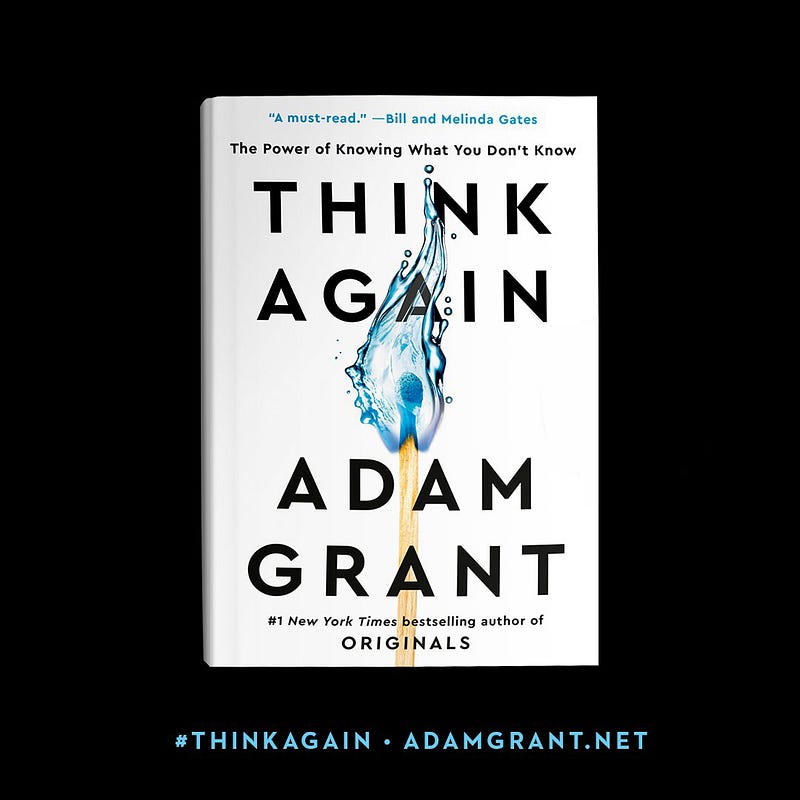
Grant argues that intellectual flexibility and openness to new ideas are crucial for personal and professional growth in today's rapidly changing world.
He explores the concept of "cognitive flexibility," which involves actively seeking out diverse viewpoints and being open to changing one's mind based on new evidence or information.
The book delves into the human tendency to fall victim to cognitive biases, such as confirmation bias and motivated reasoning, which can hinder critical thinking and limit our ability to learn and adapt. He offers practical strategies and techniques to overcome these biases, encouraging readers to engage in constructive debate, actively seek dissenting opinions, and challenge their assumptions.
Favorite parts from the book —
“If knowledge is power, knowing what we don’t know is wisdom.” ― Adam M. Grant
“We listen to views that make us feel good, instead of ideas that make us think hard.” ― Adam M. Grant
“Thinking like a scientist involves more than just reacting with an open mind. It means being actively open-minded. It requires searching for reasons why we might be wrong — not for reasons why we must be right — and revising our views based on what we learn.” ― Adam M. Grant
“Research reveals that the higher you score on an IQ test, the more likely you are to fall for stereotypes, because you’re faster at recognizing patterns. And recent experiments suggest that the smarter you are, the more you might struggle to update your beliefs.” ― Adam M. Grant
“A mark of lifelong learners is recognizing that they can learn something from everyone they meet.” ― Adam M. Grant
4. Seeking Wisdom: From Darwin To Munger
by Peter Bevelin

In Seeking Wisdom, Peter says that wisdom can be attained by integrating knowledge from various disciplines and applying it to real-world situations.
He draws on Darwin’s insights into the principles of evolution and natural selection and Munger’s wisdom from the world of investing and decision-making to provide readers with a comprehensive framework for practical thinking.
Bevelin delves into human cognitive biases and the errors of judgment that often cloud decision-making. He highlights the importance of mental models, or frameworks, for understanding and navigating the world's complexities.
Through captivating storytelling and extensive research, Bevelin presents practical advice on improving their thinking processes and making more rational decisions.
Reading is a top-tier habit that can change your life drastically. Read thousands of other stories on Medium. Become a member using this link (PS. It helps me a little, too).


