
BOOK REVIEW
Read First, Talk Later — the Story of my Life
3 books I recommend — so far — for anyone else trying to self-educate around the topic of #BlackLivesMatter

Here are the occasions when I’ve been actively criticised for trying to bury my head in a book instead of interacting with the world around me: at family breakfasts as a child; at big family birthday parties, also as a child; on work experience as a teenager, waiting for my chronically workshy supervisor to make his inevitable 11am appearance, and having nothing else to do (still fume at the injustice of that one); whilst allowing my baby to eat finger foods in her highchair, with half an ear cocked for choking sounds; and many times on a bench, at the park, while my small children played on the climbing frame and swings.
Leaving aside my own feelings on how fair or unfair these criticisms were (actually, no, I will rant briefly on this — I see plenty of mothers these days scrolling through their phones whilst feeding their babies or sitting at the park, and I see zero difference in our behaviour other than the fact that I was probably reading something more interesting than a Facebook weird trick to melt away belly fat, so yeah I wish I’d known we’d all be ignoring our kids at some point and stood up for myself more vociferously back in the day) you’ll see the theme here. I love reading. I’ll choose the world I can find within pages over the world in front of my eyes in all sorts of scenarios.
Last month, when George Floyd’s brutal murder at the hands of police hit the headlines, it was obvious immediately that the terrifyingly appalling injustice of what had happened — combined with the febrile near-mania induced in so many of us by week upon week of pandemic lockdown — was going to lead to civil unrest on an unprecedented scale, both here and in the US. All of our social media feeds went crazy with the #BlackLivesMatter message, the blackout day, the call to arms in the form of hastily arranged protests and marches and petitions and fundraisers.
I felt the same panicky rage that everyone was describing. I’d recently read Malcolm Gladwell’s “Talking to Strangers”, which focuses in depth on the way that police (in this case, in the States) are basically, through their training and targets, stuffed to the gills on purpose with racial prejudice and primed to act upon it. Gladwell uses the the case of Sandra Bland in his writing, but his point could be illustrated by any number of case studies across any number of states and countries. It is a problem. I understood that immediately and just as immediately, I knew that action and change was needed and justified.
My social media feed, though overwhelmingly (thank fuck) supportive of the #BLM cause and simmering with similar opinions to mine, did rustle with occasional whispers of the “all lives matter” rhetoric. One of my own parents tried the line on me, too. “Surely all lives matter, in a pandemic?” I tamped THAT right down. I’m just saying, though — people I love, people I respect, were offering up viewpoints that I knew to be problematic and just plain wrong. Sometimes, you can’t just block the haterz and move on. Sometimes, there has to be discussion.
Look. I’ll put it out there. If anyone were pigeonholing me without knowing me, they’d definitely stick me in the Karen slot. I’ve got blonde hair to my shoulders, I’ve never been afraid to confront a restaurant manager about some sub-par avocado toast, I work in a traditionally conservative profession at management level. We have a labrador, ffs. And hanging baskets, which I deadhead. I’ve got a yoga mat and I’m not afraid to use it. Basically, I am well aware of how I appear. I’m also well aware that my politics don’t match my appearance. (I don’t want to make assumptions about anyone else either; I try not to).
What I wanted, when suddenly the systemic racism that I’d been vaguely aware of (but not aware enough) was thrust into the spotlight, was actually to change minds in the people I spoke to about it. I wanted the fence-sitters and the “I’m not racist but” and the “yes but that’s in America, not here!” and the “but it works both ways!” voices to listen to what I might have to say in our conversations about the news and to accept, perhaps, the fact that it’s OK to change stance on something as important as this. It’s OK to admit to a lack of knowledge.
And what I realised, when I contemplated this mind-changing exercise I’d loftily tasked myself with, was the yawning chasm at the heart of my own knowledge. There are things I understand and feel informed about, but there are untold things that I do not yet understand. And instinct is no weapon in any battle.
So, I’ve reverted to type. I’ve kept my head — relatively speaking — down, and I’ve buried it in books. Fiction and non-fiction, educational and entertaining, but all centred around racial issues. These are my top 3 recommendations, all of which have contributed to the point I’m now at, which is where I’d tentatively have a bit of an argument with a fellow Karen and feel confident of my viewpoint but I wouldn’t do an Instagram story about it yet (partly because my friend Shereen would derail it somehow with an irrelevant Corbyn quote I’d still struggle to argue with and I’d feel deflated, and partly because the last thing the world needs is another Karen trying to be woke).
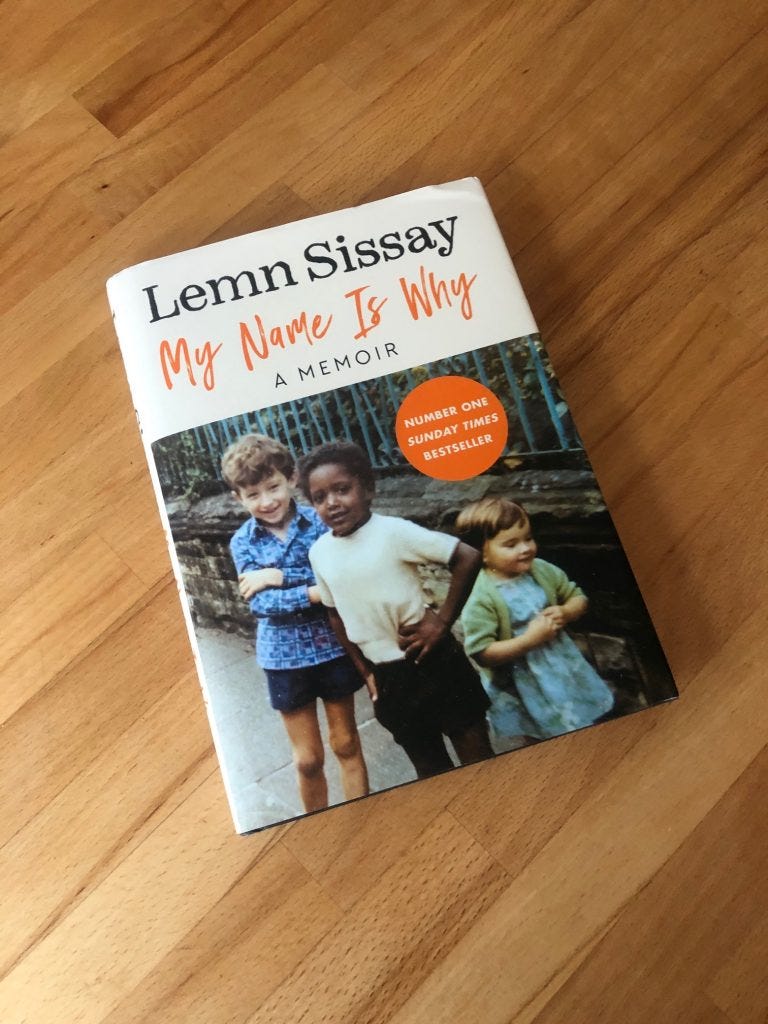
Beautifully written, with a humblingly hopeful and optimistic tone, this is Sissay’s autobiography detailing his early years as a foster child initially placed, for many years, within a strict and very religious white family. As a person of colour Sissay was left doubtful and confused about his identity and I think his experiences within the care system would have broken a lot of children. The extracts from the social workers’ files are particularly heartbreaking.
This is fiction, and all the better for it. It kicks off with an episode in which a black nanny is confronted by a security guard in a supermarket and accused of kidnapping the small white child in her care. The incident is defused almost immediately when she calls the child’s father, and everyone is sufficiently apologetic and humiliated and appalled, but the repercussions of this event ripple out through the story. Some astonishing links are uncovered down the line between a man who films the supermarket furore (later using the footage to strike up a friendship with her) and the nanny’s employers.
I found myself uncomfortably challenged by the dynamics in this book. It’s about as good as a depiction of the “good/bad racism binary” as I’ve ever seen. Read it if you still think you’re not a racist. It’s also quite light and funny — a deft combination. Doesn’t feel like a lecture in fiction form.
White Fragility — Robin DiAngelo
An explorative and explosive work by DiAngelo, who is a white woman employed for many years in diversity training and as a Professor of Whiteness Studies. She coined the term “White Fragility” to describe the way that white people will so often retreat behind being offended or hurt when the issue of their attitude to race is raised. This shuts down essential conversations and can lead to a dangerously entrenched seam of plausibly deniable but divisive racism.
DiAngelo kicks off her book with a list of the things that right-thinking white people will often say when race issues are raised. “I’m different because…” is the recurring theme. I cringed, as she predicted I would, but then I sat up and listened. By accepting the fact that white people will have racial prejudice — that we cannot be objective, but that this is not our fault — it is possible to override the good/bad binary and stop equating racism with “bad people”. We can be good people and still hold racial prejudice and accept that, in order to move to an open conversation that brings about change. I found this thought process refreshing and it gave me real hope for genuine societal change if the message filters through. (I’d have liked a bit more “how” after the “why”, though. I was willing to own my racial prejudice and open up to change, but I’d have liked a few more tips tbh).
I’m not done, by a long stretch, on the reading front. I’ve got a whole list lined up (there’s a good list here I’m aiming to work through, and I’ve had some other recommendations too). My purely historical knowledge of racial conflict in the UK is still shockingly poor so I’m addressing that next, for example. But so far, the ones above are the ones I’d re-read.
BRB, written worlds are calling.
Originally published at https://theunravelling.net on June 17, 2020.


