
Re-inking the Ribbon
That typewriter hadn’t cost shirt buttons, to quote my father on the subject of anything that cost anything at all
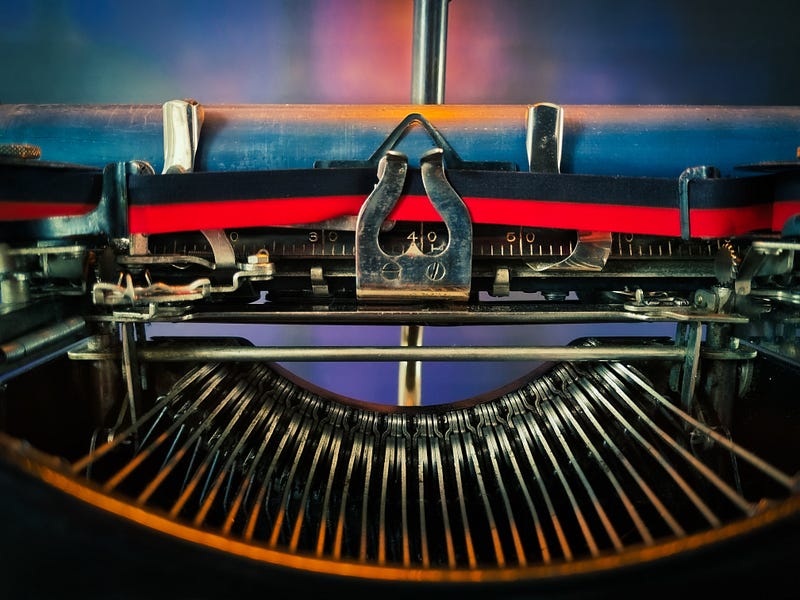
My first novel was a shocker. Indeed, it was called Shock. Or perhaps Shock! The manuscript might still exist somewhere but, like so many of the things from my childhood, it’s most probably in storage and unlikely ever to be unpacked.
I can see it, though. I can feel the heft of those 280 or so A4 pages. Would we have bought the paper new? Doubtful. My family didn’t exactly frequent stationery stores, not even when it came to Back to School season each September.
I expect it came from next door neighbour, Victor. He of the permanent leer and the wandering hands. Victor worked for the council and those hands tended to wander not just around his fellow staff but also council property. At least one of my typewriters came via that route. The last of my typewriters, I recall.
When the Olivetti Lettera 35 — now considered a classic of its kind — clattered its loose-springed last, it was replaced with a machine a good forty years older. A typewriter of upright piano proportions with circular keys and raised metal rims. It belonged to the age of Orwell, even though the machine had more than likely only ever been used for invoices and requisitions. The council, after all, were not known for their fiction output.
Sometimes, the paper seemed equally old. Foolscap rather than A4. Yellowed with a dusty crust. Not exactly the pristine white I would have wanted for my work, most especially when I had plans to send my material out to publishers.
It was all very well having the typewriter and getting the paper from Victor’s council surplus raids, but there was also the matter of the ribbon. The Olivetti used a black and red ribbon. I had little use for the red, wanting my work to look professional. Needing my work to look professional.
That typewriter hadn’t cost shirt buttons, to quote my father on the subject of anything that cost anything at all.
It hadn’t been bought for me to “fanny about with”. Quite the reverse. If I had planned on just “fannying about,” the noise of the thing alone would have caused one or other of the two authority figures in the household, (before that number was brutally halved), to chuck the typewriter out of the window.
It does amaze me that it never was. My Bontempi organ was smashed to pieces when I was about five or so. I don’t remember the crime on that occasion. I do remember that, like all things that were used up, broken, or just fell apart due to the effects of entropy, there was never going to be another.
So, it does amaze me that the Olivetti lasted. But, of course, it wasn’t bought for recreation. It was bought because I was going to be a writer.
That was her idea. The woman who would spend much of the latter part of my time in the household under the tartan blanket on the sofa. She had a notion — and who was I to argue her out of it? — that I might become a writer.
Writing might equal success. And success might equal money. I had, after all, had my three Witch Washington stories “published” by the headteacher at St John’s primary.
Those books are still in storage somewhere, too. My stories were typed up, most likely by the school receptionist, on the rather nice typewriter they had in the school office. One of the electronic golf ball types that produced text that could almost be mistaken for professional printing.
I was given the typed pages to illustrate in my naïve felt tip style, and then the whole lot was stapled, laminated, and presented back to me in assembly. And, yeah, I felt like I was a proper writer. I had achieved something.
And the woman who would later exist under the tartan blanket had the notion that I could perhaps do much the same, but for money. We could most definitely do with the money.
And so the Olivetti Lettera 35 appeared.
But it only came with one ribbon. And, true to form with capitalism, the ribbon was either shorter or less well-inked than the replacements that would cost those additional shirt buttons we didn’t have.
For a while, as I typed my way into the evenings after school and over weekends and during each one of the school holidays, replacement ribbons did appear. But, then, as entropy worked its way with my family, and we lost the income of the one parent who worked, I had to resort to desperate invention.
It was lucky I still had the felt tips.
I realise this sounds somewhere on the way to something very like “mad” — if you don’t realise the real ramifications of that word — but I would spend my time with my felt tips colouring in my worn ribbon.
It was almost possible for the increasingly uneven type to look something approaching black once again. Of course, anything that was likely to be considered a draft would be typed in the faintest of faint type. Or red, if I was really desperate.
I was under a promise not only to the woman whose idea I am sure it was but also to myself. I’d written so very much and piled the dusty, yellowed paper up so very high, that I wasn’t going to give in.
I was going to send the stuff off, precisely as we had discussed. I’d gone to the library to look in the Writers’ and Artists’ Yearbook for publishers (but not agents, because I didn’t know better). I’d had worked out who should receive my magnum opus, whether they wanted it or not.
So, I needed to write it, no matter the state of the typewriter or ribbon.
Or, indeed, the degree of alcohol-related distraction at home.
I don’t think, then, that it ought to surprise anyone that my first novel was a shocker. Shock! Maybe even Shock!! A mixture of murder mystery and horror that you would expect from a child who was largely brought up on his own by the television. And who had spent far too many Friday nights watching the Hammer Horror double bills on the BBC.
At least one teacher clocked that one.
Nothing was ever done about my “inappropriate viewing”.
If the teacher had dared to say anything, she would have been called every name under the sun.
Behind her back. When we got back home. But, then, the words weren’t for the teacher’s benefit. It was vitally important that I understood these people were idiots who didn’t know anything.
Why else, after all, would they have become teachers?
So, my first novel was an unsavoury mixture of murder mystery and horror in which — to take just one or two of the more choice examples that still squat in my mind — a body is found drained of blood in a bin in an alleyway, and a murderer attempts to conceal their identity and the really very large cast they are wearing on one foot, by wearing a wedding dress in order to commit their crime.
As you do.
It’s naïve and it makes me cringe, even as I know I need to forgive my younger self a bit more for the more risible plot points. There I was, trying to write the next Booker Prize winner, knowing that I had to write a multi-million bestseller.
I wasn’t just without the internet then (everyone was, of course). I was without the life experience necessary to get anywhere close to the kind of material that might have made a publisher ask for the full manuscript.
You know, of course, that I didn’t have the sense to send a covering letter, synopsis, and sample chapters, don’t you?
You know that I sent off the entire thing, don’t you?
And you can probably guess how the request for a Jiffy bag and postage went down in a family where shirt buttons were the major form of currency.
So, guess whose fault the rejection was when it came?
Guess what kind of indolent, useless piece of crap I was for failing at something so important?
Yeah, I need to forgive my younger self a bit more for the risible plot points and the re-inking of the ribbons.
Because, if nothing else, he kept writing all the way through it.
And that is a habit that has kept me going through so very many worse things since.
150 Medium pieces in now, I think I’m getting the hang of this. If you’d like more of the same, here’s a piece about a very…peculiar childhood ambition of mine.


