
Re-Examining Spike Lee’s Do the Right Thing 30 Years Later
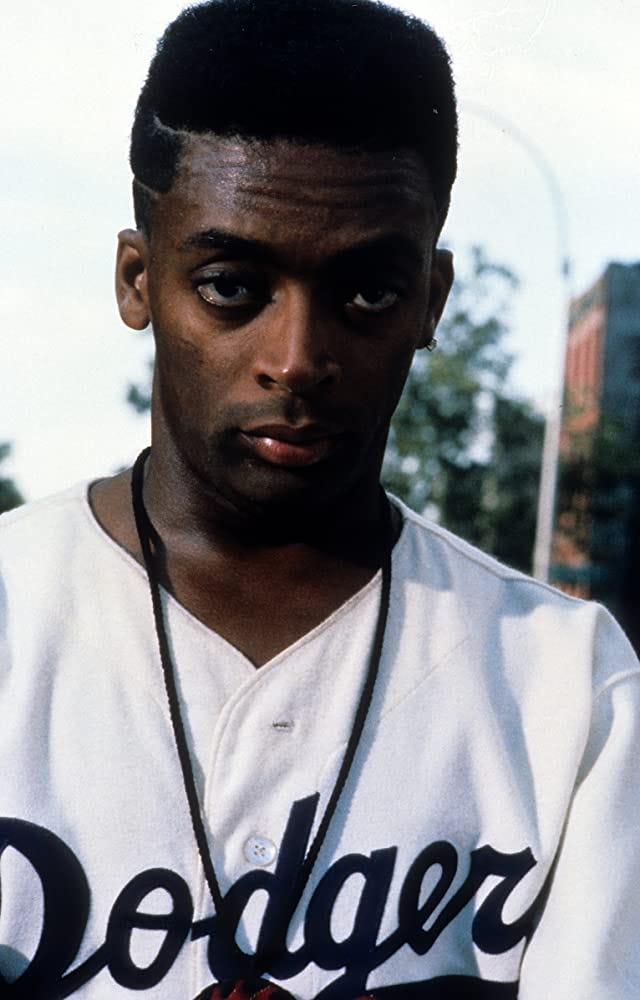
Spike Lee’s Do the Right Thing was a bold project when it released in July 1989. A complex film that doesn’t flinch when confronting racial and economic tensions, Do the Right Thing manages to feel human where later star-studded projects (à la 2004’s Crash) can feel didactic.
One of the more abstract connections to the film may be Alan Moore’s 1986 epic The Watchmen. Both narratives explore the trope-y economic landscape of New York that so dominated the 80s mindset, but the connection runs much deeper. The use of violence as a proxy for larger, more complicated issues colors the climax of both stories. Following the ultimate showdown in The Watchmen, the primary antagonist even asks of the heroes “I did the right things, didn’t I? It all worked out in the end.”
Perhaps the greatest connection the two share is their depiction of the Godian Knot. The legend of the knot sees Alexander the Great coming to Phrygia, where he learns of the knotted bark and the oracle’s prophecy: whoever untangles the knot will rule all of Asia. After meeting no success with traditional methods, Alexander draws his sword and cuts the knot in half to allow him to untangle the mess. The legend is often referenced as one of the earlier records or lateral problem-solving, but it also demonstrates the use of violence to cut through more nuanced, complicated problems.
The symbol is much more overt in The Watchmen, where locksmiths and book covers and dialogue reference the allusion directly, but Do the Right Thing depicts the tangle of complex economic and racial issues with a day-in-the-life view of a city block on the hottest day of the year.
Up You Wake
We open with the oracle himself, Mister Señor Love Daddy (Samuel L. Jackson), isolated away in his DJ booth temple and broadcasting his wisdom to the masses. Holding an alarm clock up to the mic, he tells us to “Wake up” in a rhythmic mix of syntactic inversions. His language even weaves itself in tangles as he transposes subjects and objects and verbs (“Here I am. Am I here? You know it. It, you know.”) before he gives the forecast (read: prophecy) for the day.
The call to wake up fits with the movie opening to the citizens of the block waking up, but it’s also clearly a demand for us to sharpen our own awareness. The fact that his call to wake up is repeated again at the end reminds us that Lee is looking to do more than entertain his audience with this story.
Whenever an element is repeated in art, it’s never the same as it was before. How could it be? The first call to wake up serves as warning to not shut our eyes to the world of the story while second alerts us to look beyond the world of the story to the larger world around us.
Oracle Mister Señor Love Daddy makes this fact patent when he follows up his repeated call to wake up with an imperative: “Register to vote. The election is coming up.”
And the election is coming up.
The oracle’s predictions about mechanisms for change remain just as essential today as they were 30 years ago. But could he have predicted the world of 2020?
Gotta Get Paid
Some of the most complicated (and relevant) aspects of the film stem from the attention it places on economic conflicts. Money is on everyone’s mind right from the start, with Mister Señor Love Daddy prodding his listeners to get to work so no one loses their job. We’re even introduced to Mookie (Spike Lee) sitting on the fold-out counting his money, focusing on his primary concern throughout much of the film.
One of the most polarizing characters is Mookie’s boss, Sal (Danny Aiello). Early on, Sal professes his love for the community he feeds with his pizza and chastises the more aggressive of his sons, Pino (John Turturro), for his disrespectful attitude toward the environment in which the small business thrives. What becomes clear as the movie progresses is that, like the speaker of Tony Hoagland’s “America,” Sal is very much asleep. Whatever altruistic ambitions Sal may once have had are now compromised by a capitalist ideology.
When forced to choose between the community and the store, he abandons his talk of living and working together and focuses on “my place.” One of the conflicts that slowly brews toward the ultimate climax deals directly with Sal refusing to make the interior of his business reflect the community in which it operates. He constantly falls back on claims of business and ownership and property when forced into a human conflict; though he muses about community when the going is easy, those claims crumble under the slightest weight.
The Korean market across the street operates under no such delusions. Its owner expresses no sympathy for the community; all of the character engagements are purely transactional with little to no concern for the customers’ actual interests. When the mob threatens to lay waste to the market after pillaging Sal’s, the owner makes one of the film’s more slow-burn addresses: “You? Me? Same. We same.” The delivery in a broken English has a tinge of humor, but when the Korean shop owner tells the crowd that he’s also “black,” it’s a sobering reminder to them not to punch down.
Violence toward the Korean family doesn’t break down any walls because it’s already naked and honest, while the violence to Sal’s allows for the open and honest confrontation at the end of the film which navigates through the need to move forward.
And this is a film with its camera lens trained especially on violence.
These Violent Delights Have Violent Ends
Violence is the inciting incident in many of the conflicts of Do the Right Thing, but it is a certain type of violence that stands out more than others: violence to property.
The influence of capitalism on the characters is so deeply rooted into their identities that they conflate the value of their things with the value of themselves. The conflict between the kids playing in the open hydrant and the convertible driver. The conflict between Buggin Out (Giancarlo Esposito) and the cyclist. The conflict between Sal and Radio Raheem (Bill Nunn). Violence done to property translates into violence done to self, which prompts retaliation.
And it is the destruction of property (or the threat of such destruction) that summons the police each time. The oracle emphasizes this point at the film’s closing when he relays the mayor’s message to his listeners: “The city of New York will not let property be destroyed by anyone.” The message is clear. The priorities are clear.
This priority of property over people is one of the most relevant and compelling features of the film to resonate decades later. The value of community is an evergreen theme. The complexities of “village” life is a timeless motif. But the fallout from internalizing a capitalist mindset on a diverse cross-section of society? Spike Lee’s talent truly comes to the forefront here.
Lee revisits this theme with Inside Man, where he focuses more on the institutions of power than on the everyman perspective, but the two films form a complement to one another. And while Inside Man certainly captures the nuance of a post-9/11 world, Do the Right Thing expresses a humanity that resonates more deeply with an audience after all these years. Which is refreshing — it’s a reassurance that we are more invested in characters (and, by proxy, people) than in props and plot. Lee seems aware of this priority in his viewers, as well, putting Jodie Foster and Christopher Plummer’s characters in the background as obstacles more so than outright antagonists aggressively defending the film’s MacGuffin.
Beyond the capitalist thread of violence to people spurred forward by violence to property, Inside Man also addresses the most overt theme of Do the Right Thing: racial politics.
Plain as Black and White
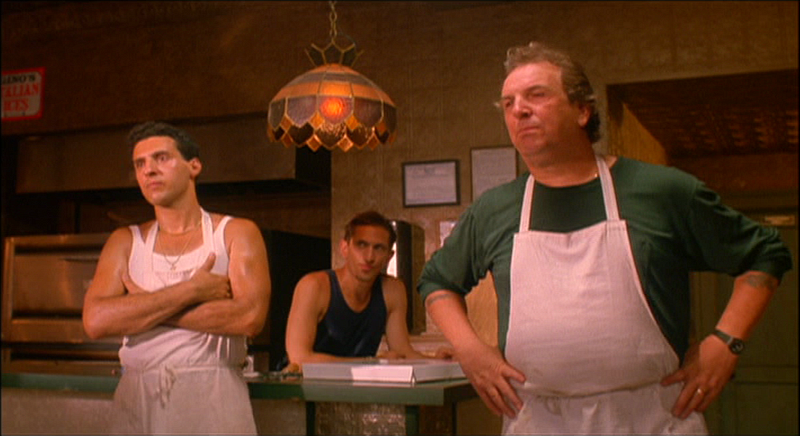
Lee’s use of mise-en-scene clearly highlights the film’s focus on racial tensions. The racist Pino dresses in a white undershirt while his more open-minded brother sports black. Mookie himself even points out the complicated history of Italian-Americans on the racial spectrum, regarded as both black and as white at various points in the past. And while Pino and Vito may be too young to have experienced the associations Mookie points out, their father definitely isn’t. And it’s Sal who displays the most complex perspective — business and personal, community and self, black and white.
Though the film’s conflicts may be framed as tempers running high from the heat and over-attachment to property, it’s clear that they are propelled along by racial politics. Whether propelled by the subconscious assumptions of the characters or the subconscious assumptions of the audience, the racial contrast between the sides of the film’s many conflicts looms constantly.
Mookie and Tina aren’t just a couple, they’re an interracial couple. Mookie and Pino aren’t just co-workers. The yuppie cyclist doesn’t just happen to be white. Lee’s focus is made overt when representatives from the community’s various cultures stare directly into the camera and unleash a tirade of racial insults, but it’s also diabolically vague.
One of the most complicated and insidious aspects of racism is the paranoia a person experiences trying to root it out. Was that racist? Would it have been racist to do the opposite? Many racists are acutely aware of this and exploit the fact to tease and manipulate, gas-lighting by claiming that they’re misunderstood or taken out of context. By placing a racial dimension to every conflict in the film, Lee forces the audience to undergo that same paranoia. Without the audience’s participation and inclusion, the stakes of the film are hollow. And it’s this inclusion of the audience in the conflicts and in the paranoia that continue to reveal the film’s brilliance and relevance so long after its inception.
Consider: At first, Sal is presented as sympathetic — hard-working, firm but loving, a bit old-fashioned. So when the deeper complexities of his character come out, the audience has to confront its initial impressions of his character. This happens after Mookie primes us with the history of the dual identity of Italian-Americans, after we’ve recognized the obvious costuming choices of Sal’s sons, after we’ve already witness so much evidence of Sal’s benevolence — it’s impossible to ignore all of the inertia. The powder-keg is so overfull that the only thing it can do is explode. And Lee forces us to witness not only its explosion, but the crater it makes in the community. Where a lesser director might conclude the story with the destruction of Sal’s pizzeria, Lee understands the importance of the mental friction and cognitive dissonance with showing the morning after.
Mookie struggles with the decision to go back to Sal’s to get his money. It’s uncomfortable. The tension with Tina makes it more so. The anticipation is uncomfortable. The audience is uncomfortable. The resulting uncertainty after his confrontation is both uncomfortable and unsatisfying. And it should be! There are no easy solutions. These are two men coming face-to-face with the last person they each want to see right now, but they do it anyway.
If Lee sold us a more satisfying conclusion, Do the Right Thing gets shelved as a forgettable urban fantasy that fails in its depiction of community. Instead, we get a masterwork of film that challenges its audience with an authentic view of the world that is as relevant in the altered landscape of post-9/11 America as it was when it was first released in 1989.