
Re-Examining David Fincher’s Fight Club 20 Years Later
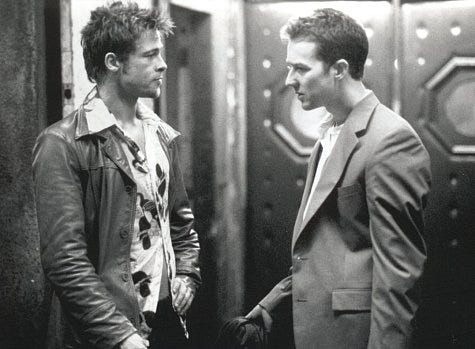
David Fincher’s Fight Club made cultural tidal waves when it released in September 1999 amidst a landscape of post-impeachment Clinton politics and Y2K angst. Its non-traditional narrative structure and depictions of violence struck many of the same chords that Quentin Tarantino rang five years earlier in Pulp Fiction, but with an apparent ambition toward more philosophical heights than Tarantino.
Listen Up, Maggots
While the film inspired plenty of copycats at the time (“The first rule of X;” “You don’t talk about X”), one of its more enduring and complex contributions to culture comes from Durden’s late-film propaganda blared through a megaphone:
“You are not special! You are not a beautiful or unique snowflake! You are the same decaying organic matter as everything else!”
The quote, particularly Durden’s reference to a “snowflake” (decades later conflated into “special snowflake”) has been simultaneously co-opted by various — even contradictory — political groups as ammunition in an ongoing culture war.
Like many aspects of the film, the term is more loaded and complex than it appears. And it is this inherent complexity that ultimately causes problems for the film. In the Narrator’s first official interaction with Tyler — as “single-serving friends” in the emergency exit row — Tyler accuses the Narrator of being clever, and further implies that such cleverness is problematic. Fincher’s film (and Palahniuk’s novel) appears to suffer from a similar flaw of cleverness, namely that its satire subtly avoids detection by much of the audience.
Though Poe’s Law was still a few years from being etched in stone atop a virtual Mount Sinai, the truth of its commandment nonetheless plagues Fight Club. Intended as satire of the behavior of fragile, “lost” male egos, the film also inspired the kind of behavior that it sought to ridicule. The rise of “real life” fight clubs and the rendering of Tyler Durden by many young men at the time as an almost zen figure of anti-corporate sentiment attest to the failure of Fight Club’s satire.
Durden typifies the superficial charm of the psychopath, and because the Narrator’s perspective colors the audience’s perspective so tightly, Durden presents himself for most of the film as a charismatic anti-hero. Like the Narrator who must “rewind” to ultimately solve the puzzle of Tyler Durden, so too must the audience. A second viewing of the film makes clear Durden’s faults from the start since we know now to look through the facade he presents.
Another Woman Is Really the Answer We Need
Fight Club is a story so focused on the male perspective (in particular the middle class male) that it’s tempting to fault it for its flimsy female characters and its rejection of progressive feminist ideologies. But those apparent shortcomings reveal the underlying cleverness of the film, especially when lined up alongside the canon of Fincher’s work.
It seems absurd that Fincher would forget the lessons he learned with Alien 3 and Se7en — both focused on largely male concerns but with developed female perspectives —before then going on to craft even more complex female figures in The Girl with the Dragon Tattoo and Gone Girl. Fincher isn’t incapable of portraying well-rounded female characters, but for Fight Club he chose to make Marla a codependent damsel-in-distress hellbent on failing the Bechdel Test.
To better understand this decision, it’s worth looking to the film’s only other named female character: Chloe. The film presents Chloe, who is in a support group for terminal cancer patients, as a sexually liberated modern woman. She’s uncertain, but she’s honest and straightforward. Unlike all the men in the film who’ve all been let down by the unfulfilled promise of success, Chloe doesn’t displace her feelings. She freely admits that in the face of inevitable oblivion, all she wants is the companionship of another human (“all I want is to get laid for the last time”).
The Narrator’s assessment of Chloe is brief: “Chloe looked the way Meryl Streep’s skeleton would look if you made it smile and walk around the party being extra nice to everybody.” Later, when Marla informs the Narrator of Chloe’s death and asks if he cares, he gives a dismissive “I don’t know.” When we finally learn that the film is lying to us because we see the world through the unreliable perspective of the Narrator, it becomes clear that these female characters are so underdeveloped in the film because they’re so unimportant to the Narrator.
Again, the film’s cleverness and subtlety threaten its message against the dangers of the kind of testosterone-driven mayhem Durden perpetuates. Marla is ultimately the catalyst that drives the Narrator’s redemptive arc, but her character and her compassion are underdeveloped to the point that she is nothing more than a plot device. Her perspective, which could have offered the audience a much-needed alternative to Durden’s, is absent. There is no real alternative perspective for the audience to weigh against Durden until deep into the final act.
Compare this to a more recent take on dissociative identity disorder in Sam Esmail’s Mr. Robot. Though Elliot is just as unreliable a narrator as Fight Club’s Narrator, the audience has touchstones in characters like Darlene and Krista to temper the seductive, anarchic ideations of Mr. Robot or The Mastermind.
What a Man Looks Like
One of the better questions Fight Club presents the audience with comes right after Durden and the Narrator muse about which celebrities they’d love to have a fight with. Spotting a bus ad for male underwear, the Narrator asks, “Is that what a man looks like?”
The question is never directly answered, but it ends up being the driving the question for most of the interactions in the film. What does a man look like? Who decides? Who evaluates?
Corporations are widely rejected as potential guides to the truth as the film routinely portrays any corporate entity as greedy, superficial, and/or incompetent. Family is also rejected as a reliable guide given the number of fatherless characters who’ve been led astray by their upbringing. Even cultural benchmarks of masculinity are rejected (“If you could fight any celebrity…”; “…any historical figure?”) as guides, which seems to presage the concept of toxic masculinity that would enter the mainstream in the subsequent decade. The only outlets that ever yield even marginally positive results are the support groups and the fight club itself.
The support groups depicted in Fight Club offer men a platform to voice their pain. Through guided meditation, communication, and engagement, the support groups allow for men to be heard and affirmed by their peers. Despite its obvious flaws, the fight club (and subsequent Project Mayhem group) serves as an outlet of male frustration and acknowledges the frustrations of a male identity at-odds with modern culture. It appeals to the need to take action — even destructive action — rather than to be passive or idle. Unlike the support groups, the fight club discourages meaningful communication. We are reminded time and again that one should not a.) talk about the fight club or b.) ask questions. There is no place in the fight club to discuss the pressing question of what a man looks like or how a man behaves, and thus we are no closer to answering that question, even after Project Mayhem completes its metamorphosis.
The ultimate irony the story expresses in addressing this question may very well be that a true man — a complete man — is not entirely masculine. Just as the Narrator needs the influence of Marla in order to finally find redemption, it may be that that the masculine/yang/fight club must be tempered with the feminine/yin/support group to produce a complete person.
Without a dialogue to help men make sense of the disparities between historical concepts of masculinity and a modern world that no longer values many of those concepts, we see the kind of destructive flailing behavior play out today that was only hyperbole back in 1999.
All-Singing, All-Dancing
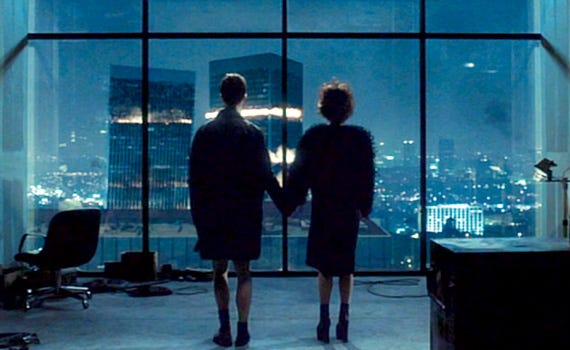
If Fight Club muddies the waters with its treatment of sexuality and gender roles, we can all at least agree that it has a clear take on Capitalism and the influence of corporate ideologies on American lives, right? Corporations and institutions of power have castrated the masculine populace to produce consumer livestock, slaves who labor for the benefit of corporate masters. These corporations leverage their resources to keep the population docile.
This is why Project Mayhem sets out to destroy credit records, right? If the corporations who hold the population hostage through bureaucracy and propaganda are toppled, then people (read: men) will finally be free again!
Right?
So then why does Project Mayhem not even bat an eye at the thought of “corporate sponsorship?” (“This is how Tyler and I were able to have fight club every night of the week.”) Why does the Narrator refer to the various fight clubs that operate across the country not as “chapters” of some fraternal organization but as “franchises”? Why does Tyler espouse the same kind of propaganda that he lambastes institutions of power for employing? In seeking to destroy the corporate influence over people’s lives, Tyler Durden simply imagined a dark inversion of that influence. In waging war against the monsters, he became such a monster.
It is here that Fight Club’s satire and the hypocrisy of Tyler Durden become most apparent. The film’s climax is seductively framed as victory until we examine it with any amount of scrutiny.
The Narrator’s criticism against Marla (and himself) was that she was a “tourist,” someone just visiting the support groups but not really a citizen of that world. Later, he admits the same is true about the fight club members:
“Even if I could tell someone they had a good fight, I wouldn’t be talking to the same man. Who you were in fight club was not who you were in the rest of the world.”
Fight club is not a coping strategy or a lifestyle, but an escape from reality. In the same way, Tyler’s vision for the world is not self-sufficient but a reactionary lashing-out at whatever institutions he believes denied him (and all men) of their promised glory.
As a revolutionary, the real irony of Tyler Durden is that his worldview is too narrow and juvenile comprehend later revolutions like #MeToo or BLM. Instead, Tyler appropriates the image of the revolutionary (or the “outsider who tells it like it is”) to fulfill his own selfish need for attention rather than to bring about any meaningful change for the people he claims to champion. But for irony to succeed, artist and audience need to draw from a common well of expectations. Because the film masks its expectations so masterfully, much of that satire comes across as sincere.
And maybe Tyler was already aware of the enormous power of misdirection when he first met the Narrator: “How’s that working out for you? Being clever?”


