
Re-Entering the Boxing Ring with Eczema
Tips and Lessons Learned after a 25+ year break
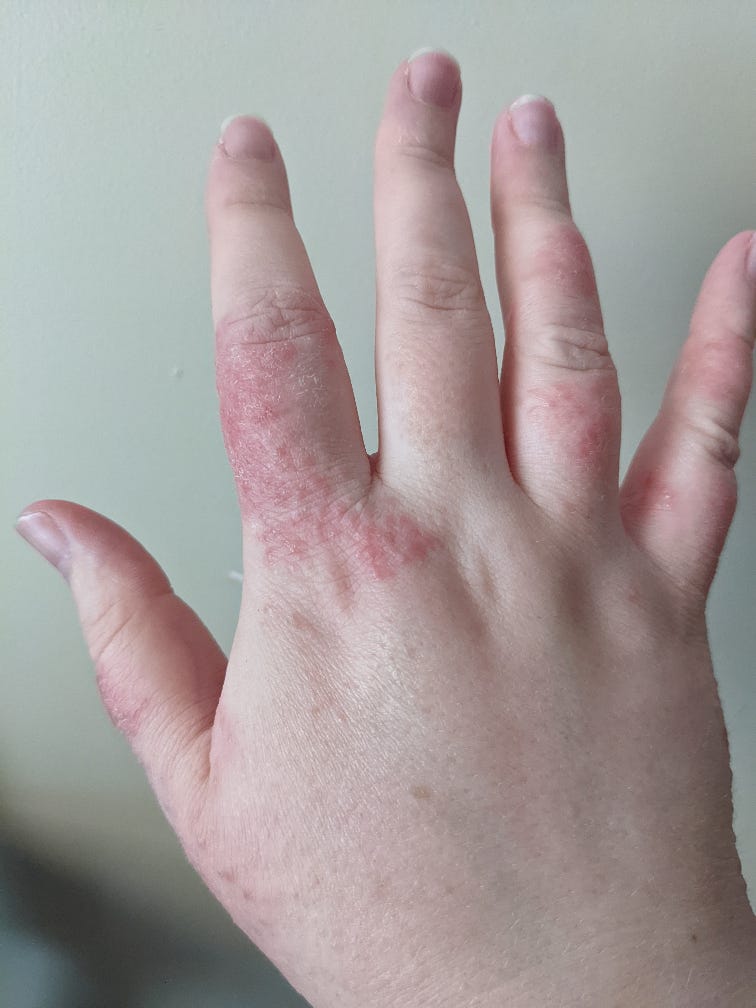
Like many other babies, I struggled with the skin condition eczema: dry, itchy red skin that could worsen depending on how much I scratched it.
But also like many other children, I grew out of it. Sure, I struggled with dry skin every once in a while, but eczema was a thing of the past that had long since faded from my memory.
At the time, I was struggling to survive a toxic work environment, taking much too much of my time, effort, and sacrifices and consistently spitting me back out without any support.
At some point, my hands started getting itchy. My partner noted that I was unconsciously scratching them, that it was a stress/ coping mechanism that was clearly hurting me. I balked at this suggestion. On some level, I knew that that would imply that I was practicing self-harm behavior on a very minor level, but still self-harm behavior and I didn’t want to believe I was that far gone.
“I’m scratching because it itches,” I said over and over again. And it did itch, but even I had to admit that he was catching me scratching unconsciously.
Weeks passed and I had scratched my hands raw. They were harsh red, swollen, sometimes scaly, sometimes bumpy to the point of tiny blisters, and very dry. I had tried everything. I was using lotion all the time. Nothing was helping.
On a doctor’s visit for an unrelated issue (though honestly either caused or aggravated by my stress), the nurse practitioner, grabbed my aching, inflamed hand.
“And what’s going on here?” I explained that I had planned to bring it up with her towards the end since I was there, that I didn’t know what it was.
“Come into contact with anything new? Lotions, pets, soaps?” Nothing was new. I was using lotion as often as I could, but also washing my hands a lot because you know, a pandemic was sweeping the nation.
“It looks like eczema. Do you have eczema?” Not since I was a baby, but somehow, it had come back after over 25 years. She recommended some higher quality lotions than the ones I was currently using (mostly generic brands like Suave that had always worked for me in the past). She explained that Eucerin, Cetaphil, etc. would be more expensive but would be a better quality of lotion that should help. She also told me about Aquaphor, an ointment/ salve that should also help nip it in the bud.
I spent that weekend on the couch, constantly lathering on Aquaphor and lotions, hovering my hands on the armrest and back. As many know, it can be extremely painful while damaged skin is healing.
The new lotions and Aquaphor helped, but it was still there, still itchy, still throbbing. I left the toxic work environment a few weeks later and the eczema cleared up within two weeks.
I had hoped that I had been “cured” even though I knew there is no cure. Overall, it is gone, but I do have flare-ups still. It’s taken me a while to learn how to live with eczema and I wanted to share my journey along with tips and lessons learned.
Especially, because it is not uncommon for adults who had eczema as a child to have a resurgence years later, despite the fact that, like me, they may have no memory of how to treat it.
Below are my Lessons Learned/ Tips in order of most importance, at least in my case. Everyone’s eczema experience will be different. Everyone’s triggers and treatments will be customized to them, especially because research indicates that our genetics are a factor. Also, my eczema has never gone past my hands and doesn’t present in other parts of my body, but yours may be different.
1. Daily Moisturization is KEY
Dry skin leads to eczema flare-ups, plain and simple. Having a daily moisturization routine is key to helping your skin stay moisturized, reducing flare-ups and the severity of flare-ups when they do happen.
Find lotions and skin protectants that are specifically formulated for eczema if possible, especially if you are seeing signs of a flare-up. At a minimum, look for “advanced treatment/ repair” free of fragrances for daily hydration that target your main symptoms of eczema including: itch, dryness, scaling/ peeling, roughness, and redness/ irritation. Look for ingredients like colloidal oatmeal. Some brands also have specific products for flare-up treatment and you might find you need to at least swap out a better lotion or use these flare-up treatments during a flare-up.
If you are like me and have trouble remembering to moisturize when you’re not having a flare-up, consider having a couple different bottles at places that will remind you to use them such as by your bed, in the bathroom, at your desk, even in the living room so you can easily add some while you’re watching TV, etc.
If you are traveling, you may not be able to find your preferred lotion in a travel size and again, just focus on getting the best you can in TSA-approved/ smaller sizes and maybe try to increase how often your use it to off-set the quality decrease.
2. The more you itch, the worse it will get.
No seriously. Scratching can also lead to infection if you scratch open the skin. letting bacteria in. I personally seem to move into different types of eczema (warning for pictures of Eczema in the previous link) if I let it get that far including dyshidrotic eczema with small blisters or neurodermatitis featuring thick scaly sections. Again, this hasn’t been diagnosed but I know that my eczema has different symptoms and changes throughout the process of a flare-up, especially if I scratch more than I should, usually because I don’t moisturize enough.
So the key is to reduce itching. You probably don’t have the ability to simply wear socks on your hands like you did when you were a baby (though I hear from my sister who recently had a baby that they often discourage that treatment now?).
Instead, you may need to trim your fingernails to reduce the chance of scratching your skin open. You can also get cotton gloves to wear at night with lots of lotion to help those hopefully 7–8 hours that your sleeping and might unconsciously scratch your eczema. I have also seen gloves that are fingerless or even touchscreen-friendly if you can wear them during the day.
Try to pat instead of itching, even when drying with a towel, etc. In general, you want to do everything you can to keep yourself from actually itching, even when it is very itchy. A cold compress can also help.
3. Know Your Triggers
Everyone’s triggers will be different. Dry skin is typically number one, but it is not the only one. Many products may cause irritation and it may take some detective work to figure out what triggers your eczema. Per the National Eczema Association, common irritants include:
“hand and dish soap, laundry detergent, shampoo, bubble bath and body wash, or surface cleaners and disinfectants. Even some natural liquids, like the juice from fresh fruit, vegetables or meats, can irritate your skin when you touch them.”
In general, you might want to swap out soaps for milder ones to help reduce irritation.
A big one for me? Hot water. We don’t have a dishwasher in our apartment so we have to do our dishes by hand, meaning lots of hot water directly in contact with my eczema. Investing in a pair of dishwashing gloves helps immensely. They don’t have to be anything fancy, but providing a layer of protection is key. Switching from hot to warm showers may also help.
4. Stress Management
So, stress is a trigger, but I wanted to take a moment to focus on it particularly. Although we still don’t know exactly why, stress does seem to be a trigger for eczema, so managing stress will help to keep your eczema under control. Though I can’t prove it, I do believe my toxic work environment triggered the return of my eczema, and while removing that stress did severely reduce my eczema, it obviously didn’t cure me. It was my final wake-up call to get out, sooner rather than later.
Finding daily ways of taking care of your mental health and managing your stress will help to keep your eczema better under control. The National Eczema Association has a whole page devoted to its association with mental health/ emotional wellness with suggestions including exercise, diet, relaxation, and mental health resources/ support groups.
Self-care including things like yoga, meditation/ deep breathing, nature strolls, reading, pet time, and baths/ showers are good ideas to start.
5. Diet?
The research is still inconclusive on diet being related to eczema flare-ups. However, it is common for people who have eczema to also have other allergies like hay fever and asthma as well as food allergies to things like dairy, gluten, nuts or fish. On the Internet, you can find suggested diets and foods to remove from your diets, but the research has yet to provide a conclusive answer for everyone. Find what works for you.
I personally do not have any food allergies, or at least any that have adverse enough effects that they have raised flags. However, my most recent flare-up occurred after a weekend where we indulged in more and different snacks than we normally do. I don’t know if I am allergic or have a mild intolerance to any of these or the ingredients in these, but I’m curious enough to try keeping note of when flare-ups happen and if certain foods are related. It also could have been that I didn’t hydrate enough which reduced my body’s natural moisturization.
If you can’t get the rash under control in a few weeks or are worried about signs of infection, contact a doctor or talk with your local pharmacist to see if they can recommend a better over-the-counter treatment before going to your doctor.
That’s it for now. It’s been a long, hard road getting to this point and it looks like eczema will be around for a bit now. It’s forcing me to make daily changes that impact my health in a very real way. I hope that these tips and lessons learned help you if you are also struggling with eczema or help you catch the signs before you get to the point I did.
If you (think you) struggle with eczema, what have you found that works for you? Do you have any resources for us? Thank you!
Note: I chose not to bombard everyone with images of eczema that can leave people squeamish. If you want some more examples, especially to help make a call on your rash, there are a couple of reputable sites that I found in my search including Healthline and the Mayo Clinic. Not the most reputable, but WebMD has a good visual guide to eczema as well. Ideally, have a medical professional diagnose it officially, but if you have a rash and want and idea, these might give you some guidance until you get professional help.


