
RBG Leaving the World On Rosh HaShanah is Perfectly Tragic
The liberal feminist icon left the world just as Jews were gathering to welcome the New Year
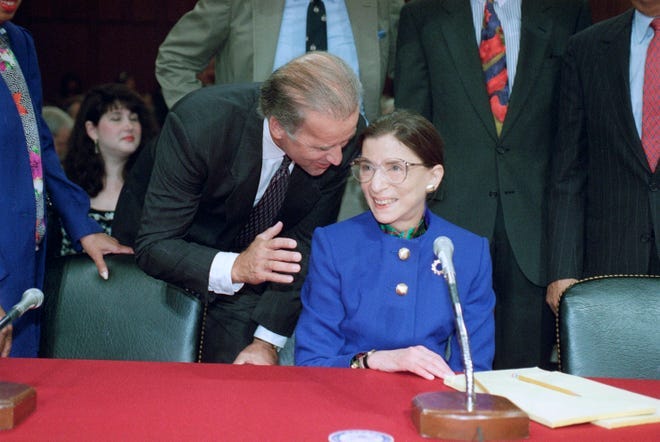
Supreme Court Justice Ruth Bader Ginsburg was a feminist icon and towering figure of the court. Jewish, in 2018 Justice Ginsburg co-authored an essay meant to accompany the text Jews use to guide their Passover seders. She credited her faith tradition as an anchor for the moral compass that guided her work on the court. As such, it is especially poignant that she left the world just as Jews were gathering, albeit in stilted and altered ways, to welcome in the Jewish New Year.
If you are not Jewish, you will find it shocking to read through the central prayer Jews recite today, on Rosh HaShanah, to welcome in the New Year. Part celebration, part call to reckoning, Rosh HaShanah, marked today by Jews around the world, initiates a ten day period of soul searching, calling upon worshipers to set right intention for the year.
In this New Year’s celebration, we imagine a Divine scroll being written year after year. Known as the Book of Life, Jews declare “On the New Year it is written. On the Day of Atonement, it is sealed. Who will live, and who will die. Who by water. Who by fire. Who in their time, whom before their time…”
Sobering words to recite during a global pandemic.
Jewish tradition offers a beautiful teaching about those who leave the world when Justice Ginsburg did, on the eve of the new year, teaching that such a soul had indeed been destined to leave the world during the previous year. However, thanks to her merits, the angels who guard the gates of heaven have granted her an extension. Surly there were few as meritorious in 2020 as Justice Ruth Bader Ginsburg
A champion of equal rights for subjugated classes, most especially women, Justice Bader Ginsburg was Jewish, an active member of her synagogue community and shared publicly that the ethical monotheism of her own faith tradition inspired her jurisprudence. During a 2018 interview in celebration of an addition she co-authored to the Passover Haggadah, she reflected “ grew up in the shadow of World War II. And we came to know more and more what was happening to the Jews in Europe. The sense of being an outsider — of being one of the people who had suffered oppression for no … no sensible reason … it’s the sense of being part of a minority. It makes you more empathetic to other people who are not insiders, who are outsiders.”
Beyond her tireless championing of equal rights for all, there is something else about Ginsburg’s legacy on the court that was particularly Jewish; her long, warm friendship with neoconservative Justice Antonin Scalia. Jewish tradition values healthy debate, and no two embodied that value more than Justices Ginsburg and Scalia, a trait rare in the polarized landscape of 2020.
In discussing their decades-long friendship, Justice Ginsburg echoed a quote preserved in the Talmud, a collection of Jewish law and lore. There, the story is told of two great houses of study, the House of Hillel and the House of Shammai, shapers of rabbinic Judaism. Though both houses were deeply learned, the tradition almost always follows the teachings of the House of Hillel. Why? Because the House of Hillel always first presented the views of the House of Shammai, and only then presented their own. Justice Ginsburg expressed a similar sentiment about the views of Justice Scalia, relfecting about him that “his critiques — and Scalia could have some doozies, believe me, made me better.”
This value for healthy debate, based on the understanding that disagreement often yields a more nuanced understanding, is all but forgotten in the polarized climate of 2020. We have never needed Justice Ginsburg’s wisdom more, as the US, ravaged by pandemic, must now uphold the most basic prerequisite for democracy, free and fair elections.
We need the legacy of Justice Ginsburg now more than ever, and she knew that, sharing her dying wish with her granddaughter “My most fervent wish is that I will not be replaced until a new president is installed.” Her loss embodies everything we have lost in 2020, everything we must reclaim if we want to continue to live in a world that is free and fair.
Here is a prayer, composed for her in 2018 by writer Abby Pogrebin, published in Lilith Magazine, so resonant today:
At a time as disquieting as this,
When so many of us feel deflated, shaken, worried for the future,
When we almost can’t remember what it’s like to go a day without name-calling, without lies, harshness, or callousness.
When we’re nostalgic for those halcyon years of complete sentences, dignified statesmanship, acts of empathy,
We still look to you, Ruth Bader Ginsburg — yeshiva-girl-turned-legendary-justice, RBG icon, fighter for the powerless and wronged.
May you go from strength to strength because you have been ours.
May you live many more years because you make the world brighter, fairer, kinder… Because we need you.
You have helped us remain clear — not just on the foundational principles of a nation, but on our Jewish mandate: to welcome the stranger and never to stand idly by.
The Hebrew words on your office wall in calligraphy read, “Zedek, Zedek, tirdof: Justice, Justice shalt thou pursue.” You have. And we’ll keep trying.