
Ray Tracing Is A Waste Of Time (In Real-Time Applications)
The other day I saw this post about how the Mac did pretty good against Windows gaming computers. I can’t find the post, otherwise I’d link to it. I wish you could see your Medium read history.
Update: As pointed out in the comments it is possible to view Medium read history. Just go to your lists and click the ‘recently viewed’ tab. And here is the article:
Anyways I wrote this post about a similar topic:
So I was intrigued. The post didn’t say anything that interesting. But it did bring up the fact that the M1 Max went toe to toe against other gaming laptops.
Pretty standard article. But then the post said that even though the results were good the MacBook couldn’t game because it lacked ray tracing.
OK, where do I begin?
It’s Slower
In 2018 Nvidia shocked the world with the RTX 20 series of graphics cards. They promised real-time ray tracing. What before would take a server hours to do now only takes a fraction of a second.
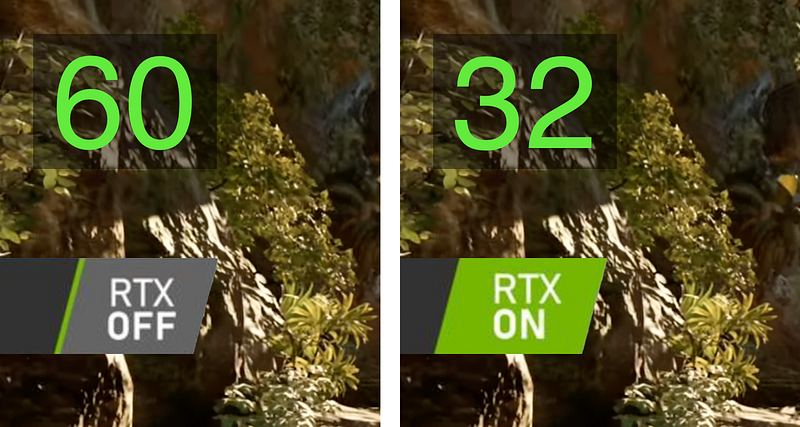
A fraction of a second… well video games need to render a frame at least 30 times a second to even begin to look smooth. Ray tracing is just not fast enough to keep up.
And that was indeed the case with the first generation of ray tracing games.
And it has improved since then.
Just kidding, it hasn’t. People still complain that ray tracing cuts their FPS by half. Well, it’s more like 30% but it’s still a huge hit.
So why would anyone turn ray tracing on? Especially as:
You Can’t Tell The Difference 90% Of The Time
Ray tracing is physically tracing light beams. There are two types. The natural physics version of ray tracing is where the light beams go from a light source (such as the sun) to the ground.
Then there’s the backwards version of ray tracing where we work backwards. So we start at your eye and then shoot out rays into the world and calculate the angle to each light source. You get a less accurate image but now you don’t waste any rays.
I’m not really sure which type of ray tracing is actually used when GPU manufacturers say ‘ray tracing’. But I’d assume it’s the second because it’s easier.
Anyways this goes to show that the only benefit you get from ray tracing is from light. And reflections (because reflections are caused by light).
You’re not going to see any benefit most of the time. And then you say, “but light is everywhere, surely you’ll see a benefit.”
Well, if game developers really sucked at lighting, sure. But developers have gotten really good at faking things.
The most obvious way this is done is by ‘baking’ the lights. You apply ray tracing once (on the dev’s machine) and then you just save the brightness caused by the lighting to the texture file. So you essentially ‘bake’ the light right into the texture.
This isn’t perfect. Like it doesn’t deal with lights that move around. And it doesn’t properly account for specular lights. Specular lights are basically shiny lights.
That’s why ray tracing is so shiny, because they can accurately reproduce the specular lights.
So in most cases you can’t tell between ray traced and non-ray traced images. The only time you can tell is if something is shiny which does not happen that often. Well, unless the devs made all the floors shiny just to show off they can do ray tracing.
That’s why every single ray tracing demo has to have those damn chrome sphere everywhere. Otherwise you literally could not tell.
There’s No Demand To Improve
So it slows down your game. There’s almost 0 benefit. Why would anyone want to implement ray tracing?
There is no reason, it’s a stupid marketing gimmick that Nvidia made to sell more cards.
And the only reason a game developer would want to implement ray tracing is if they wanted to slap it on the box for marketing.
Unless they have graphics devs with too much time. I guess that’s possible.
No one cares about ray tracing. And that’s why it’s not going to improve. That’s why there hasn’t been any improvement in the performance aspect.
What, you think devs will take time out of their crunch filled schedules to work on a feature maybe 5% of players will ever see (and 1% will ever notice)?
Give me a break.
Conclusion
OK, don’t get me wrong. Ray tracing has its place. Every animated movie uses ray tracing. Pretty much every animation that isn’t real time uses ray tracing.
Although personally, rasterization (the way to render images without ray tracing) is pretty good and I bet you could make a full movie with it without anyone realizing it’s not ray traced.
But anyways back to the topic at hand. The MacBook Pro. Would it be better if the MacBook Pro had ray tracing cores? Yes, yes it would.
Because there are professionals that use ray tracing. Like modellers, and animators, and developers.
But gamers definitely do not need ray tracing cores. Because real-time ray tracing has and always will be a marketing gimmick.
If you liked this post make sure to clap and hold down on the clap button until it reaches a number you’re happy with. Yeah, I know it sounds like cheating, but it’s not.


