
Ratcheting Towards Death by Tattoo
Why tattoo is the most powerful artform imaginable
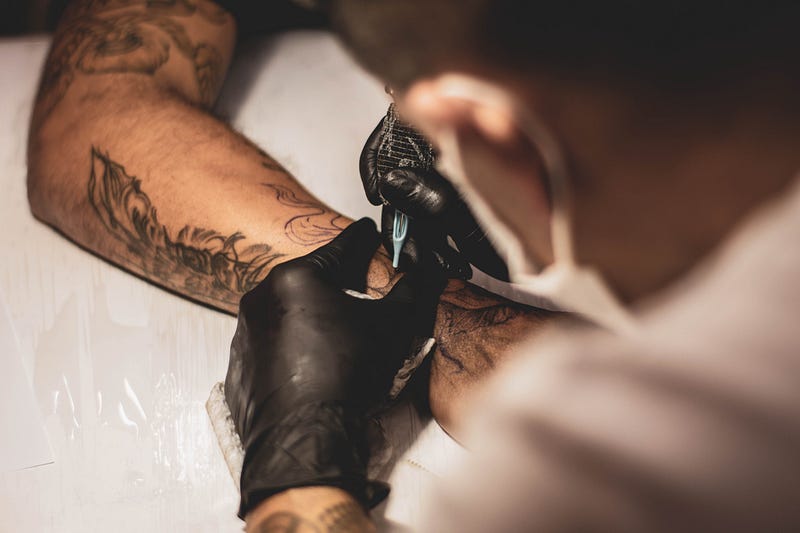
Tattoos date back to… well, we don’t know. The oldest tattoos we have found are on Ötzi (“the Iceman”), a naturally-formed mummy dug out of the Italian Alps by tourists in 1991. Ötzi is 5,300 years old — dating back to the Bronze Age of Europe — and has 61 tattoos in 19 groups covering his body. Most of these are straight horizontal lines or simple geometrical shapes like crosses, and their meaning is elusive.
Suffice to say, though, tattoos are old business.
I contend that humans have sought to modify, design, and change their bodies as long as they have had them. Blank skin is a canvas, a space of pure opportunity, an instrument waiting to be played. Tattoos have been variously curative, aesthetic, magical, warmongering, philosophical, and tribal.
I’m a big believer in tattoos for another reason entirely.
Tattoo is a form of art that is different to any other.
Go and buy a painting you like and hang it on your wall. Or, if you don’t have the extortionately large amount of money needed to do this, imagine that you have done so.
What happens when you change your mind about the painting? You can take it down or hide it behind furniture. What happens when you move house? You can lose or forget about it. What happens when you invite your little cousins over? The painting gets damaged, dropped, or touched with sticky little hands; the painting is removed, an embarrassment.
Try music instead: music is, by definition, fleeting. A song only lasts a few minutes. An orchestra or a punk band can keep going for an hour or three, but rarely longer. Every jam session must come to an end; strings stop vibrating, soundwaves die in the air, and our ears stop perceiving. This is the day the music dies (and this day always happens).
Tattoo is different: your tattoo dies when you do. A tattoo is a permanent commitment to an aesthetic or a philosophy. A tattoo is a lifelong commitment, like having a child or adopting a turtle.
But it is also more than this, because your child and your turtle age along with you: your tattoo, in a way, does not. Your body changes beneath it and so the imagery might become slightly faded or distorted, but the meaning is immutable.
Your tattoo is an anchor in your body, rooting you in a particular time and place in the river of your past.
I was 16 when I got my first tattoo, in small backstreet studio in Turkey.
Yeah, I know. Long story.
This tattoo is a Biblical Hebrew inscription that bears both the etymology of a family name of mine (which also serves as my middle name) and the meaning “God was gracious”. Though I am no longer religious in the same way I was when I got it, the meaning — gratefulness at having been born into a pretty good life, all things considered — remains. I have also been shaped by a childhood of religiosity, being part of a Church family (most of my extended family and family friends, in fact, are priests or otherwise deeply Church-y folk), and so despite having dropped out of the faith, it is still an anchor harkening back to that childhood I am still so pleased I had.
In a way, part of me is always now that 16 year old in a backstreet in Turkey, and I never won’t be. That Rory is always with this Rory in a very literal sense: the ink in my arm is the same, and has come with me all the way down the river of life from then until now. I am he, and he is me. But my arm has changed, my body has changed, my mind has changed — all of this marks the passage of time.
The ratchet of life, marked by tattoo
Imagine tightening a nut or bolt with a ratchet. Ratchets are smart tools because you don’t need to take it off the head of the bolt until you’ve finished tightening it. You move the handle one way, and it tightens; but you move it the other, and it does not loosen. You cannot undo it. The ratchet ratchets, getting you ever closer to the end — the fully tightened bolt — without ever letting go or moving you backwards.
This is how time works. Each year is another crank of the handle, another revolution of the bolt. Eventually, your time runs out, the ratchet lets go, and you die.
It is all too easy in life to forget that this, ultimately, is how it works: that your time is finite, that the ratchet is always moving, always tightening, until you’re dead.
This is the other reason tattoos are the ultimate artistic expression. When you get one — when you indelibly change your body — you have to explicitly or implicitly acknowledge the ratchet of life. You know, the second the needle hits your skin, there is no going back. For the rest of your life you will have this tattoo, though every memory you have right at that second is spent without it.
The tattoo needle is the handle of the ratchet, cranking it — turning you — ever closer towards the end. Like the ratchet, it is undoable. Like the distinct cranks of the ratchet, each tattoo partitions you into the you you were before and the you you are after. There is very little you in between, when the ratchet is winding.
It’s just clunk… clunk… clunk… and you’re dead.
If you want to appreciate the brevity and the unidirectional flow of life, you should get tattooed: get a tattoo that is you now, and you as you are in fifty years (if you are so lucky) will always be anchored back to this very moment.
If you want to avoid this thought of mortality at any cost, though, it is probably best to leave your body blank.