
Rapper DMX Made It Cool To Be Vulnerable
He leaves behind a powerful legacy of passion and vulnerability
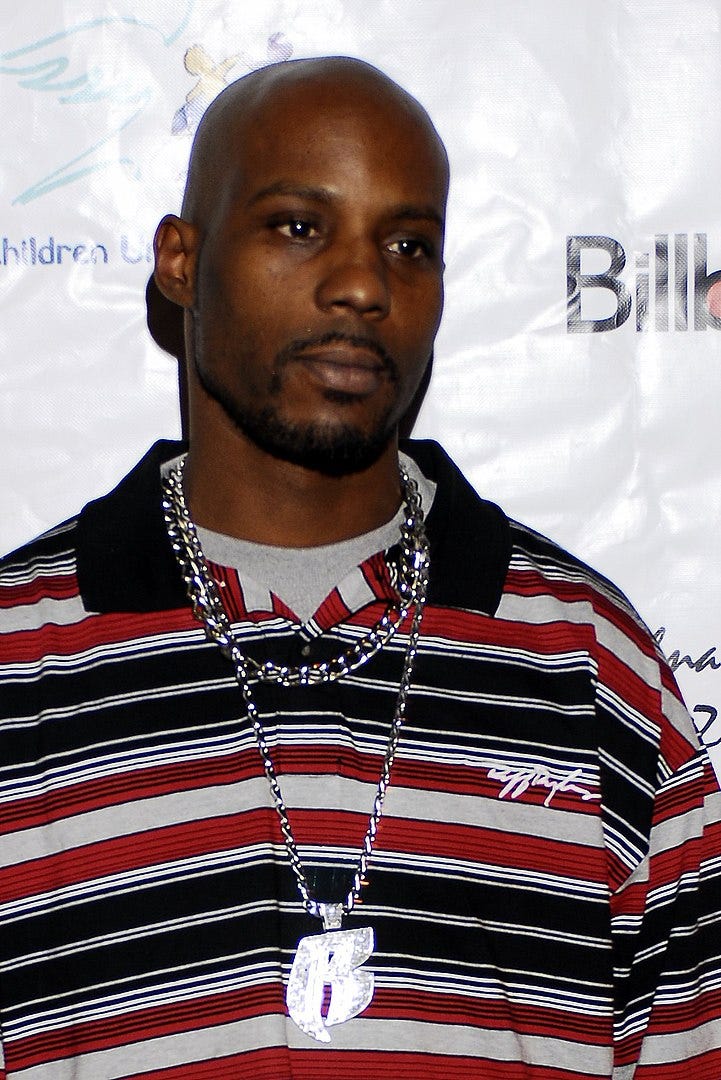
DMX (real name Earl Simmons) aka Dark Man X, has passed away April 9th, 2021, age 50, from an apparent drug overdose and heart attack and I don't know how to deal.

I didn't want to write today, but here I am attempting to craft words to eulogize the life and legacy of one of my favorite rappers of all time.
I was first introduced to DMXs music in the ’90s by my dad.
At that time, I was growing a steady roster of top rap artists that spoke to my formative teenage years. The likes of Jay-Z, Nas, 2pac, Foxy Brown, Lil Kim, Diddy, and The Notorious B.I.G, were on easy repeat.
I will never forget the first time I heard the Ruff Ryder anthem and Get at me Dog from his debut album, It’s Dark and Hell is Hot. It was 6 a.m and we were heading to mass.
I was immediately enthralled by this gritty, gravely, hoarse-voiced rapper with punchy, passionate beats and lyrics that simultaneously riled you up, whilst speaking viscerally on pain.
If 2pac is to intelligent social commentary rap, and B.I.G to a Joie de vivre lifestyle, then DMX was the beloved, sweet soul love child of pain and suffering. Like Irv Gotti said, “if you are a person who had any struggle or any pain, you love X, because he speaks to it.”
In the sea of heavy Hip Hop heavyweights, DMX stood toe to toe with his gruff and philosophical, often poetic expositions on life.
Besides 2pac, he, in my mind, was the first rap artist to carefully articulate the raw emotions embattling this once angsty teen (now adult) who had little to no recourse for emotional expression. Which is why his death hits hard.
DMXs life was a contradiction and we got a front-row seat to the inimitable success and struggles he had.
On one end of the spectrum, he was a Grammy-nominated rapper and actor garnering commercial and critical success with his songs, album, and movies. On the other end, he was a man not without his very public struggles (addiction, incarceration for tax evasion).
In fact, he has spoken openly about the things he went through. For instance, as a child, he suffered physical abuse at the hands of his mother.
However, most notable of his struggles was the war he fought against his personal demons, drug addiction, and mental health.
But in it all, he showed grace in vulnerability and openness in mental health struggles
Power Of Vulnerability
It's cool to be vulnerable. This was DMXs superpower.
He made it okay to speak and name the demons that haunt you. And speak he did, in his music.
Whilst a few would reduce his life and legacy to just another black person suffering from addiction issues, the majority saw a man baring his soul for all to see, NO exceptions.
He served as a necessary voice and reminder for self-love, empathy, compassion, and faith (Christianity), despite it all.
Particularly poignant, painful, and inspiring to watch, was his 2020 interview with rapper Talbi Kweli in which he details his fall into addiction.
For background, DMX was allegedly introduced to crack cocaine at 14, by his then mentor, rapper Ready Ron “he introduced me to what would be the best part of my life, which would be the rap. But he also… everything in my life is blessed with a curse.”
Prior to that, in Xs’ words, “I didn’t smoke cigarettes, I didn’t smoke weed, I didn’t do anything, 14-years-old”
I’ve never felt like this. It just f*cked me up
According to X, he initially turned down the blunt passed around by Ready Ron, deciding later to try it, “I’ve never felt like this. It just f*cked me up”. He later found out the blunt was laced with crack.
In his emotional words, he bluntly states “a monster was born. That monster was born.”
He continues, “Drugs were a symptom of a bigger problem…There were things that I went through in my childhood where I just blocked it out — but there’s only so much you can block out before you run out of space, I really didn’t have anybody to talk to about it. So often talking about your problems is viewed as a sign of weakness. When it’s actually one of the bravest things you can do.”
Used to get high, just to get by / Ate somethin’, a couple of forties made me hate somethin’ / I did some coke, now I’m ready to take somethin’… I’m possessed by the darker side, livin the cruddy life / s — like this kept a N — with a bloody knife- DMX Slippin lyrics
X wore his vulnerability openly.
He was a man who took the baton and showed the ugly sides of trauma and addiction; the wins and losses along the way.
He was never afraid to cry, and express the pain that he had experienced in life’s often cruel hands.
It was a welcome change to witness in a society that continuously seeks to dehumanize and emotionally stunt the very real struggles of Black people, in this case, Black men.
Mental Health struggles
Once upon a time for a myriad of complex reasons, Black Mental Health struggles were largely ignored on a societal level. This permeated Black communities as most mental ailments, was quietly swept under the rug.
Nonetheless, major strides have been taken by Black Mental Health advocates (celebs and non-celebs) determined to destigmatize, educate and provide powerful transformative resources to the Black community.
In my opinion, X was one of the first to shed light on mental health in Black communities through his music. But did we really pay attention or did we chalk it up to exaggerated lyrics?
In a BET interview, he opens up about his mental health struggles which reportedly included bipolar and multiple personality disorder.
Of his multiple personalities, he states “They’re different things. There are a few things, a few people in me — they get me through life”
Although hesitant to expand, he states “I wouldn’t want anyone to know anything. I don’t talk about them…You already got me talking about them. Nope … They’re there to get me through life. I don’t know if I made them or if God gave them to me, or maybe circumstances and situations did.”
They’re different things. There’s a few things, a few people in me — they get me through life
His being able to talk about his mental health is particularly important especially for Black men dealing with mental health issues.
It's no secret that most Black men struggle with being vulnerable and sharing emotions. I mean is it any wonder why?
Those who dare to express their emotions are shamed and belittled by society and peers who continue to push the foolish, stunted narrative of what a strong Black man looks like.
The notion that men, in this case, Black men don't cry is drilled into children who grow up to be emotionally hesitant adults unable to articulate complex emotions.
Now I am not a Black man, but I have a Black father. The one time I saw my father cry was when his mum (my grandmom) passed away. In that instant, I saw the softness in my father, not this impenetrable person who had to carry the weight of the world on his shoulders.
As the tide turns and more Black men hold space for healthy conversations surrounding Mental Health, I can't help but applaud DMX for being one of the first prominent Black male figures in the rap genre to talk about mental health.
In my book, by speaking openly he gave and still gives permission to the likes of Kid Cudi, Kanye West, and Black men everywhere to lean into vulnerability and share their struggles regarding mental health.
It's hard to eulogize a man like DMX.
In fact, I feel I have done a mediocre job. I mean, words don't do justice in highlighting the real and reverberating effect X had on a whole generation of people.
Yes, you get the sense of a man filled with unquestionable pain from his music and interviews.
Nonetheless, beyond that, what I want people to see, is the power he wielded by wearing his vulnerability, weakness, and struggles out loud and unapologetically.
Even though young Earl Simmons was failed by the adults in his life, who probably didn’t have the tools to do better, he went on to do the impossible in a world where everything was seemingly against him.
At the peak of his musical career, along with his club bangers, he expertly and humanely synthesized painful themes (suffering, survival, the struggle between God and the Devil, the yin-yang) into heartfelt introspective reflections of life.
I just need to have a purpose,…and I don’t even know that purpose, because God has given me that purpose since before I was in the womb, so I’m going to fulfill that purpose … whether I want to or not, whether I know it or not, because the story has already been written. If you appreciate the good, then you have to accept the bad” CNN
In the still-evolving hip hop/rap industry largely dependent on braggadocio and bravado, he was a necessary foundation for holding space for emotional trauma. The one we never knew we needed and one that will be greatly missed.