
Rants, Raves, and Fun Facts from the 71st Annual Primetime Emmy Awards
On Sunday, September 22nd, the Television Academy announced their picks for the best television and streaming has to offer in a ceremony on Fox. Here, I recap the winners and review the show.
Reflections on the Winners
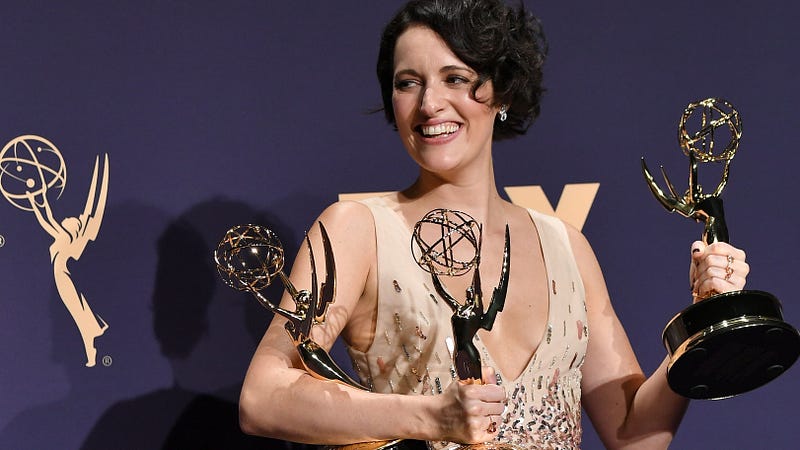
- Fleabag unexpectedly dominates the comedy categories. The major story of the night was undoubtedly the dominance of the edgy British export Fleabag, which aired its second installment on Amazon Prime this year. The show upset over the heavily favored HBO’s Veep (for its final season) and fellow Amazon series The Marvelous Mrs. Maisel (for its mega-nominated second season). Creator/writer/star Phoebe Waller-Bridge won Outstanding Lead Actress in a Comedy Series (preventing a possible historic win by Julia Louis-Dreyfus, see below) and Outstanding Writing, and the show additionally picked up Outstanding Directing and Outstanding Comedy Series. The remaining awards were won by The Marvelous Mrs. Maisel (Supporting Actor for Tony Shalhoub, a three-time prior winner for Monk, and Supporting Actress for Alex Borstein, winning her second consecutive trophy for the role) and HBO’s Barry (which brought Bill Hader a second consecutive Lead Actor trophy.) Veep went home empty-handed for its final season making the final season the only one that did not win a major Emmy.
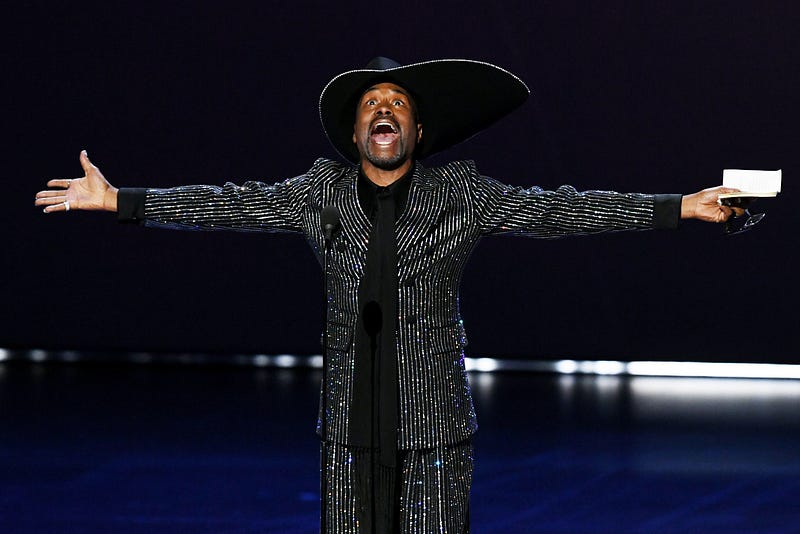
- Game of Thrones wins top honors, but doesn’t dominate the drama categories as predicted. The highly divisive final season of HBO’s Game of Thrones gave the show its fourth win in the category of Outstanding Drama Series, thus tying it with Hill Street Blues, The West Wing, and Mad Men for the most wins in this category. But for a while there it looked like the show was going to get toppled. After Peter Dinklage won his fourth Emmy for Supporting Actor for the role of Tyrion Lannister (a record number of wins in the category), the show went through a long string of losses. The show got upset in writing and directing by HBO’s Succession and Netflix’s Ozark, respectively. In addition to the directing win (which marks Arrested Development star Jason Bateman’s first Emmy), Ozark also won Supporting Actress for Julia Garner. Her win means that all four nominated Game of Thrones co-stars lost, which makes Dinklage the only acting winner from the series and the series as having the distinction of the most nominations in the Supporting Actress category without a win (12). In a huge upset, the Lead Actress Emmy went to Jodie Comer for her role as the sociopathic assassin on BBCAmerica’s Killing Eve and not to her heavily favored co-star Sandra Oh (who between Killing Eve and Grey’s Anatomy is 0 for 8 at the Emmys). Although, it would have been wonderful to see Oh get her long overdue and historic Emmy, Comer was sensational in the second season so it is hard to argue with her win. The Lead Actor Emmy winner went to an openly gay black man for the first time, as Billy Porter accepted the trophy for Fx’s Pose.
- Chernobyl unexpectedly topples the Central Park Five in the limited series categories. Chernobyl, HBO’s limited series about the Chernobyl disaster, took home Outstanding Limited Series, Outstanding Writing, and Outstanding Directing. These three categories that were expected by many to go to the Netflix limited series When They See Us, which depicted the wrongful conviction and exoneration of the Central Park Five. That show went home with only a single award on tonight’s telecast — Lead Actor for newcomer Jharrel Jerome. The Lead Actress Emmy went to Michelle Williams for her role as real-life star of stage and screen Gwen Verdon on Fx’s Fosse/Verdon. The Supporting Actor Emmy went to Ben Whishaw for his captivating work as the spurned lover of a British politician on Amazon’s A Very English Scandal. Supporting Actress was taken by Patricia Arquette for her gutsy performance in Hulu’s The Act. Arquette unexpectedly upset Patricia Clarkson, who had an eerily similar role in Sharp Objects (that HBO series went home empty-handed.)
- Repeat winners reign in the variety and reality show categories. VH1’s RuPaul’s Drag Race and Netflix’s Queer Eye won the Reality Competition and Structured Reality series Emmys for the second consecutive year. Meanwhile, HBO’s Last Week Tonight with John Oliver and NBC’s Saturday Night Live won Variety Talk and Variety Sketch series for the 4th and 3rd consecutive times, respectively.
- The rare guarantee that this year’s top winners won’t repeat. Game of Thrones has wrapped its run, Phoebe Waller-Bridge has made it clear that there will not be another season of Fleabag (at least not one any time soon), and When They See Us is a true limited series (not an anthology series) so the Drama, Comedy, and Limited Series awards will assuredly not be repeats next year. Those who don’t like change can rest assured, though. It seems unlikely the Reality and Variety series will have any turnover any time soon.
- Some notable records were set whereas some notably were not set. In addition to its various records listed above, Game of Thrones also extended its lead as the drama series with the most Emmy wins in history (58 in total). One notable record that was not extended, however, is Julia Louis-Dreyfus’s role as Selina Meyer on Veep being the most Emmy awarded role in television history. Louis-Dreyfus went an astonishing 6 for 6 for the show’s first 6 seasons, with her 6th win breaking her tie with Don Knotts (The Andy Griffith Show) and Candice Bergen (Murphy Brown) as the most Emmys ever won for a single role on a single series. Had Louis-Drefyus won this year, she would not only have extended that record but broken her tie with Cloris Leachman as the most honored actor in Emmy history (they remain tied at 8 wins after tonight). It turns out even she was no match for Phoebe Waller-Bridge.
- The winners included terrific LGBTQ visibility. Billy Porter and Ben Whishaw are openly gay men who won for playing gay men on screen. Both Emmys for Guest Actress went to openly lesbian women — Jane Lynch (The Marvelous Mrs. Maisel) and Cherry Jones (The Handmaid’s Tale). Jodie Comer won for playing a woman whose difficult-to-categorize sexuality is pivotal to the series. Alex Borstein won for a character whose sexuality has never been discussed, but whose gender nonconformity is front and center. RuPaul and Queer Eye dominated the reality categories. The Emmys embraced the LGBTQ community in unprecedented ways this year, just as the Oscars did when they gave 3 of the 4 acting awards to actors portraying gay or bisexual characters.
8 Thoughts on the Telecast
- The costs and benefits of going host-less. As the Oscars learned earlier this year, there are some key benefits to putting on the show without a host. It helps the show be shorter, it helps get more A-list talent on stage, and it really diffuses the blame if the show sucks. But, there are also costs. It can contribute to the show feeling aimless, scattered, and soulless. I didn’t love either the Oscar or Emmy telecast this year, but I am hesitant to call this a failure given that last year’s cohesive but dismal SNL homage was so much worse.
- Fox’s shameless self-promotion was on full display. Yesterday, I predicted that the annual tradition of whichever network airs the Emmys (it rotates between the four broadcast networks annually) shamelessly promoting its own lineup would be back and bigger than ever in the hands of the largely scrupulous Fox network. And right I was. We were subjected to bits, presenters, and references all related to shows that combined were up for zero awards at tonight’s telecast. These include — but certainly are not limited to — The Simpsons, Family Guy, Empire, Last Man Standing, The Masked Singer, and 911.
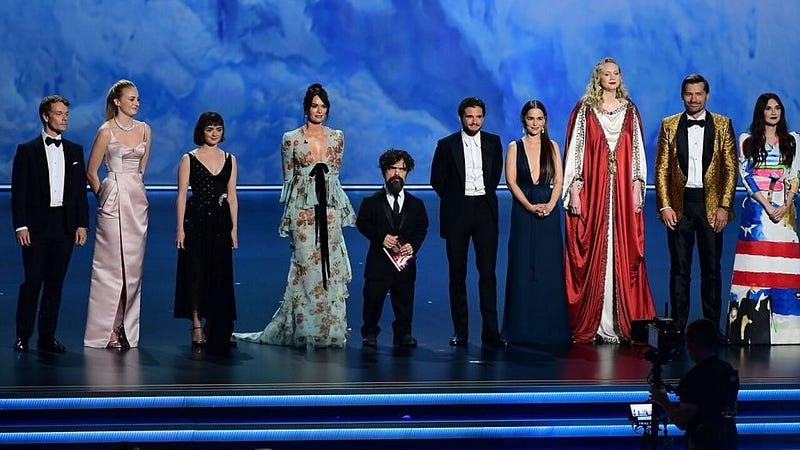
- Saying goodby to several classic series. Two big moments from the night undoubtedly were the showcase of two departing series that were profoundly beloved by the Television Academy — Game of Thrones and Veep. They reunited the casts on stage and then had them present an award. It worked very well for Veep, due to an inspired bit that made good use of Julia Louis-Dreyfus’s comic skills and played to the show’s dysfunctional character dynamics. It did not work well for Game of Thrones. The whole thing seemed disorganized and the cast seemed awkward and stiff. I also thought it was a big missed opportunity to bring back long gone cast members (e.g., Michelle Fairley, Richard Madden), that would have led to a much more moving reunion. One curious thing is that The Big Bang Theory didn’t get more of a send-off than the brief montage. I have actually never seen a single episode, but it has the distinction of producing more episodes than any primetime sitcom in history, being the most viewed television comedy to premiere in the last 20 years, and won 7 Emmys out of 46 nominations. Perhaps they asked them and they said “No”? Or did HBO just pay more?
- Particularly terrible musical numbers. It’s almost cliche at this point to complain about the pointless musical numbers on awards shows, but these were truly bad. Adam Devine’s off-key singing on the utterly pointless variety series song-and-dance was cringe-inducing (albeit well-choreographed). And not only did Halsey show way too much skin for an In Memoriam segment but her uneven vocal performance did even more damage than the odd placements (e.g., the late, great icon Valerie Harper wasn’t nearly prominent enough) and the fact that it committed one of the tackiest offenses an awards show can do — having the audience intermittently applaud for the dead.
- The goofy announcer bit got real old, real fast. At first, I actually thought the idea to have Reno 911 star Thomas Lennon serve as a goofy and sarcastic announcer was inspired. But I quickly learned how wrong I was. After his umpteenth joke fell flat, it became apparent that this was a terribly executed idea.
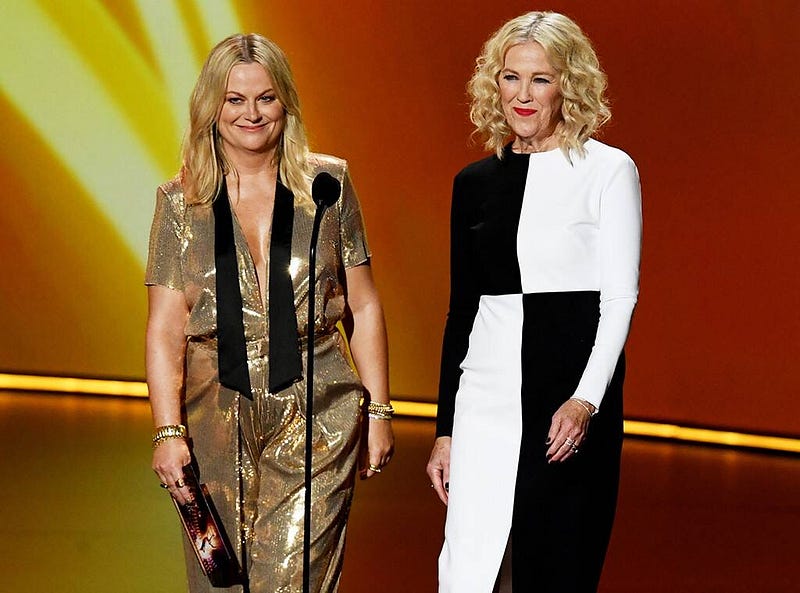
- The good, the bad, and the ugly of the presenter pairings. Despite the complaints above, there were some great moments from presenters throughout the show. The highlights came early with Amy Poehler/Catherine O’Hara and Ben Stiller/Bob Newhart being absolutely brilliant. Other inspired pairings included Don Cheadle/Kristen Bell, Anthony Anderson/Randall Park, Norman Lear/Marisa Tomei, and Bill Hader/Phoebe Waller-Bridge. However, many fell flat, including the particularly atrocious Ken Jeong/Nick Cannon, as well as Kim Kardashian West/Kendall Jenner, Jon Hamm/Naomi Watts, Terrence Howard/Taraji P. Henson, and Maya Rudolph/Ike Barinholtz.
- The speeches. There may not have been a super awkward marriage proposal like there was on last year’s ceremony, but there were nevertheless some very memorable speeches. Michelle Williams’ plea for gender equality in the industry was heavily scripted, but it was beautifully written and eloquently delivered. Similarly, Billy Porter’s was more passionate during his acceptance speech than the majority of the night’s other winners combined. Patricia Arquette gave a lovely tribute to her late sister Alexis and a related plea for trans rights. And Phoebe Waller-Bridge was delightfully flabbergasted every time she went on stage. The only speech that really didn’t work for me was the one given by Lorne Michaels, which was presumably well-intentioned but felt ridiculously self-congratulatory.
- The throwbacks. There was a shoutout to the 20th anniversary of the premiere of The West Wing when former co-stars Bradley Whitford and Jimmy Smits presented, but not a single word about the fact that 25 years ago to the minute, the inconic, multiple Emmy-winning sitcom Friends was premiering. Did the Academy not feel it was worthy of celebrating or did they reach out to the cast and creators and get rejected? My guess is on the latter, but it still would not have hurt to reference it.
Now, it’s time to get ready for next year, which will involve me having an epic meltdown if Schitt’s Creek ends its run empty-handed.
For Your Consideration: Follow the author on Medium and Twitter.


