
Ram Dass Brilliantly Explains Karma In 40 Powerful Words
It will shift your understanding of this “complex” concept.
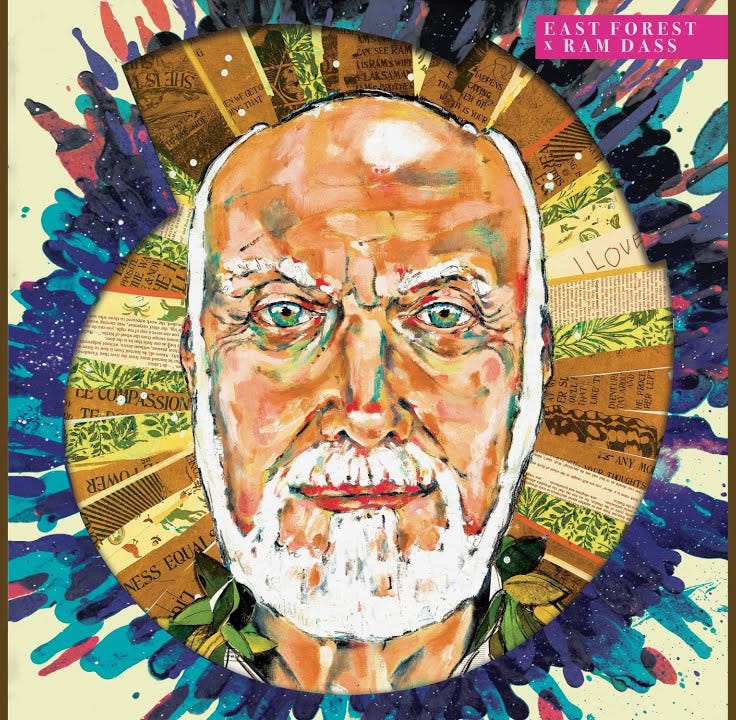
Despite popular belief:
- Karma is not fate.
- Karma is not about getting what you deserve.
- Karma is not a mythical moral justice system that hands out rewards and punishments.
- Karma is not about what you did in a past life. (Though in some traditions, the energy you created in a past reincarnation can affect future ones.)
While all of these notions have some merit in understanding karma, they are all misleading because karma is not a result.
Instead, karma is an action. It is an energy created by our thoughts and emotions.
The definition of karma I absolutely love comes from Ram Dass in the song Mind Karma he recorded with East Forest and Trevor Hall, in which he says:
Our karma is our mind.
Reread that and take a second to really think about it.
In short, your life experience and the quality of your existence come down to your mind.
However, as you will see in the rest of the lyrics below, “mind” is not a reference to having a positive mindset or mental attitude. Instead, Ram Dass equates “mind” to our egoic self.
Here’s the rest of the lyrics from the song.
Our karma is our mind. And the mind stands in the way Of a clear view of god.
Our minds give us clouded perceptions.
This incarnation has in it… individuality.
Individualism leads to war And anger And insecurity And fear.
Only 40 words, but what a profound description of the havoc our minds (a.k.a our ego) can create in our life!
Let’s break each one down.
“Our karma is our mind.”
If our mind is essentially our ego, then the experience of our lives is based on how well we can navigate and see beyond our egoic self.
What is the egoic self?
The egoic self is what Eckhart Tolle refers to as your identity derived from what your mind tells you about yourself. It’s the part of ourselves run by the constant flood of thoughts like “I’m not good enough, skinny enough, talented enough.” Or “I’m the best.” “I’m smarter than them.”
“And the mind stands in the way of a clear view of god.”
Our ego prevents us from recognizing our oneness, our divinity, our true nature, and who we really are.
Well, who are we?
The conscious self is who we really are. It’s the “you” that exists in the present moment when you are not being controlled by your ego. It’s where awareness, love, and peace lives.
Our ego (a.k.a. our mind) is what blocks us from what Michael Bernard Beckwith calls “The Presence which is never an absence.”
You can call this “Presence” god, eternal love, the essence of life, universal mind, or whatever other name you prefer that describes the source of intelligence that permeates throughout the cosmos.
“Our minds give us clouded perceptions.”
The mind’s default mode of operation is confusion.
Our ego makes us believe we are separate from “The Presence”, the rest of humanity, and all of creation. While our ego’s job is to keep us safe from physical danger, it also works hard to preserve that sense of self it has tricked us into believing is who we really are.
This pushes us into an illusion — an artificial reality created by the narratives played out in our minds.
- It’s when someone says something to you that irks you and you automatically believe they are insulting you.
- It’s when you see something on the news you disagree with, and you become convinced there’s a faction of people out in the world that is out to get you.
- Or, on a smaller scale, it’s when your boss passes you over for a promotion, and you take it as a sign of disrespect and lack of appreciation of your abilities — so now they are forever banished to your shit list.
This is the great lie of separation perpetuated since the beginning of human civilization.
“This incarnation has in it… individuality.”
In this line in the song, Ram Dass reminds us that the human experience of having a mind brings with it the sense of “I am.” And when we identify with “I”, we become a separate, single entity, cut off from all the energy around us — including everyone and everything.
While oneness is our intrinsic nature from the soul’s perspective, individuality is baked into our experience as humans.
“Individualism leads to war and anger and insecurity and fear.”
Where do we even start with this one? How about looking no further than the divisiveness in the world right now?
Forget the world — look at just the US. Sometimes you forget the word united is in the name of the country.
This is the side-effect of the chaos created by our minds:
- Our ego inflates our sense of individuality and the need for a personal identity, which unavoidably leads to self-righteousness and moral superiority.
- Righteousness and moral superiority lead to judgment and fear.
- Judgment and fear lead to hatred, racism, homophobia, xenophobia, sexism, gaslighting, genocide…
We can go on all day.
So what is the answer?
Do we destroy our ego? (good luck with that)
Do we travel to the Himalayas and meditate in a cave for three years?
Again, the answer goes back to the first line of the song: our karma is our mind.
The quality of your life is determined by how well you can take a leadership role with your mind. But not only your mind, but also taking charge of your emotions, your body, and your very life energies.
As the Indian mystic, Sadhguru often says:
“Karma means the experience of your life is entirely your making.”
And it all starts by noticing when the mind has taken over, making us believe we are the principal player in a never-ending drama that has us at the center of the universe. If we can do this often enough, we soon awaken to the truth that playing that role is not only an illusion but one heavy, frightful proposition.
And eventually, in small doses, we start to experience all of creation as one interconnected, amazing colossus unfolding in harmony with each other in which no part is greater than the whole, and no thing and no one is separate.
I’d like to think that is our karma as a species.
Experience miracles happening all around you! Download my FREE 5-Senses meditation to help you become more present and practice taking a leadership role with your mind.