
Raising Dion: The POWER of Black Mothers Who Risk it All for Their Sons
“If you had another child, would you want it to be a boy or a girl?” An acquaintance asked.
Such an innocent question on the surface, but when aimed at a black woman it comes with parameters.
Because of Trayvon Martin, Michael Brown, Tamir Rice, LaQuan McDonald, Jordan Davis this question asks a black mother, if she births a boy child, why she would willingly walk into the possibility, or likelihood according to statistical studies, of her son being killed by the police or other outside factors that work against young black boys.
It’s a silly, illogical question when set against the understanding that no one can choose the sex of their child. But it is also a question that opens a necessary dialogue about the plight of young black boys in America.
“You live in some worlds that are more white than black,” Imani Perry tells her sons in her new book Breathe: A Letter to My Sons. “And so, you learn, early on, that the aversion to blackness can turn perfectly lovely people grotesque.”
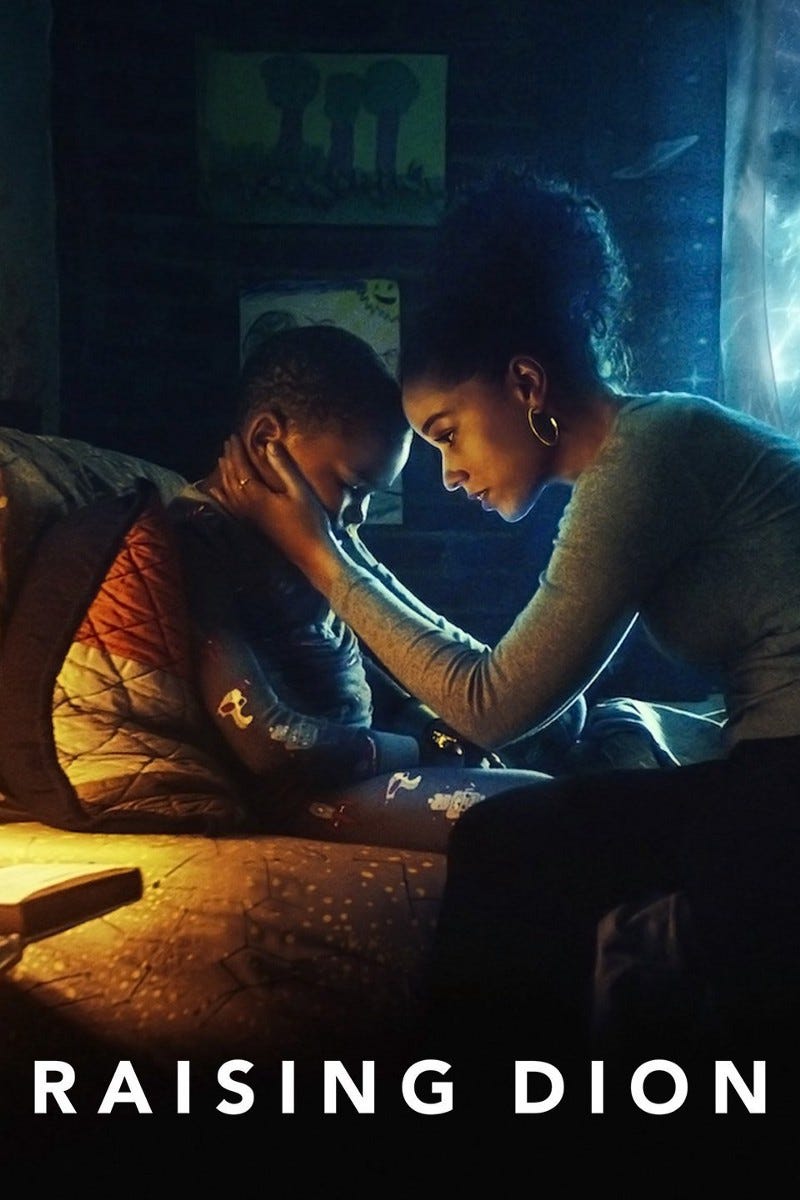
This forewarning given by Perry is also played out in the new Netflix series Raising Dion. Raising Dion is a science-fiction drama set in Atlanta that shows what happens when a young single mother has to grapple with grief- her husband is killed in a freak accident- and her young black son’s newfound superpowers.
Dion (Ja’Siah Young)is gifted with a multitude of powers that his mother, Nicole (Alisha Wainwright), has to hide from the outside world while also battling a predominantly white school system that sees Dion as a threat simply because of his skin color.
Raising Dion takes the science fiction genre to the next level by giving centerstage to the economic struggles of class separation, racial politics, and what it takes for a single black mother to save her son on a daily basis.
In one pivotal scene Nicole has to step in when the white principal of Dion’s school sets out to punish Dion for attacking a white student who steal’s Dion’s watch. The principal coddles the white student and berates Dion. If Nicole had not been present, Dion would have been suspended for an altercation he had not started. These type of situations filter into the prison to pipeline system that sees young black boys and girls suspended at higher rates than their white counterparts. In some of these instances, law enforcement is called in to mediate, which can lead to black children being handcuffed, abused, and sometimes killed.
To be a black mother and have to shape your life around these circumstances that show up on a regular basis is beyond daunting. So, what does a mother do?
Perry offers, “Feeling deep love and complete helplessness to protect the beloveds is a fact of black life……..Hypervigilant panic is our misfortune.” This is often the plight of black mothers. There is little space for pronoia.
In Raising Dion, Nicole does not possess superpowers as Dion does. Her only power is constant, daily anxiety that lives in her as she covers her child from the dangers he does not understand. A set of pursuits worthy of its own television series.
But while these two black mothers do not recoil from the facts, they also do not hide from their sons that life is for living. “Your testimony is living with the passionate intensity of one whose presence matters despite the violence of this world,” Perry says to her sons.
Nicole, while watching Dion sleep, renders, “I wish I could keep you safe forever, but that’s not how this works. I don’t know what’s coming. But I can promise you one thing: whatever it is will have to go through me first.”