
Rainier
Where is it going?
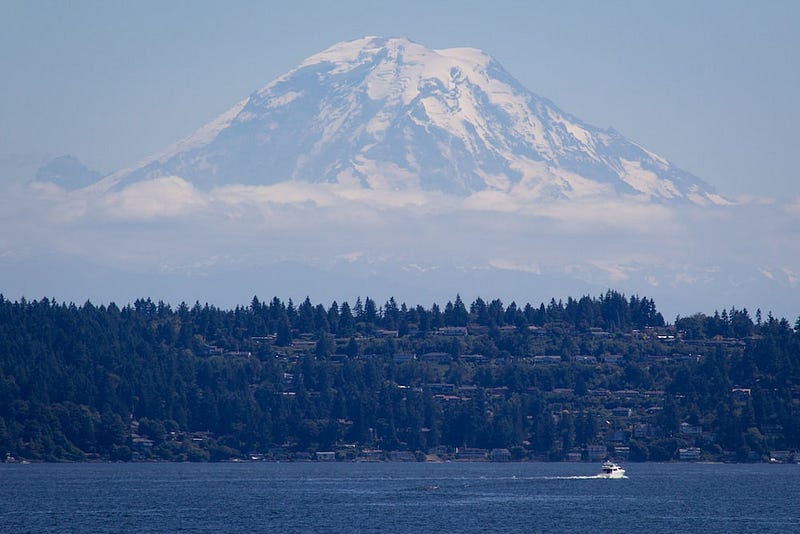
On the Way to School
As kids, my siblings and I spent some time in Seattle. On our way to school, we counted ourselves lucky when Mt. Rainier was visible in full force, all of its 14,408 feet. Somehow, it now measures 14,411 feet.
The Olympic mountain range can be seen from Seattle, as can the Cascade mountains. Even in this land where peaks routinely appear to city dwellers, Mt. Rainier so dominates the entire region that despite living in its shadow, no one tires of its majestic presence.
This experience likely is aided by the fact that the famous northwest cloud cover prevents us from taking the scene for granted. Even as kids, we exclaimed every time Mt. Rainier made an appearance in the southern sky.
On our way to class, we often stopped in our tracks, breathed deep, and just took in the mountain. When you stare at Rainier even at great distances, it is easy to convince yourself that you see the crevices in the glaciers, the groomed slopes, or the summer mountain meadows.
That massive mountain reminded us that when classes ended and school let out, it would be there waiting for us. It anchored our day.
Pitch Black Summer Nights
During summer break, when the northwest late summer nights could run as late as 10 pm, my brothers and sisters often pulled the neighborhood kids together for Kick the Can. We hid behind trees, large rocks, or in our neighbor’s prolific garden, where we picked a few snap peas, and quickly chomped them while whoever was “It” searched for us in vain.
When the sun finally dropped to close the day, last clink of the can dissipated, and deep night fell, all the kids walked to the end of the street.
It was from that spot one would meander during the day to get a glimpse of the mountain. But at night it was different. Night was pitch black, birds were still, and the stars were out.
We were tired.
But if you looked really hard, you could sketch Rainier’s outline. At night, we told each other, it glowed while it somehow extended the day past the 24 hours. Then we all turned and dragged our feet back to our respective homes.
We knew Rainier was there, and would be there again in the morning when we pedaled our bikes out to chase the next summer day.
Rainier Stayed with Us
As we aged and headed to high school, we still admired Rainier. Our bus stop was at the end of an uphill path which afforded a full view of the mountain. We could not stop and stare on those days, because we always cut the timing so close that if we had, we would miss the bus. But the glimpse kicked off the day. On clear days, we’d try to finish off the day hanging with friends with Rainier in the background.
About this time, we started to appreciate the perspective of time.
We would talk about how Rainier had been admired by hundreds of generations. While we just were in awe of it, those generations actually lived off all it offered. Maybe the mountain gave us wonder, but it sustained the very lives of those generations.
The Salish called it Tahoma — the giver of water. Hunting, fishing, lumber for shelter, water for life all came from the mountain. And its natural diversity supplied those generations with all they needed.
Rainier lives through cycles. The glacier mass grows in winter, and then melts a bit and fuels the blooming meadows in the summer. But that mass remains ever present, and is also ever changing. That mass binds us to earlier times.
A Recent Visit
I visited Seattle recently. We had a few nice days, and I was fortunate to see the Olympics, Cascades, and the beautiful Rainier. But while I still experienced deep awe, it was now different.
The stability I felt as a kid has morphed into a reminder that nature is not so permanent. Continuity has given way to unpredictability, even for the massive Rainier. That unpredictability is not just that Rainier remains an active volcano.
That’s not it.
Rather, it is that at so many points along the way, we have broken down nature. And now nature feels it. It is as though Newton’s Third law — that every action has an equal and opposite reaction — has caught up with us.
Instead of supporting and protecting us, nature threatens us with increased hurricanes and tornadoes, just as we have failed to support and protect it by pillaging its resources. Now instead of emotionally moving us, nature exerts its force upon us with floods, winds, and drought, as we have exerted our force of development and civilization upon it.
Nature may not be able to actively seek vengeance, but it sure seems pissed at what we’ve done to it.
My siblings and their respective partners take in Rainier and other natural wonders. They play in it and study it. Nights are spent on the glaciers, and they are physically closer to Rainier and nature than they ever were as kids. They see the changes over time, and still feel the bond to the past.
But instead of holding it tightly, they have nostalgia as it slips away through their fingers, because the bond may not last into the future.
Where is it Going?
Nature’s power has always found its way, but the scale and frequency has changed its essence. We’re still in wonder of it, but we are as much in awe of its danger as we are its beauty.
Kids still take those same paths to school and the the bus stop. They still stare at Rainier on late summer nights, and on the way to and from school. They still think about what it has been through.
But they don’t know where it is going.


