
Ragazzi di Nocera
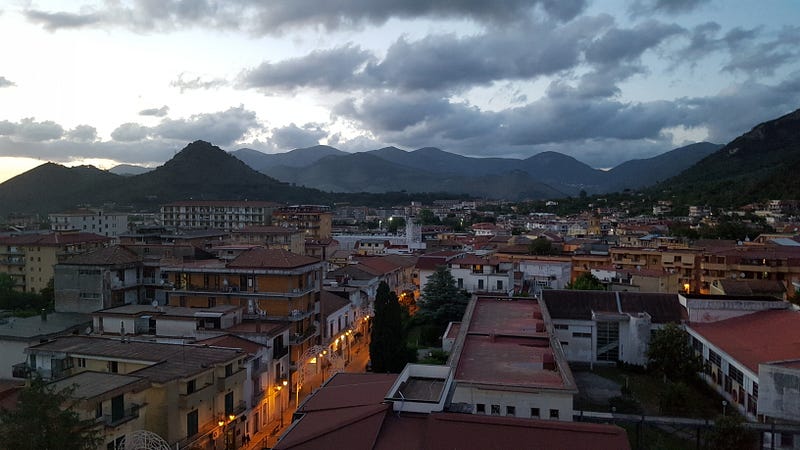
It always takes a little while. When you move every six months, every new place means you have to adjust. Too early to form opinions when you first arrive. You need to wait a little while before you can begin to know how you feel about a place.
But a new place can show you something you knew and yet overlooked a thousand times. Lifted out of your normal patterns of thought, the familiar world becomes strange and new. The best thing about travel is not the places it shows us, but the parts of our true selves it reveals.
I liked Nocera from the start. The people were friendly, but the language acted as a wall to protect me from any unwanted intimacy. The weather was rainier than you would expect south of Naples. It’s a working Italian city, not some pastel-painted Eat Pray Love movie set. I missed the sea, but the mountains are spectacular.
Of course, we’re not on holiday. This is our life. And life, even one as charmed as this, has its demands. We can’t just ignore the tedious tasks and unending chores that have to be done. So what gets ignored instead is this:
The sunset. The church bells. The old women on the benches, singing together in the darkness under the trees as evening falls. The bats that swoop in and out of the streetlight’s orange halo, and the cats that prowl the garbage-strewn streets.
The boys have been here since the day we arrived, of course, and long before.
They play football in the school parking lot under our balcony, every night if there isn’t a storm. On the seventh floor, I’m invisible to them. But I can see them, hear them, singing and yelling and laughing, playing the same games I used to play with the kids who grew up near me. I don’t need to speak the language. I know the rules. The fat kid gets picked last, and the youngest has to climb to fetch the ball when someone inevitably blasts it over the fence into the fallow fields beyond, and the winner takes his turn in goal. It’s not as long ago as it feels. Not nearly as long ago as that.
There were elephants here once. Or so I like to imagine. In the right kind of light, you can watch weary African soldiers who marched all the way from Spain descend the scrubby hills into the valley. Hannibal found this town waiting for him, and shattered it. Surus was Hannibal’s last and favourite elephant, his single tusk a pleasing echo of the Carthaginian general’s one remaining eye. I read somewhere that it’s the broad nasal cavity of the elephant’s skull that gave birth to the idea of the Cyclops. Like all good stories, it’s probably untrue.
Nocera’s football stadium, named for a Polish pope, sends out shafts of coloured light as the national anthem rings out over the town. Italia, Italia! But when Dante stayed in the castle on the hill, there was no Italy. There were only Italians, ruled over by Spain or France or Austria or a rapid succession of popes. None of this matters when you’re late for an appointment or struggling to get to work. Nocera’s long history is not readily apparent the way Rome’s is. There are no houses here, only blocks of apartments younger than my father.
But some things outlast marble monuments. Some of the boys downstairs have been called home, but the rest still play on under the swarming street lights. Not long now. Two years; maybe less. Already sometimes, a girl or two will wait on the concrete bench under the tree. Playing football for hours will fade in importance compared to chasing girls. And there’s drink and drugs too, the destructive pastimes that will descend on these young men in their insignificant town just as they did on me in mine. The last time I talked to any of my old friends was a decade ago.
One boy is called away, but another takes his place. Before Italy, before Dante, before Hannibal, the boys of Nocera laughed and bragged and argued just as they do now, just as they will when those playing now are as dead as one-tusked Surus. None of us know when we will slip silently into the running stream of time and never surface again. But while we’re here, still standing, still warm, it’s a pleasure to watch it flow.

This story is published in Writers on the Run. If you’re interested in submitting your travel stories please visit our submission guidelines.