
Racist AI Robot Reveals Industry Bias
The FN Meka controversy shows the need for greater diversity awareness
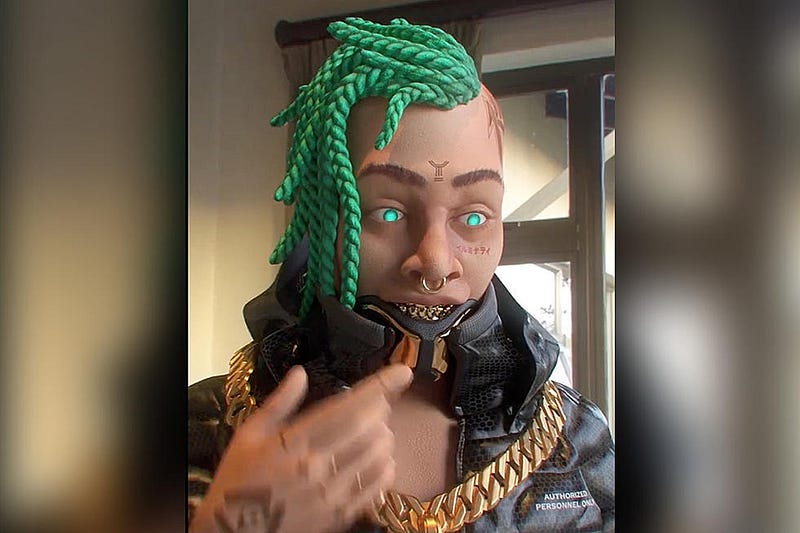
He was tapped to become the next big thing. Industry professionals viewed FN Meka as the one to watch, ticking off every marker of stratospheric success to come. A TikTok account with more than nine million followers. Three solidly performing songs. Exciting collaborations with other artists. A look stripped from SoundCloud, with brightly dyed hair and facial tattoos. FN Meka also boasted all the trappings of an Instagram-worthy lifestyle, from a Gucci-print Tesla truck to a Louis Vuitton stroller. And while his music sought to mimic competitors rather than to break new ground, his persona was one of an entirely brand-new of creatives.
Because FN Meka was a virtual artist.
As the world’s first AI-powered robot rapper, FN Meka sold successful non-fungible tokens (NFTs) and used TikTok to gauge his music’s potential success. He was not only a rapper, but a virtual influencer, too — with billions of views offering lucrative opportunities for brand representation.
By these metrics, Capitol Records appeared prescient in inking a deal with FN Meka. The label described FN Meka as “the world’s first A.R. artist to sign with a major label.” Capitol Records appeared intent to be convey an openness to technological advances, while also recognizing the ever-increasing confluence between the worlds of music and gaming. Ryan Ruden, the company’s vice president of experiential marketing and business development, described the FN Meka project as meeting “at the intersection of music, technology, and gaming culture” and “is just a preview of what’s to come.”
But in its haste to be the first, Capitol Records forgot the lessons of history. FN Meka, though original for being a virtual artist representing the latest in cutting-edge technological advances, is a kind of modern-day minstrel accused of donning digital blackface. We’ve met him before. He’s a pejorative caricature of a Black man, appropriating the rich heritage which long preceded him for a cultural attack.
The backlash to FN Meka was swift and fierce — not only to the flashy robot with the high follower count, but also on behalf of the unseen Black men who fueled his rise.
While announcing the deal, Capitol Records released FN Meka’s first single, “Flood Water.” Soon afterwards, critics took Capitol Records to task for the blatant racial stereotyping associated with its rapper avatar. Activity group Industry Blackout released a statement, saying that FN Meka “is a direct insult to the Black community and our culture. An amalgamation of gross stereotypes, appropriative mannerisms that derive from Black artists, complete with slurs infused in lyrics.”
Immediately, Capitol Records scrapped the deal. After dropping its first virtual artist, Capitol Records released its own statement: “We offer our deepest apologies to the Black community for our insensitivity in signing this project without asking enough questions about equity and the creative process behind it.”
Capitol Records’ misstep in championing FN Meka is surprising considering its nuanced representation of many Black artists. From solid heavyweights like Babyface to promising newcomers like Mooski, the label has cultivated the long-term careers of many iconic performers. Some of their artists unapologetically display material wealth. Others include the N-word in their lyrics — perhaps to take back ownership of the power which had historically been stripped from them. In defending his use of N-word, Jay-Z famously told Oprah: “We weren’t so close to the pain. So, in our way, we disarmed the word. We took the pin out of the grenade.”
Capital Records’ (human) artists showcase their personal experience in their work. Their image, their music, and their intended legacies are all borne of careful consideration. And by virtue of their humanity, these artists will get it wrong sometimes, too. But even in moments of public backlash, they can never be reduced to caricatures — just as FN Meka can never be a blank slate.
From the outset, FN Meka was never an individual. The robot rapper was a group project. Created from “thousands of data points” amassed from video games and social media, FN Meka was specifically tailored for industry success. His catchy songs were designed in part by A.I. technology and were also compiled from elements of existing music. Factory New, the ‘virtual’ record company which created FN Meka, steered FN Meka to build a presence on TikTok and to drop an NFT before officially releasing music. FN Meka was designed to thrive in a notoriously competitive industry, though his reliance on these outward markers of success set this virtual artist up for a downfall.
Because data points do not absolve us of responsibility. Our data sets might contain the best of human expression, but they contain our biases, too.
Historically, the music industry has been adept at putting artists into boxes. Tightly confined genres have allowed A&R executives to market artists with ease, while limiting individual expression. A flashy music video dripping with expensive jewelry and cars is as much a reflection of the demands of industry gatekeepers as it is individual choice. And though artists are increasingly nimble, exploiting lucrative opportunities for cross-genre collaboration, the categories still matter.
A virtual artist stitched together by the micro successes of those who went first will fit neatly into a box. FN Meka had a recognizably SoundCloud look. He had a familiar, generic sound. His imagery displaying material wealth and product placement and offensive language all resembled what is already known.
But FN Meka rung hollow. His music lacked the Black artist’s generational struggle against oppression, nor the minority performer’s fight to be truly seen. Unlike his predecessors, the virtual artist has no blood in the game. At base, the racism intrinsic to FN Meka challenges the assumption that Black artists’ contributions can be reduced to data points this way.
A.I. technology, while as limitless as its human creators in its capacity to create, has been hit hard in recent years with charges of racism. Despite its novelty, it carries society’s baggage with it.
Because A.I. technology is fed massive data sets in training, it often encodes discriminatory intent. For instance, machine learning predictors of medical data have been found to have underrepresented people of color. A.I. tools have enabled housing discrimination against people of color, particularly due to features like microtargeting of a specific audience. In addition, U.S. Courts relied on a computer program which predicted that black prisoners would be more likely to reoffend.
Currently, our regulatory framework lags behind technological advances. As long as human activity serves as the basis for machine learning’s data sets, our prejudice is guaranteed to be passed on. Instead of working to eliminate it (which could be as impossible as eliminating bias in humans), some experts suggest working instead to vigilantly recognize discrimination and to act quickly to mitigate its effects.
The biases woven into institutional decision-making, such as whether to lengthen a prison sentence or offer a mortgage on a home, are unquestionably significant. But discrimination matters in the cultural spheres, too.
FN Meka’s imagery has been compared to the practice of blackface, where whites covered their faces in black face paint to perform dehumanizing stereotypes of Black people for entertainment. Beneath the laughter and the music, blackface served as a way for whites to assert dominance and to reinforce a racial power structure.
Blackface, minstrel shows, and racist radio hits were often the only contact many whites had with Black culture. And so these gross distortions of Black people were not only a source of embedded racial trauma for the Black community, they were also rife with landmines of misunderstanding. A bundle of lies set to a catchy beat. As a result, many whites walked away from these shows with a swing in their step, thinking they knew a people whom they’d never even met.
Frederick Douglas criticized the practice of blackface in 1848, saying that the performers were “the filthy scum of white society, who have stolen from a complexion denied to them by nature, in which to make money, and pander to the corrupt taste of their fellow citizens.”
Sound familiar?
Unfortunately, it often takes a minority figure to make non-minorities aware of offensive stereotypes. As system designers and developers confront evidence of discrimination in A.I., experts suggest diversifying the team to mitigate the effects of bias. Tech executives are overwhelmingly white and male. Because studies reveal that individuals have trouble recognizing racial and cultural nuances outside of their own race, too easily backsliding into a primal tendency to categorize, a diverse team could better predict pitfalls for the end-user. More diverse teams mean more representation in training data sets — allowing people of color to be seen.
But a diverse team cannot inoculate an algorithm from design flaws. By all accounts, the creators behind FN Meka were people of color fixated on inclusivity. And perhaps FN Meka is alarming for precisely this reason: the project failed so spectacularly despite every effort made to steer it toward success.
FN Meka was designed to thrive. Its creators at Factory New intended to champion a roster of digital artists predisposed to excel in a competitive industry. As its founder Anthony Martini told Music Business Worldwide, “Even with all the money labels devote to finding talent, the success rate is a pitiful 1%. Now we can literally custom-create artists using elements proven to work, greatly increasing the odds of success.”
While billed as a virtual artist, FN Meka was of course a joint effort between A.I. technology and human talent. In the wake of FN Meka’s downfall, Houston-based rapper Kyle the Hooligan came forward with claims that he had created FN Meka’s three successful songs and had lent the digital artist his voice. Kyle the Hooligan told Vice that “they promised me equity and a percentage of the character . . . They never compensated me. I basically got ghosted afterwards.”
Kyle the Hooligan further claimed that a second individual voiced the music on the records he created. That individual has not yet been identified. Though Kyle the Hooligan had been excited about the prospect of involvement with A.I. technology, he claims the final product of FN Meka relied on his talent. Moreover, Kyle the Hooligan claims that Factory New “got that pass because I was involved . . . They basically used me for the culture.”
Despite their cultural blind spots, Factory New’s creators nailed one aspect of the music industry: the odds are stacked against most artists. Most musicians cannot make a living wage from streaming. Covid decimated the live music industry. NFTs, once heralded as modern alternative to merch sales, are in a freefall.
A willingness to cede one’s talent to an avatar demonstrates an openness to evolving technology and a hunger to succeed. For some creatives, it also speaks to desperation. A sense that the traditional path available to artists might only result in a dead end. That the music itself is not enough anymore. In justifying the FN Meka project, Martini argued that the industry already strips an artist’s personhood away: “Not to get all philosophical, but what is an ‘artist’ today? Think about the biggest stars in the world. How many of them are just vessels for commercial endeavors?”
Just as artists will continue to explore new platforms to showcase their talent, A.I. design teams will continue to rely on human creatives’ talent lend authenticity their algorithms. This new relationship has all the makings of a dysfunctional marriage. In a worst-case scenario, humans could disappear into the final product, while machine learning technology could be saddled with humanity’s darkest impulses.
The music industry has had a long history of relying on ghostwriters, often emerging songwriters whose talent is used to bolster established artists. Their anonymity leaves these shadow artists vulnerable to exploitation. They are uncredited, receive one-time payments, and are ineligible for awards. Songwriters recognize ghostwriting as a lucrative option — often presented as a form of apprenticeship — and could be more open to A.I. collaborations for this common practice.
But with A.I.’s tendency toward bias, collaborating on a digital creation might prove a riskier endeavor for artists. Whereas the ghostwriter’s goal is to inhabit another artist or group, the opaque data fed into machine learning technologies cannot be known. If an artist were ever outed for their contribution, their name risks being attached to a stereotype. It’s not a collaboration for the artist, then, but a trust fall. And if an artist’s contribution is ambiguous, their compensation might be in jeopardy too.
Since the controversy, Martini quit Factory New and severed ties with FN Meka. Martini later commented to The New York Times: “If you’re mad about the lyrical content because it supposedly was A.I., why not be mad about the lyrical content in general?”
He has a point. FN Meka’s lyrics, message, sound, and avatar all have an (albeit distorted) basis in reality. And the questions posed by the FN Meka controversy transcend the music industry, perhaps highlighting that all industries should perform comprehensive A.I. audits to determine whether their technologies are perpetuating harmful stereotypes.
In the end, it might take a robot for us to choose the kind of people we want to be.