Racism’s targets were once Italians and Asians, both vilified by President Woodrow Wilson
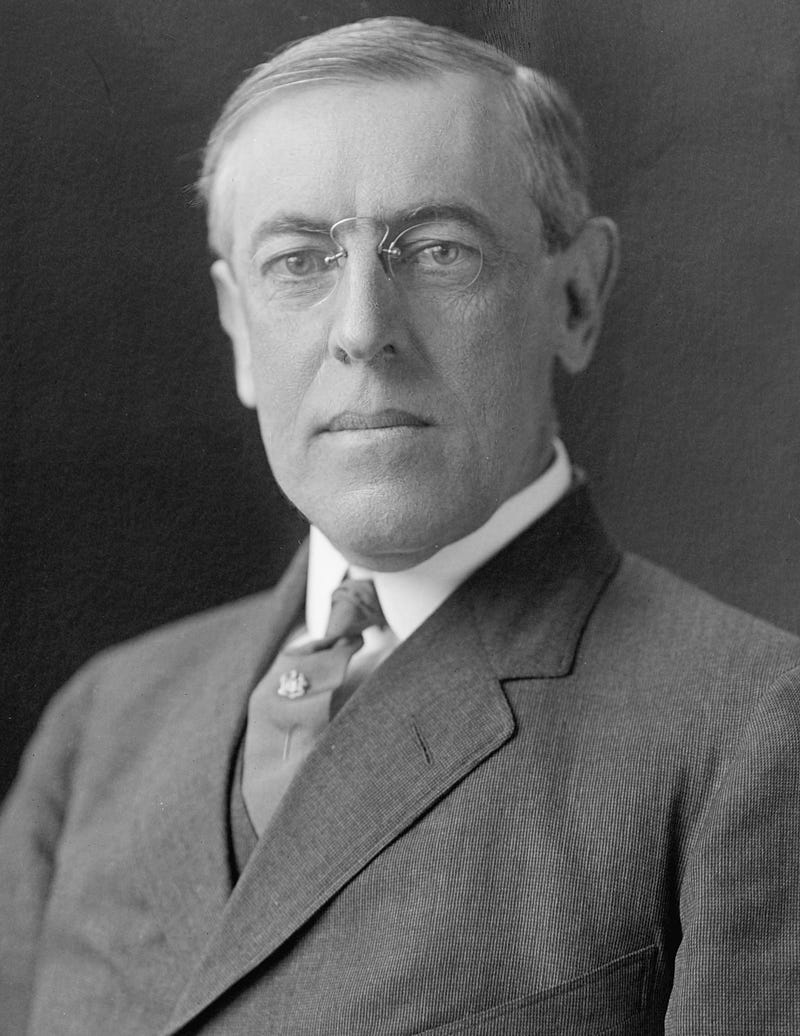
Ethnic bigotry is ugly regardless of the race of the target. Here’s a quote from a book by Woodrow Wilson, at that time a professor at Princeton and later president of the United States: “Throughout the [nineteenth] century men of the sturdy stocks of the north of Europe had made up the main strain of foreign blood which was every year added to the vital working force of the country … but now there came multitudes of men of the lowest class from the south of Italy and men of the meaner sort out of Hungary and Poland, men out of the ranks where there was neither skill nor energy nor any initiative of quick intelligence; and they came in numbers which increased from year to year, as if the countries of the south of Europe were disburdening themselves of the more sordid and hapless elements of their population” (Source: “A History of the American People,” by Woodrow Wilson, 1902).
It’s often said that Wilson improved his views in later years, or at least moderated them in response to political realities when he ran for public office, first the New Jersey governorship and later the American presidency. However, he simply exchanged one set of bigoted attitudes for another, apparently deciding that he wanted Italian and Eastern European votes in New Jersey where those ethnic groups were increasing in number, but that attacking other ethnic groups on the faraway and thinly populated West Coast would help him win votes.
During his 1912 presidential campaign, Wilson wrote this: “In the matter of Chinese and Japanese coolie immigration I stand for the national policy of exclusion (or restricted immigration). The whole question is one of assimilation of diverse races. We cannot make a homogeneous population out of people who do not blend with the Caucasian race….Oriental coolieism will give us another race problem to solve, and surely we have had our lesson.”
Perhaps it’s not surprising that California and Washington were among the few states Wilson lost in the 1912 election. Even then, California was a center of America’s Asian population, with 79,000 of the country’s 146,000 Asian-Americans recorded by the 1910 census living in that state, and another 15,000 living in the state of Washington, making Asians by far the largest ethnic minority group in both states at that time since few people of Black ancestry had then moved to the West Coast. Teddy Roosevelt, then running as a third-party candidate due to a Republican Party split, eked out a narrow victory in California over Wilson by 174 votes or three one-hundredths of a percentage point, and Roosevelt’s victory in Washington was by a much larger 8 percent margin, or 26,858 votes.
Wilson’s bigotry was certainly not limited to Asians, Italians, and Eastern Europeans. He’s better known today for screening the pro-KKK film “Birth of a Nation” in the White House. A Southerner by birth during the era when most Southern Blacks were barred from voting by racist laws, Wilson moved to the north when he taught at Princeton University. As a New Jersey resident running for office, unlike most Southerners, Wilson actually had to deal with Black voters during his time as governor of that state and regarded them as his political enemies.
All of that was wrong then and it’s wrong now. The targets of ethnic bigotry change over time, but the bigotry remains wrong regardless of the target.
The only colors that are supposed to count in America are red, white, and blue, not the skin color of the person who pledges allegiance to that flag.