
Racing for the Stars: The U.S.-China Competition in Advanced Space Plane Technology
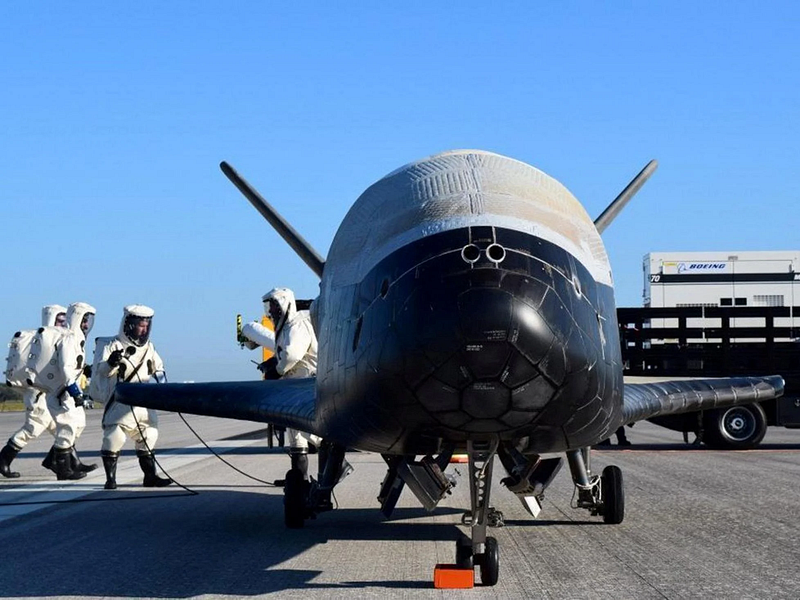
The ongoing advancements in space technology and the evident competition between the United States and China in this realm are leading to significant developments, particularly in the field of reusable space planes. Both countries have launched their respective space planes, the U.S. with its X-37B and China with its Shenlong (or “Divine Dragon”), adding a new dimension to their space race.
The U.S. X-37B, a Boeing-made spacecraft, operates much like a mini-space shuttle and is known for its secretive missions. It’s an uncrewed craft that launches atop a conventional rocket and has been in operation for years. The X-37B has been involved in various experiments, including the Photovoltaic Radio-frequency Antenna Module (PRAM), which aims to harvest solar energy and transmit it back to Earth in the form of microwaves. This technology underscores the potential of the X-37B in various fields, including energy research and possibly even reconnaissance or offensive missions in space, given its capabilities.
China’s Shenlong, on the other hand, reflects Beijing’s growing confidence and advancement in space technology. Launched from the Jiuquan Satellite Launch Center, the Shenlong has completed multiple missions, with the latest launch being its third. The timeline between these launches is decreasing, indicating the maturation of China’s reusable technology. There’s limited public information about Shenlong, but it’s speculated to be similar in size and payload capacity to the U.S. X-37B. An intriguing aspect of Shenlong’s recent mission is the release of six unidentified objects into Earth’s orbit, which are still emitting signals and being observed by the U.S. Space Force and amateur astronomers. This action signifies the advancements China has made in space technology and raises questions about the potential applications and implications of such missions.
The close launch timelines of these space planes from the U.S. and China are suggestive of a competitive spirit, as noted by Gen. B. Chance Saltzman of the U.S. Space Force. The ability to deploy objects in orbit, conduct experiments, and safely return them to Earth offers significant strategic and technological advantages. This competition extends beyond mere technological demonstration, as it encompasses aspects of geopolitical rivalry and the pursuit of strategic supremacy in space.
In conclusion, the development and deployment of space planes like the U.S. X-37B and China’s Shenlong signify a new era in space technology and exploration, marked by rapid advancements and strategic competition. While the details of these missions remain largely classified, their implications for space technology and geopolitical dynamics are profound and far-reaching. As space becomes increasingly integral to national security and scientific advancement, the actions and developments of these space-faring nations will be critical to watch.