
Rachel Hollis and Her Fauxpology Are Only Relatable to Dangerous White Women
The “Christian living” self-help influencer is at it once again.
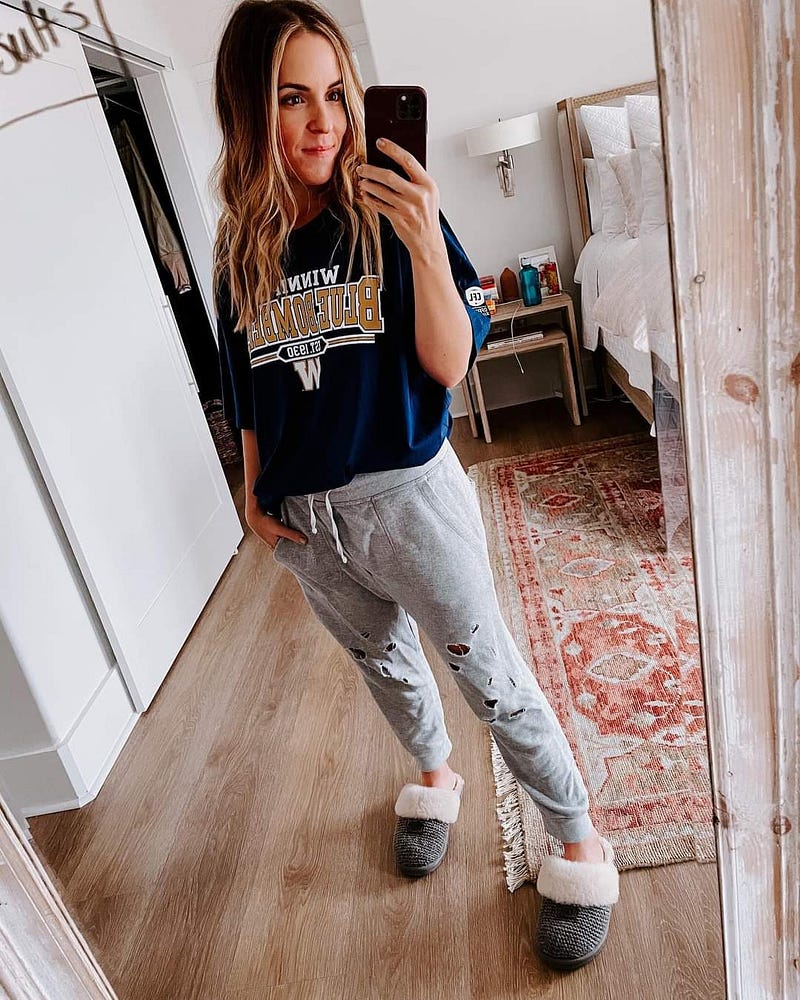
If you’re familiar with Rachel Hollis, author of Girl, Wash Your Face, Girl, Stop Apologizing, and Didn’t See That Coming, you’ve likely heard that the social media influencer is back in hot water again, this time for a deeply disturbing rant she posted last week to Instagram after a woman from her audience called her “unrelatable AF.”
There were all sorts of complaints about Rachel’s tone-deaf words, but hell really broke loose when she said, “What is it about me that made you think I want to be relatable? No, sis, literally everything I do in my life is to live a life that most people can’t relate to. Most people won’t work this hard. Most people won’t get up at 4 a.m. Most people won’t fail publicly again and again just to reach the top of the mountain. Literally every woman I admire in history was unrelatable. If my life is relatable to most people, I’m doing it wrong.”
If you don’t know who Rachel Hollis is, you might be a bit confused. Perhaps you picked up on her condescending tone but still thought, “so what?”
It’s noteworthy, though, because this is a woman who gained her popularity by supposedly being relatable. She likes to talk about herself as this unpolished person who doesn’t hide behind a facade, and that brand of “honesty” has served her pretty damn well.
She’s got 1.7 million followers on Instagram, and her pseudo-spiritual, pseudo-self-help books are massive bestsellers. Love her, hate her, or don’t even know her — it doesn’t really matter. Rachel Hollis still carries a huge amount of influence.
Yet, she still can’t seem to stay out of controversy, either. Over the years, her career has been tainted by plagiarism. Even when called out, she’s gotten through it with few consequences. She blames her team, leans into her message of messing up because she’s human, and then calls it a day. You can read more about some of her plagiarism issues here. And here.
Plagiarism, however illustrative of her problems, is still really the least of her scandals.
A larger problem with Rachel Hollis is her inauthentic message of authenticity. Many of her former fans felt duped when she and her husband announced their divorce last summer. After all, she and Dave Hollis have made a lot of money by pushing their narrative of a healthy marriage and even offering expensive marriage retreats. To discover that she and Dave were doling out marriage advice, claiming to be transparent, but hiding the difficulties in their marriage felt like a real betrayal to the readers who’d invested so much time, energy, and money into the couple.
Then, when Rachel announced her newest book, Didn’t See That Coming, folks found it off-putting how she never seemed to learn anything from her mistakes, but still felt qualified to “guide” the rest of us through the trauma of the pandemic.
The latest Rachel Hollis debacle is playing out much the same as her past controversies. With Rachel parading her tone-deaf worldviews through social media, and people being rightfully appalled… yet, she’s responded with a bizarre mixture of shock and indignation, and hasn’t appeared to lose much of anything.
There are multiple reasons why folks are frustrated with her whole “unrelatable AF” rant, but here are a few of them:
- The classism in her voice about getting housecleaning help and her weird fixation on mentioning that her cleaning lady cleans her toilets. If you hire housecleaners, everybody gets that part of the job is scrubbing toilets, right? Why did Rachel feel the need to define the housecleaner by that task… twice?
- Rachel apparently doesn’t care that she’s been asked multiple times to quit using the word “sis.” It’s a well-known word in African American Vernacular English (AAVE), but in her books, she’s used it to presumably appear more relatable. She did it again here in her rant and, this time said it with pure condescension. This is on top of the fact that most domestic workers like housecleaners are BIPOC women, and they’re more likely to live in poverty than other workers. So, once again — it comes across as tone-deaf (at best) and even barbed (at worst). Besides, if she doesn’t even want to relate to this woman, she has no good reason to call her “sis” or “sister.”
- For those of us who are familiar with Rachel Hollis and her lifestyle brand, hearing her say she doesn’t want to be relatable is just off the wall. For years, her whole thing has supposedly been all about relatability! And come on. The way she said, “What is it about me that made you think I want to be relatable” was horrifying. It was like, how dare you misunderstand me. But also? It was confusing given her whole, Girl, Wash Your Face empire.
- Rachel suggested that she works harder than most women, as if that’s why she can afford a housecleaner. Because she wakes up at 4AM.
- In the post text, Rachel listed women who she considers to be unrelatable: “Harriet Tubman, RBG, Marie Curie, Oprah Winfrey, Amelia Earhart, Frida Khalo, Malala Yousafzai, Wu Zetian... all Unrelatable AF.” People definitely thought it was weird for her to categorize herself along with them.
Who the hell really thinks that rant was okay? Other privileged or tone-deaf white women? Yeah, we’re going to talk about that.
Rachel made that cringe-worthy rant on Wednesday. For days, she didn’t make a feed post on Instagram. She just put up IG stories about stuff like Easter baskets. The frustrated comments just kept piling up on last week’s post, and then people began to notice that certain comments were being hidden — especially those of Black voices.
Yesterday, on Easter Sunday, Rachel finally posted to her Instagram feed and mentioned her previous post. And apparently, it was supposed to be an apology.
Instead, here’s what she actually posted, a fauxpology:
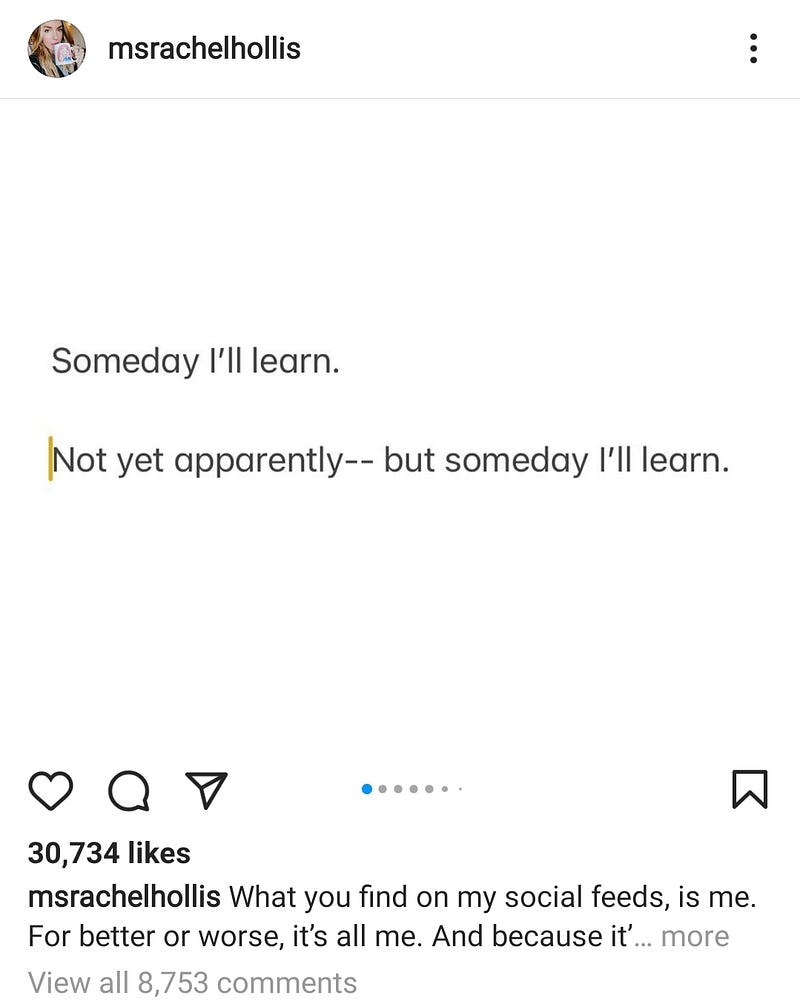
It took her 10 images to spell out her non-apology apology, but with it, she also wrote this:
What do you think about an apology like that? Does it sound like Rachel’s learned anything… or does it sound like she’s busy feeling pretty sorry for herself?
Let’s go ahead and break it down.
Someday I’ll learn.
Not yet apparently-- but someday I’ll learn.
Sigh. What do you feel when you read those words? I think that right out of the gate, she centered the “apology” on herself and the way she feels. The whole “someday I’ll learn” bit is just self-deprecating enough to suggest that she really does feel bad for herself and is hoping you’ll feel bad for her too.
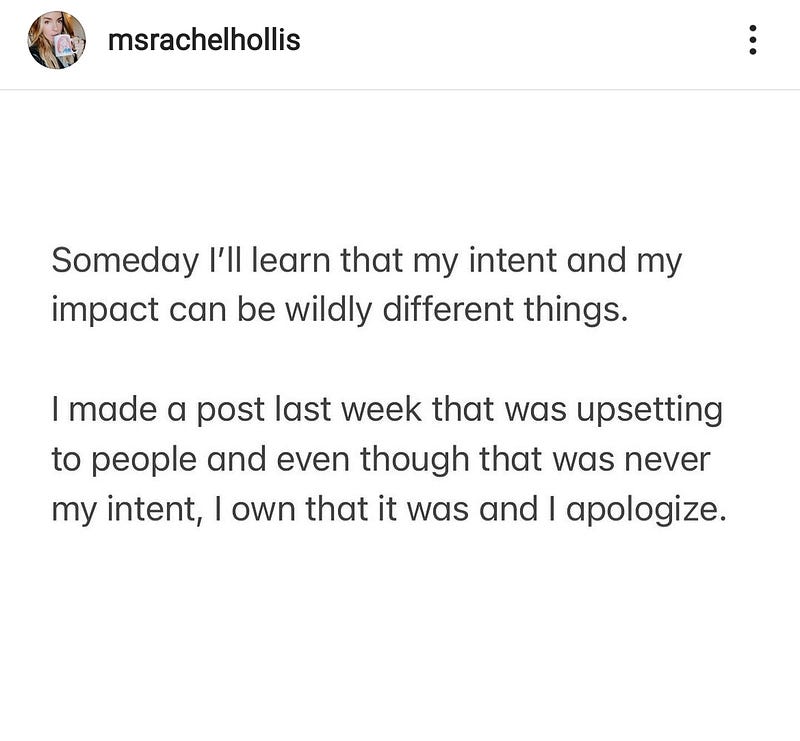
Someday I’ll learn that my intent and my impact can be wildly different things.
I made a post last week that was upsetting to people and even though that was never my intent, I own that it was and I apologize.
Intent versus impact is a heavy subject. For people with privilege, like rich white women, it’s common to hear them say they didn’t mean to harm anyone and want to leave it at that. But an important piece of intersectional feminism is recognizing that as white women, we have the privilege of tuning out our privilege. So, maybe we didn’t intend to commit a certain micro-aggression, or worse, but we did it, and then it harmed others.
It’s on us to own that and make things right. That doesn’t mean making excuses for our behavior. It also means learning and growing to understand where we went wrong.
However, the fact that Rachel Hollis hasn’t learned how her intent and impact can vary wildly says everything about her privilege as a wealthy white woman.
This is where Rachel should have ended things, though. With an imperfect apology, since she clearly doesn’t grasp her privilege.
But she continued full-speed ahead into what’s been aptly described by Luvvie as “caucasity.”
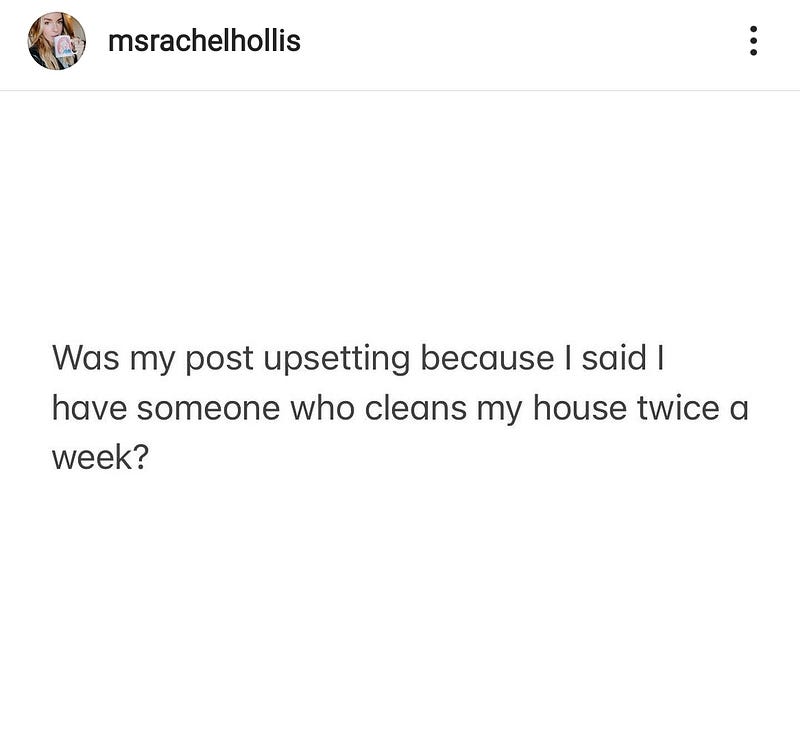
Was my post upsetting because I said I have someone who cleans my house twice a week?
Oh, girl… no. So, immediately after “apologizing” and claiming to take ownership of her error, she actually poses herself as a victim again by half-heartedly asking what she did wrong and suggesting that people are just mad she hires help.
Even though hiring help was never the issue.
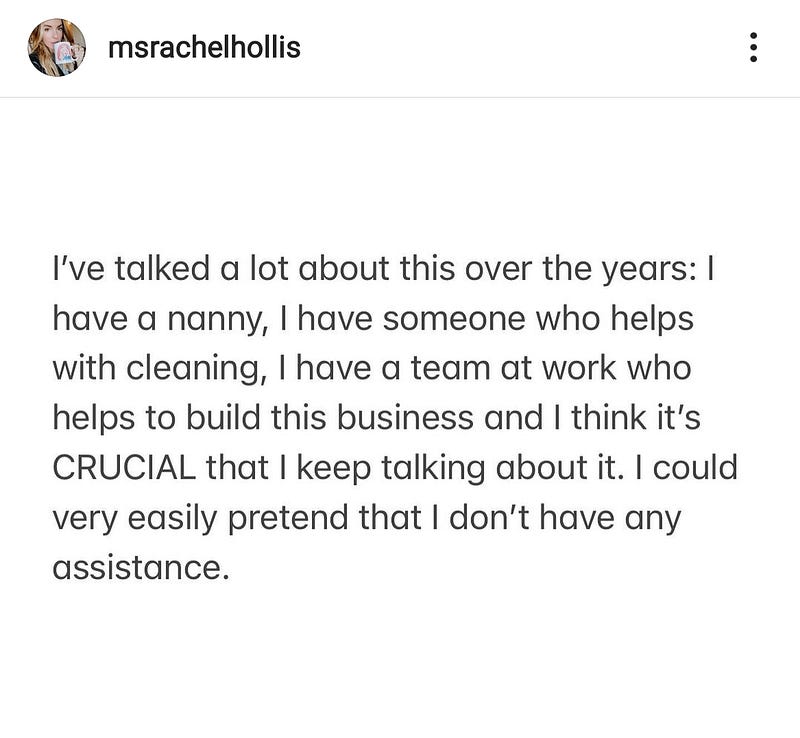
I’ve talked a lot about this over the years;
I have a nanny, I have someone who helps with cleaning, I have a team at work who helps to build this business and I think it’s CRUCIAL that I keep talking about it. I could very easily pretend that I don’t have any assistance.
Um, what? Nobody wants her to pretend she does everything alone! Though frankly, in her rant she suggested it was her hard work alone that gave her so much privilege. Nobody is punching on Rachel Hollis for having a team. Does she really think this victim narrative will distract everyone from the mess she made? Or, does she believe this story herself?
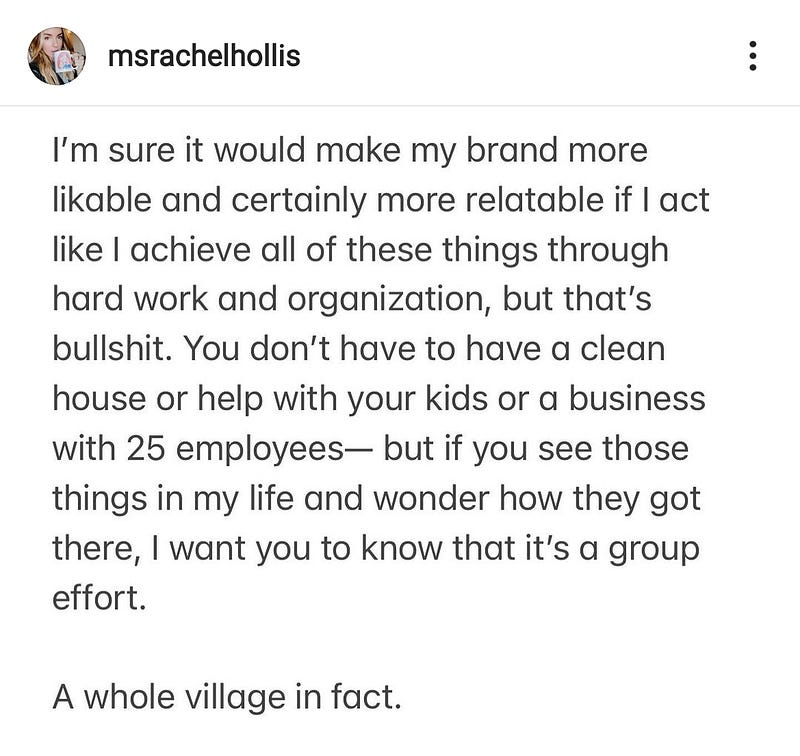
I’m sure it would make my brand more likable and certainly more relatable if I act like I achieve all of these things through hard work and organization, but that’s bullshit. You don’t have to have a clean house or help with your kids or a business with 25 employees — but if you see those things in my life and wonder how they got there, I want you to know it’s a group effort.
A whole village in fact.
Oh wow. Right here is where Rachel’s words give her away. She in fact has no fucking clue what it means to be relatable. If she did, she never would have suggested that pretending to do everything “through hard work and organization” would make her more relatable!
Reading this was like walking into some bizarre, opposite reality. For years, so much of the criticism she’s received has been about the way she preaches that hard work can solve all your problems. Or the way she suggests that she has singlehandedly built her own riches.
At this point, Rachel has officially spent more words making excuses and explaining herself in ways that have no relevance to the issues at hand.
All she’s really done is show that she doesn’t understand the backlash at all.
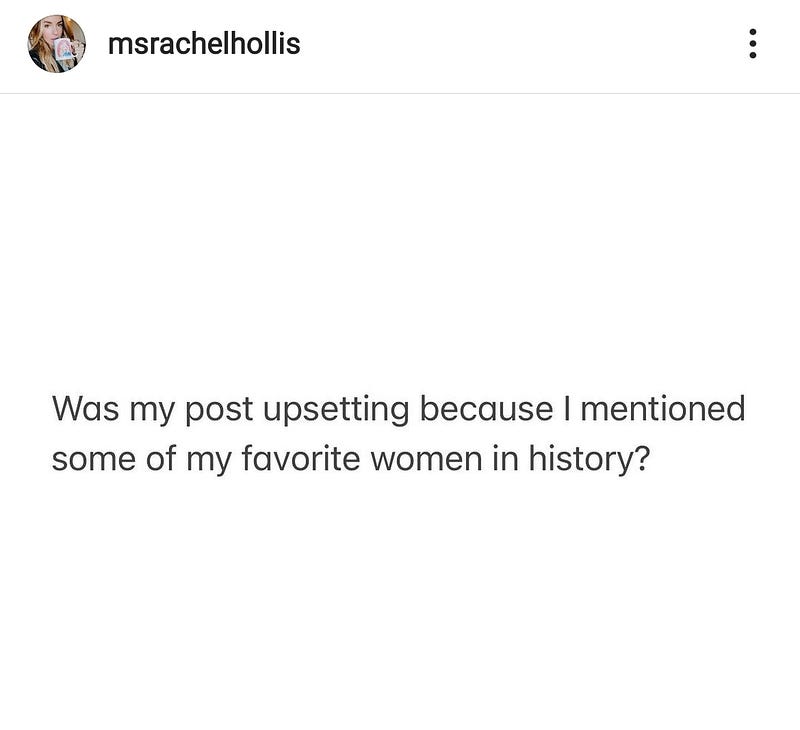
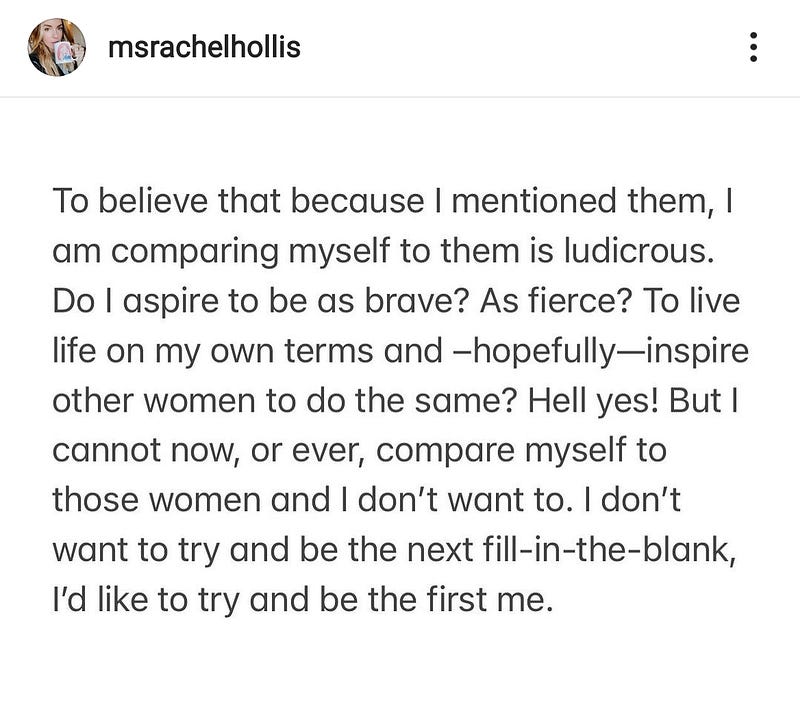
Was my post upsetting because I mentioned some of my favorite women in history?
What’s the word for this flavor of indignation, anyway? She made thoughtless, privileged, and ridiculous remarks for the whole world to see. And the, in the middle of an supposed apology, she kept suggesting that she’s the real victim.
Rachel hinted that she is under fire for bringing up “famous women in history.” In other words, she’s blaming everybody else, including those she’s harmed.
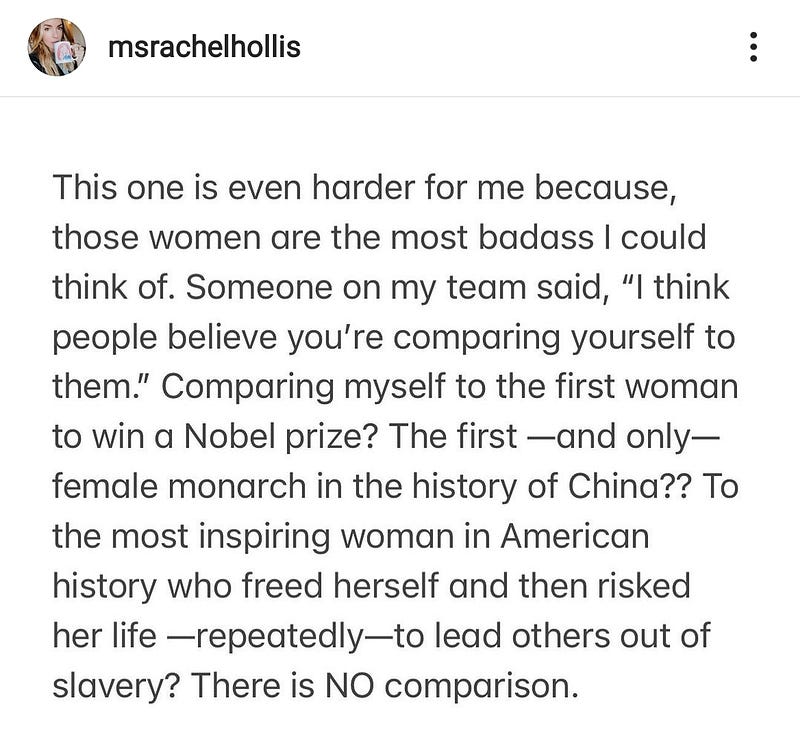
This one is even harder for me because, those women are the most badass I could think of. Someone on my team said, “I think people believe you’re comparing yourself to them.” Comparing myself to the first woman to win a Nobel Prize? The first — and only — female monarch in the history of China?? To the most inspiring woman in America who freed herself and then risked her life — repeatedly — to lead others out of slavery? There is NO comparison.
Deny, deny, deny. This is just one long stretch of saying, “That’s not what I meant. You misunderstood me.”
To believe that because I mentioned them, I am comparing myself to them is ludicrous. Do I aspire to be as brave? As fierce? To live life on my own terms and — hopefully — inspire other women to do the same? Hell yes! But I cannot now, or ever, compare myself to them and I don’t want to. I don’t want to try and be the next fill-in-the-blank, I’d like to try and be the first me.
Thanks for the gaslighting there, Rachel. Keep in mind that she’s officially turned the “apology” for her rant into extreme apologetics for her own delusions. None of this is “taking ownership.”
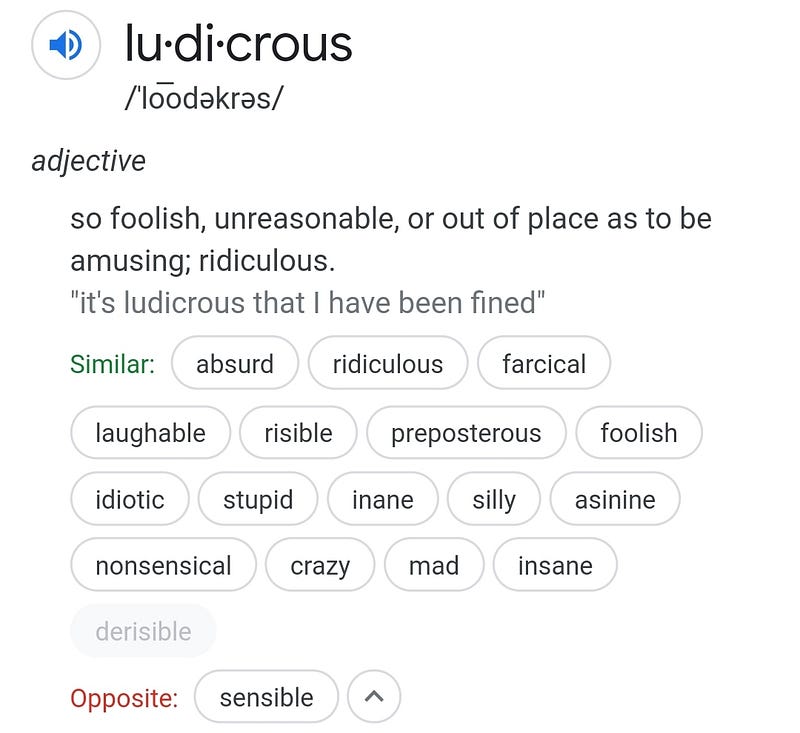
She called herself unrelatable, posed it as a good thing, and then she claimed these specific women in history were all unrelatable too. If you happened to follow the natural logic that she seemed to be comparing herself to those women, she responded to the backlash by basically calling us (and anyone she harmed)… crazy. After all, what else does “ludicrous” mean?
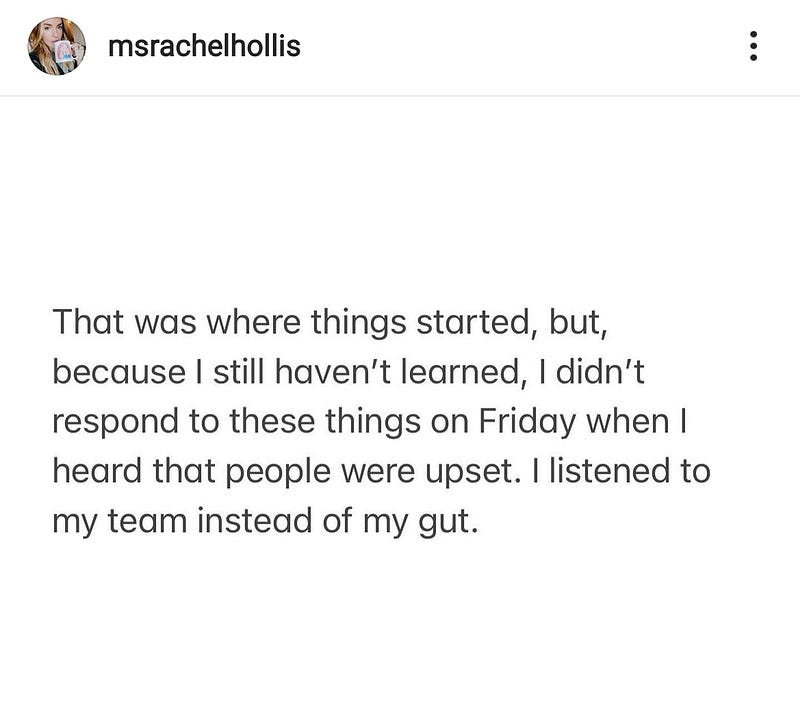
That was where things started, but, because I still haven’t learned, I didn’t respond to these things on Friday when I heard that people were upset. I listened to my team instead of my gut.
Here we are. As usual, she blamed her team.
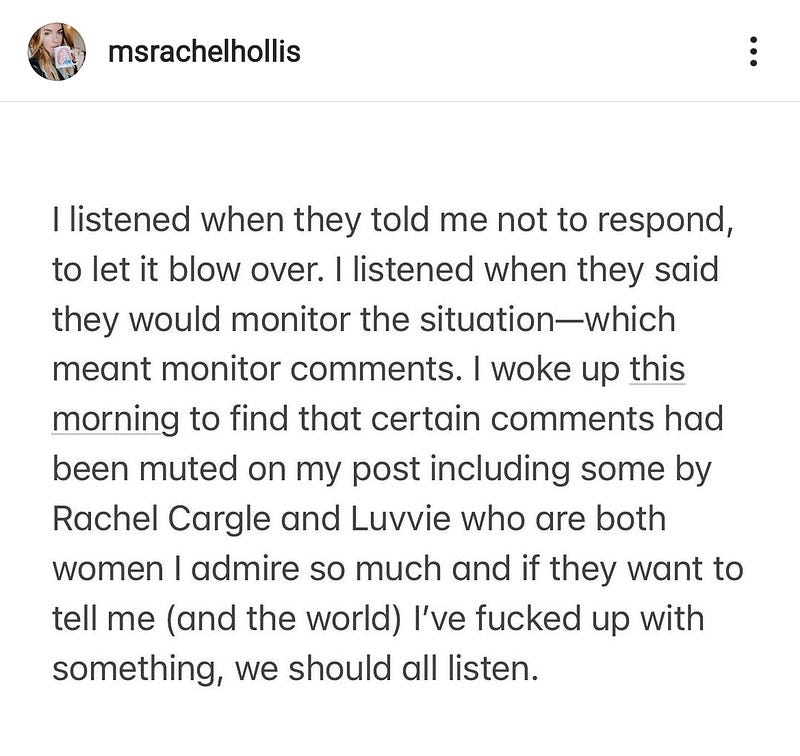
I listened when they told me not to respond, to let it blow over. I listened when they said they would monitor the situation — which meant monitor comments. I woke up this morning to find that certain comments had been muted on my post including some by Rachel Cargle and Luvvie who are both women I admire so much and if they want to tell me (and the world) I’ve fucked up with something, we should all listen.
Umm, this is just awkward, isn’t it? Rachel Hollis threw her team under the bus, claiming they were the ones who silenced BIPOC women. She insisted that she knew better and would have handled this better if she’d just listened to herself and not her team.
Is that what leadership looks like to Rachel?
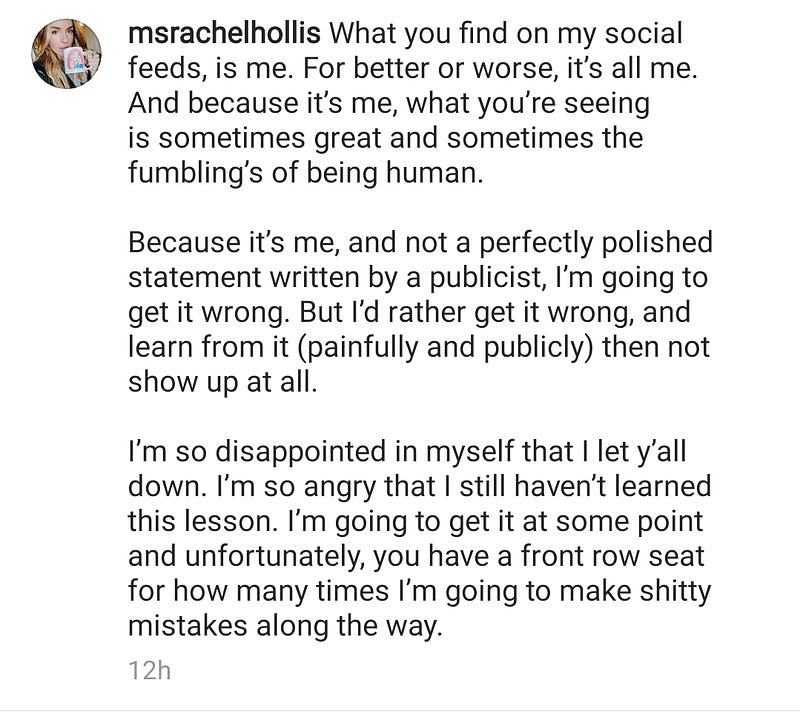
Then, to make all of this even worse, she added a lengthy caption to her image statements. She even contradicted herself.
What you find on my social media feed, is me. For better or worse, it’s all me. And because it’s me, what you’re seeing is sometimes great and sometimes the fumbling’s of being human.
Because it’s me and not a perfectly polished statement written by a publicist, I’m going to get it wrong. But I’d rather get it wrong, and learn from it (painfully and publicly) then not show up at all.
I’m so disappointed in myself that I let y’all down. I’m so angry that I still haven’t learned this lesson. I’m going to get it at some point and unfortunately, you have a front row seat for how many times I’m going to make shitty mistakes along the way.
It’s weird because, in her image statements, she claimed that her team got in the way. In the caption, she said it’s all on her.
Ultimately, though, she still clearly doesn’t get the point. She mentioned fumbling, being human, making mistakes and, letting people down. None of those things actually relate to understanding or acknowledging her privilege. They certainly don’t have anything to do with apologizing for the failure to recognize that privilege either.
And it gets worse because Rachel shamelessly brought Black voices into it by tagging Black authors Luvvie and Rachel Cargle. In her non-apology apology! The nerve, right?
We’re talking about Rachel ‘I Refuse to Listen to White Women Cry’ Cargle and Luvvie Ajayi ‘Get comfortable with being uncomfortable’ Jones.
I mentioned earlier that Luvvie attributed Rachel’s bad behavior to “caucasity” (basically, the audacity of white privilege), and I think she’s spot-on. She’s also addressed some of the mess on Instagram and Twitter.
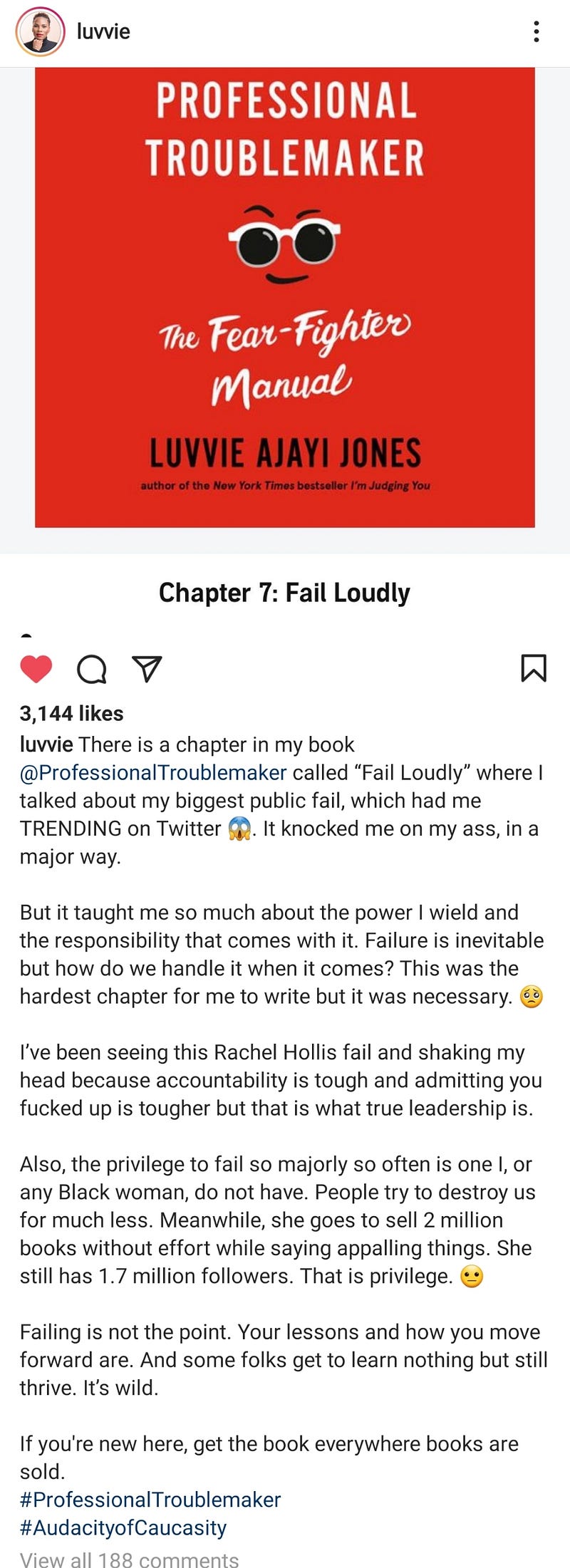
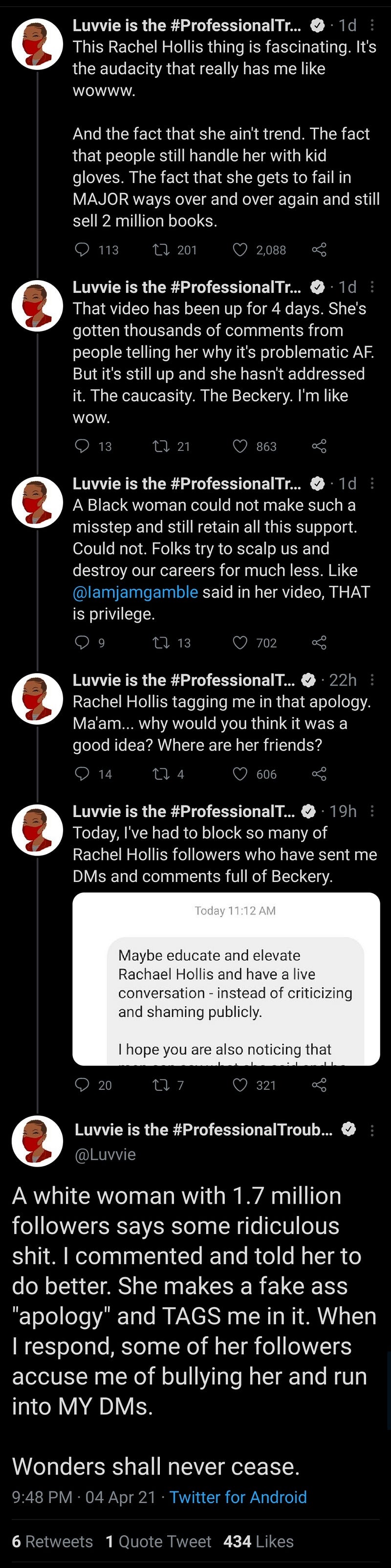
Luvvie brings up such important points — how Rachel Hollis is protected by her whiteness. And how she never really learns. Rachel Hollis went ahead and stuck her foot in her mouth once again, and made herself look like a fool to the whole damn world, but those mistakes aren’t even trending on Twitter because she’s still surrounded by fans and an industry that supports her despite her problems.
White privilege makes all of that possible.
All of this begs the question… who is Rachel Hollis talking to? If she doesn’t want to be relatable to some women, including those who call her out, because she doesn’t believe most women are willing to work as hard as she works… who the hell are her books actually for?
I guess it’s obvious.
Rachel Hollis and her whole lifestyle brand are aimed at other white women who also feel like they are “better ” than most other women. I doubt that many of those women would admit it, and it’s possible that some of them don’t even know they have these feelings. White privilege isn’t big on self-work, which is why such lukewarm or toxic self-help sells.
The Rachel Hollis message, in a nutshell, is that hard work gets rewarded. And I’m sure she believes it, because she lives in a privileged place where that seems to be true. Never mind the fact that she’s been caught plagiarizing on multiple occasions. Forget about all of the other tone-deaf moments in her career.
Apparently, Rachel doesn’t see how whiteness, financial privilege, or things like luck or timing actually play a part in any of her success. She gives those pull-yourself-up-by-the-bootstraps speeches despite never actually being there. And while I don’t for a moment imagine that her divorce has been a cakewalk, it’s not lost on me how she repeatedly shirks responsibility by defining every failure in her life as a challenge or an attack.
Nobody is actually attacking Rachel Hollis by saying that she lacks authenticity or accountability. Nobody ever would have known these things about her if she had some self-awareness. But she consistently seems to confuse “showing up” with doing good work.
White women who “show up” and harm others with white privilege, toxic positivity, and elitism might keep getting second chances, but that’s only because there’s a market that wants to benefit from the same fucked up system. Rachel is rewarded for being problematic, and it’s not so different from the way Rush Limbaugh was rewarded for being problematic.
Rachel thrives by telling privileged white ladies exactly what they want to hear, which makes it no wonder why she often says such out-of-touch, racistly, or fatphobic things. And, if some of Rachel’s antics have reminded you of Sharon Osbourne lately, I’d say that’s because they are two peas in a pod — privileged white women who feel no urgency to make things right and do better in a way that stops hurting other women.
Why grow and change when you can cry about your haters?
If you Google “dangerous white women,” you will discover a litany of resources to better understand what’s so bad about the attitudes of so many privileged white women like Rachel Hollis.
Don’t let her F-bombs fool you — Rachel walked into her success under a Christian living publisher. She still holds an enormous audience of largely white, and largely Christian readers who think she’s a breath of fresh air for “telling it like it is.” For many of those women, her rant about being unrelatable was relatable because they’re walking around with the same attitude, blissfully unaware of their privileges.
If you bring those privileges up, most of those women won’t hear you. Like Rachel, you’ll wonder if they’re being willfully obtuse. But nobody knows. I believe that’s part of the whole “caucasity.” All too often, white women simply don’t need to know how unrelatable they are. Whiteness has the luxury to ignore such things and wrap itself up in more whiteness.
Also, Rachel has the luxury to whine and moan about “fucking up” and centers her aggressions as painful for her — not for the women she’s insulting at every turn. Her fans will likewise let her get away with that.
The crux of all this is that Rachel Hollis, mommy blogger, relationship coach, and influencer isn’t really about self-help or self-improvement. How do I know this? I took a look at her website today. Clicked the menu, and then chose “self.” These are the stories I found that she (or her team) wrote and tagged with “self.”
There’s “5 Killer Habits,” a blog post she describes as the habits that fundamentally changed how she shows up in the world. They are:
- Drinking water
- Cutting out a category of for 30 days (hello, disordered eating)
- Hitting the gym
- Waking up early
- Keeping a gratitude journal
Her previous blog post is called, “How to Drink ALL the water.” In the post before that, she walked folks through her “Step-By-Step Skincare” routine. There’s also a post called “How to Go to the Gym,” and finally, “My Morning Routine.”
That’s her “Self” archive. As usual, the posts all just scratch the surface of whatever topic they’re dealing with. But I’d say it probably gives a pretty good look into her psyche and the kind of work she prioritizes for herself.
Most of it is shallow, surfacey, appearance stuff. This is not a woman who’s shown herself to care about actual self-work. This is a woman who recently did a so-called body-positive podcast where she talked about being strong for avoiding “bad foods” like cupcakes. From the looks of her Instagram post about the episode, more than 200 comments were hidden since the post invites us to see all 229 comments but less than 20 even show up.
For a woman who’s written three self-help books about “keeping it real,” it’s pretty absurd to see that bare minimum she continuously gets away with doing.
And honestly, I don’t see an end in sight if we don’t talk about this mess. The fact that a woman like Rachel Hollis can claim to love and learn from Black women like Rachel Cargle and Luvvie, and to read books like White Fragility, yet still remain in the dark about what she’s done wrong isn’t an exclusive-to-her blunder. It’s a red flag that something has gone horribly wrong in our society.
Rachel Hollis wants you to think she works harder than other women, but she glosses right over the part about marrying rich and then using the privilege of wealth and whiteness to… try to become famous. An event company, a cookbook, some novels — Rachel tried whatever she could until something finally stuck, but most women don’t have the luxury to try all of those things and juggle motherhood.
And don’t be fooled by other dangerous white women in the comments who are going to tell you that stories like this only boost Rachel’s popularity and money. What they really mean is that we’re not supposed to call out bad behavior and white privilege. Let’s be realistic. A woman with 1.7 million Instagram followers and millions of book sales who hasn’t faced the music after any of her enormous faux pas isn’t becoming more popular because bloggers call out her dangerous facade.
She’s popular and she remains popular because there are still more than enough white women happy and willing to buy what she’s selling.
We need a social shift. But that’s not going to happen until we can consistently hold dangerous white women accountable for the harm they cause without letting them make excuses or spin another story where they’re the victim.